
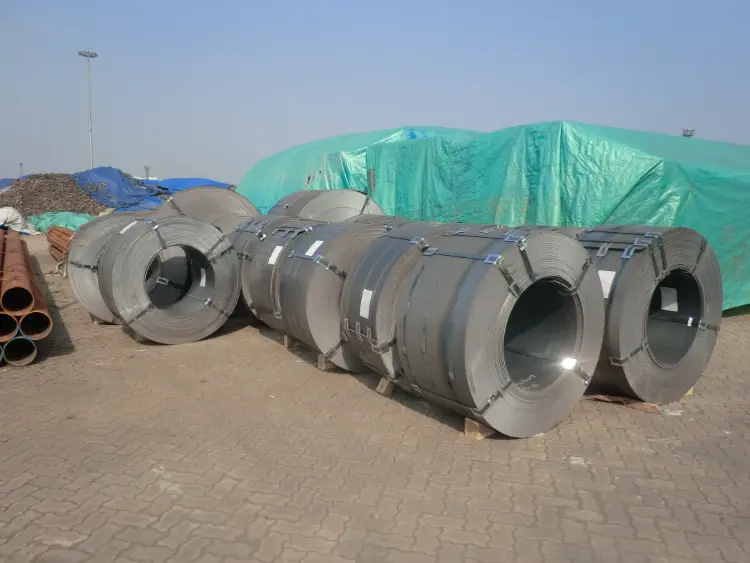
API 5L PSL1 Grade B (L245) Pipeline Steel Coil
API 5L PSL1 Grade B (L245) Pipeline Steel Coil: Composition & Properties
Explore API 5L PSL1 Grade B (L245) pipeline steel coil: chemical, mechanical, thermal, and electrical properties, international equivalents, similar materials, and industrial applications.
Forming into welded pipes (ERW, SAW, spiral welding), can also be cut-to-length and processed into cold-formed sections
- Phone : +8618037372205
- Email : [email protected]
- WhatsApp: Contact via Whtsapp
- WeChat: +8618037372205
API 5L PSL1 Grade B Pipeline Steel Coil Introduction
API 5L PSL1 Grade B (L245) pipeline steel coil is a standard carbon-manganese steel grade designed for the manufacture of welded line pipe used in the transportation of oil, gas, and water. Governed by the American Petroleum Institute specification API 5L (46th edition) under Product Specification Level 1 (PSL1), this grade corresponds to L245 in ISO 3183 and other international standards. It is supplied in coil form and subsequently processed into spiral or longitudinal welded pipes. Key characteristics include a minimum yield strength of 245 MPa (35,500 psi) and a minimum tensile strength of 415 MPa (60,200 psi), combined with good weldability and formability. The steel is typically produced by hot rolling and may be supplied in as-rolled, normalized, or thermo-mechanically rolled conditions, depending on manufacturer and customer requirements. It offers a cost-effective solution for moderate pressure line pipe applications.
API 5L PSL1 Grade B Pipeline Steel Coil Chemical Composition
The chemical composition limits for API 5L PSL1 Grade B are specified for heat analysis. These elements ensure adequate strength and weldability. Additional microalloying elements such as Nb, V, and Ti may be added by the manufacturer to meet mechanical properties, though not mandatory for PSL1. The maximum carbon equivalent (CEV) is usually controlled to ensure good field weldability, typically ≤0.43% for standard wall thicknesses.
| Element | Standard Value | Remarks |
|---|---|---|
| Carbon (C) | ≤0.28 | Heat analysis |
| Manganese (Mn) | ≤1.20 | Heat analysis |
| Phosphorus (P) | ≤0.030 | Heat analysis |
| Sulfur (S) | ≤0.030 | Heat analysis |
| Silicon (Si) | Not specified (typically 0.15–0.35) | Not mandatory; may be reported |
| Copper (Cu) | ≤0.50 | If specified |
| Nickel (Ni) | ≤0.50 | If specified |
| Chromium (Cr) | ≤0.50 | If specified |
| Molybdenum (Mo) | ≤0.15 | If specified |
| Niobium (Nb), Vanadium (V), Titanium (Ti) | Nb+V+Ti ≤0.15% (each optional) | Microalloying optional for PSL1 |
API 5L PSL1 Grade B Pipeline Steel Coil Thermal and Electrical Physical Properties
The following physical properties are derived from typical carbon-manganese steel data. These values are not part of API 5L specifications but are useful for design and processing. Actual values may vary slightly with specific composition and manufacturing process. The density corresponds to standard steel, and thermal expansion is within the range expected for low-carbon automotive/pipeline steels.
| Property | Standard Typical Value | Unit | Test Conditions / Remarks |
|---|---|---|---|
| Density (ρ) | 7.85 | g/cm³ | At 20°C |
| Modulus of Elasticity (E) | 200–210 | GPa | At room temperature |
| Shear Modulus (G) | 77–81 | GPa | Approximate |
| Poisson's Ratio (ν) | 0.29–0.30 | — | Elastic region |
| Thermal Expansion Coefficient (α) | 11.7 × 10⁻⁶ | 1/K | Mean value between 20°C and 100°C |
| Thermal Conductivity (λ) | 50 | W/(m·K) | At 20°C |
| Specific Heat Capacity | 486 | J/(kg·K) | At 20°C |
| Electrical Resistivity (ρ_e) | 0.17 | μΩ·m | At 20°C |
API 5L PSL1 Grade B Pipeline Steel Coil Mechanical Properties
Mechanical properties are based on the requirements for the finished pipe (after welding and, if applicable, cold expansion). For the hot-rolled coil intended for pipe production, the coil manufacturer guarantees these properties will be achieved in the final pipe. Tensile testing is performed on transverse strip or round specimens taken from the pipe body. The elongation values depend on specimen dimensions and are calculated per API 5L formula. No impact or bend tests are required for PSL1 Grade B.
| Property | Standard Required Value | Unit | Test Conditions |
|---|---|---|---|
| Yield Strength (ReH) | ≥245 | MPa | Transverse specimen, 0.5% total extension under load |
| Tensile Strength (Rm) | ≥415 | MPa | Transverse specimen |
| Elongation after fracture (A) | Formula: A = 625,000·A0.2 / U0.9 Typical ≥22 (for 200 mm² gauge area) | % | Gauge length 50 mm; A = standard gauge area (mm²), U = specified min. Rm (MPa) |
| Yield to tensile ratio (ReH/Rm) | Not specified (typical 0.70–0.85) | — | For information only |
| Hardness | Not required | — | Not applicable for PSL1 |
API 5L PSL1 Grade B Pipeline Steel Coil Full Equivalent Standards and Replaceable Grades
| Country/Region | Standard | Grade | Remarks |
|---|---|---|---|
| International | ISO 3183 | L245 | Identical to API 5L Grade B PSL1 |
| China | GB/T 9711 | L245 | Equivalent to ISO 3183 L245 |
| European Union | EN 10208-1 | L245GA | For gas pipelines; slight differences in chemical limits; strength same |
| European Union | EN 10208-2 | L245NB | For pipelines with supplementary requirements |
| France | NF A49-240 | L245 | Historical standard aligned with ISO |
| Germany | DIN 17172 (withdrawn) | StE 240.7 | Replaced by EN standards; commercial equivalence |
| Russia | GOST 20295 (referenced) | Kty class (near 245 MPa) | May require verification of full equivalence |
API 5L PSL1 Grade B Pipeline Steel Coil Application Introduction
API 5L PSL1 Grade B (L245) coil is the backbone material for a wide range of welded steel pipes used in fluid transmission and structural applications. Its reliable strength and good formability make it suitable for both onshore and offshore pipeline projects, as well as for construction. The steel coil is slit and then formed into pipes via high-frequency induction welding (ERW), submerged arc welding (SAW), or spiral welding processes. Common end products include line pipes for oil & gas gathering and distribution networks, water transmission mains, and structural hollow sections. It can also be used in piling and mechanical tubing where moderate strength and cost efficiency are required.
Product Applications: Longitudinally welded (ERW/HFI) line pipes, Spiral welded (SSAW) large-diameter pipes, Cold-formed hollow structural sections (HSS), Flexible pipeline steel for risers (as base material), Piling pipes and casing pipes
Processed into products: Oil/fuel transmission pipeline sections, Water distribution main pipes, Pump station manifolds and headers, Compressor station pipework, Conduits for cables and buried utilities, Structural columns and bracing in buildings, Scaffolding tubes (light structural)
Application industries: Oil & Gas Upstream and Midstream, Water Supply and Sewage Treatment, Construction and Civil Engineering, Shipbuilding and Marine, Mining and Slurry Transportation, Power Generation (cooling water lines)
API 5L PSL1 Grade B Pipeline Steel Coil Similar / Alternative Materials and Their Analysis
| Country/Region | Standard | Grade | Remarks |
|---|---|---|---|
| USA | ASTM A53/A53M | Grade B | Closely matches strength but intended for structural and pressure piping; not pipeline-specific; chemistry differs slightly |
| USA | ASTM A106/A106M | Grade B | Seamless carbon steel pipe for high temperature; higher carbon content (≤0.30) and Mn (0.29-1.06); not coil form |
| Japan | JIS G3454 | STPG370 | Pressure service pipe; yield ≥215 MPa, lower than L245 |
| Japan | JIS G3452 | SGP | General piping; low strength (290 MPa min tensile); not equivalent |
| Japan | JIS G3444 | STK400 | Structural tubing; yield ≥235 MPa; similar carbon steel but for structural use |
| India | IS 1239 | YST 210 / YST 240 | Light/medium gauge tubes; lower strength; not recommended for high-pressure pipelines |
Notes:
Important considerations:
- PSL1 Grade B does not require impact testing; for low-temperature or sour service, consider PSL2 grades with supplementary requirements (e.g., B with SR suffixes).
- Coil thicknesses typically range from 1.6 mm to 25.4 mm, widths up to 2,000 mm, depending on pipe size.
- Surface quality: free from injurious defects; pickled and oiled or as-rolled surface finishes are common.
- Weldability: good; no preheat generally required for arc welding when carbon equivalent is ≤0.43%.
- For pipeline design, refer to ASME B31.4 (liquid) or B31.8 (gas) for allowable stress values based on this grade.
- Share



