
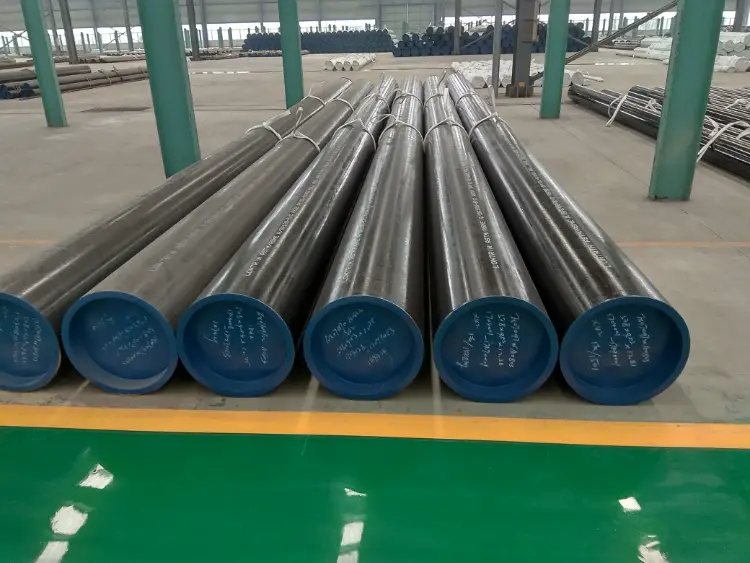
API 5L X42 PSL1 Pipeline Steel Coil
API 5L X42 PSL1 Pipeline Steel Coil: Properties, Equivalents & Applications
Full technical data for API 5L X42 (L290) PSL1 pipeline steel coil: chemical composition, mechanical properties, thermal & electrical performance, international equivalents, and usage guide.
Forming, welding (ERW, SAW, spiral), expanding, cold bending, hot induction bending
- Phone : +8618037372205
- Email : [email protected]
- WhatsApp: Contact via Whtsapp
- WeChat: +8618037372205
API 5L X42 PSL1 Pipeline Steel Coil Introduction
API 5L X42 (L290) PSL1 is a carbon-manganese steel for line pipe, widely used in oil, gas, and water transmission. Specified under API Specification 5L, this material is delivered as hot-rolled coil, plate, or strip with minimum yield strength of 290 MPa and tensile strength of 414 MPa.
Key features:
- Good weldability and formability for longitudinal or spiral welded pipes
- PSL1 (Product Specification Level 1) offers basic quality requirements with no mandatory impact testing
- Cost-effective choice for moderate pressure and non-sour service
- Available in various thicknesses to suit different pipeline diameters
API 5L X42 PSL1 Pipeline Steel Coil Chemical Composition
Chemical requirements for API 5L PSL1 X42 are relatively broad. The steel is basically a C-Mn composition with controlled impurities. Microalloying elements (Nb, V, Ti) may be added singly or in combination, but their total content is restricted. Carbon equivalent (CE) limits apply for welding purposes when specified by the purchaser.
| Element | Standard Value (max, %) | Remarks |
|---|---|---|
| C | 0.28 | Carbon |
| Mn | 1.30 | Manganese |
| P | 0.030 | Phosphorus |
| S | 0.030 | Sulfur |
| V+Nb+Ti | 0.15 | Sum of microalloying elements, if intentionally added |
| Other elements | To be agreed | Any other alloying or residual elements must be documented if required |
API 5L X42 PSL1 Pipeline Steel Coil Thermal & Electrical Physical Properties
The data below are typical for carbon-manganese steel similar to API 5L X42. These values are not part of the specification but are useful for engineering calculations. Actual properties may vary slightly with temperature and processing history.
| Property | Typical Value | Unit | Test Condition / Temperature |
|---|---|---|---|
| Density (ρ) | 7.85 | g/cm³ | Room temperature |
| Modulus of Elasticity (E) | 207 | GPa | Room temperature |
| Shear Modulus (G) | 80 | GPa | Room temperature (calculated from E and ν) |
| Poisson's Ratio (ν) | 0.30 | – | Room temperature |
| Thermal Expansion Coefficient (α) | 11.7×10⁻⁶ | /°C | 20 – 100 °C |
| Thermal Conductivity (λ) | 50.7 | W/(m·K) | 20 °C |
| Specific Heat Capacity | 486 | J/(kg·K) | 20 °C |
| Electrical Resistivity (ρₑ) | 0.16 | μΩ·m | 20 °C |
API 5L X42 PSL1 Pipeline Steel Coil Mechanical Properties
Mechanical properties are specified by API 5L for PSL1 X42 (L290). The minimum yield strength is 290 MPa and the minimum tensile strength is 414 MPa. Elongation is determined by formula based on specimen dimensions; the table provides a typical minimum value for common thicknesses (<20 mm) using rectangular strip specimens with a 50 mm gauge length. Impact testing (KV) is not mandatory for PSL1 grades unless specifically ordered. Bending test requirements are also subject to agreement for PSL1 coil material.
| Property | Standard Requirement / Typical Value | Unit | Test Condition |
|---|---|---|---|
| Yield Strength (Rt0.5 or ReH) | min. 290 (range: 290 – 495) | MPa | Transverse strip specimen, as per API 5L |
| Tensile Strength (Rm) | min. 414 | MPa | Transverse strip specimen |
| Elongation (A) | ≥ 22 (typical, thickness ≤20 mm) | % | Rectangular specimen, gauge length 50 mm |
API 5L X42 PSL1 Pipeline Steel Coil Full Equivalent Material Standards & Replaceable Grades
| Country/Region | Standard | Grade/Designation | Remarks |
|---|---|---|---|
| International | ISO 3183 | L290 (PSL 1) | Identical technical delivery conditions for line pipe |
| Europe | EN 10208-2 | L290MB | Comparable to API 5L PSL1, additional restrictions may apply |
| China | GB/T 9711 | L290 | Chinese national standard for line pipe, PSL1 equivalent |
| Russia | GOST R 52079 | K52 | Strength and chemical composition closely match X42 |
| Brazil | NBR 15316 | X42 | Similar to API 5L specifications |
API 5L X42 PSL1 Pipeline Steel Coil Application Introduction
API 5L X42 PSL1 coil is primarily converted into large-diameter welded pipes for transmission networks. It is also used directly as structural ring stiffeners or in piling projects. Below are typical application areas:
Product Applications: Longitudinally welded (ERW/HFI) line pipe, Spiral submerged arc welded (SSAW/HSAW) pipe, Cold formed structural hollow sections, Pipe piles and casings
Processed into products: Straight pipe sections, Pipe bends, elbows, and reducers (hot or cold formed), Flange connections and welded fittings, Pipeline reinforcement rings and stiffeners
Application industries: Oil & gas transportation (onshore and offshore trunklines), Water and sewage infrastructure, Structural engineering (pipes, columns, piles), Mining slurry and tailings pipelines, Firefighting and sprinkler mains
API 5L X42 PSL1 Pipeline Steel Coil Near/Similar Alternative Materials
| Country/Region | Standard | Grade | Remarks |
|---|---|---|---|
| USA/Global | API 5L | X46 (L320) | Slightly higher strength; can be substituted if higher pressure rating is acceptable |
| USA/Global | API 5L | X52 (L360) | Higher yield/tensile strength; may require re-qualification of welding procedures |
| USA | ASTM A53 | Grade B | General piping steel with minimum yield 240 MPa; weaker than X42, not for precise substitution |
| Europe | EN 10208-2 | L360MB | Stronger equivalent to X52, suitable for higher stress applications |
Notes:
- PSL1 X42 does not require impact testing, making it suitable for non-sour, moderate-temperature environments.
- Carbon equivalent (CE) should be controlled if you plan to weld the coil or its derivatives; standard API 5L CEIIW < 0.43% (typical).
- If the steel is intended for highly corrosive or sour service, consider upgrading to PSL2 or adding supplementary HIC/SSC testing.
- Actual mechanical values can vary depending on coil thickness and coiling temperature; the minimum values apply to the finished pipe after forming and any normalizing treatment.
- Share



