
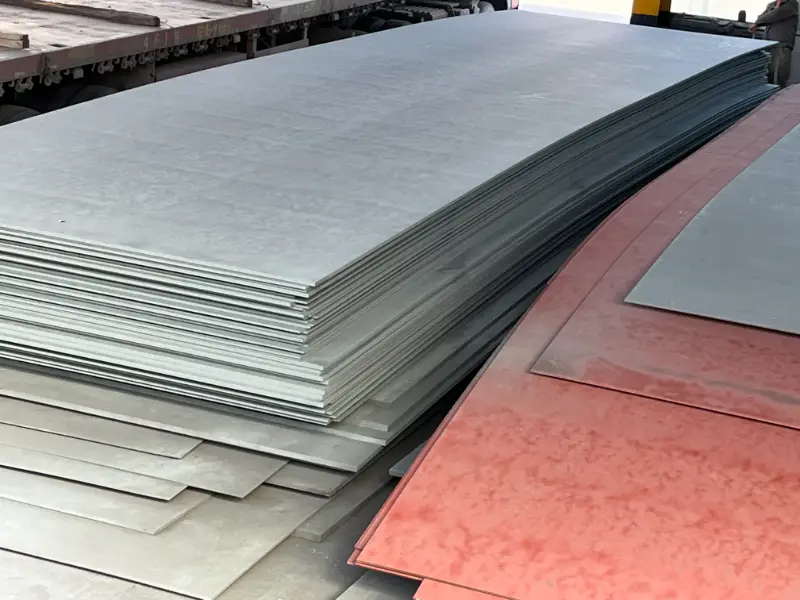
Q500C High-Strength Quenched and Tempered Steel Plate per GB/T 16270
Q500C High-Strength Quenched and Tempered Steel Plate per GB/T 16270 - Properties, Equivalents & Applications
Comprehensive data sheet for Q500C carbon and low-alloy high-strength steel coil according to GB/T 16270, including chemical composition, mechanical and physical properties, international equivalents, and application guidance.
Hot rolling followed by quenching and tempering; suitable for welding, hot forming (limited to subsequent stress relief), cold forming (with appropriate bend radii), and machining.
- Phone : +8618037372205
- Email : [email protected]
- WhatsApp: Contact via Whtsapp
- WeChat: +8618037372205
Q500C High-Strength Quenched and Tempered Steel Plate per GB/T 16270 Introduction
Q500C is a carbon and low-alloy high-strength structural steel grade defined in Chinese standard GB/T 16270 (High-strength structural steel plates in the quenched and tempered condition). It exhibits a minimum yield strength of 500 MPa and is supplied in the quenched and tempered state to achieve excellent mechanical properties. The "C" designation indicates that the steel provides specified impact toughness at 0 °C (min. 47 J longitudinal). This grade features good weldability, formability, and resistance to brittle fracture, making it suitable for heavy-duty welded structures such as bridges, construction machinery, pressure vessels, and offshore platforms. Typical thicknesses range from 10 mm to 150 mm, with different mechanical property guarantees depending on the plate thickness. Controlled alloying with micro-alloying elements like niobium, vanadium, and titanium refines the grain size and enhances strength and toughness. The steel can be supplied as coil, plate, or cut-to-length sheets and is widely adopted in demanding structural applications where weight reduction and high load-bearing capacity are critical.
Q500C High-Strength Quenched and Tempered Steel Plate per GB/T 16270 Chemical Composition
The chemical composition of Q500C is specified in GB/T 16270 to ensure the required mechanical properties after quenching and tempering. Typical values show low carbon content for good weldability, with manganese and micro-alloying additions (Nb, V, Ti, etc.) for grain refinement and precipitation strengthening. Note: Actual mill certificates may show tighter control of residuals and alloying elements to meet the mechanical and toughness requirements at the specified thickness.
| Element | Standard Value (max, unless range) | Remarks |
|---|---|---|
| C | ≤ 0.18 | Carbon equivalent (CEV) typically ≤ 0.47 depending on thickness |
| Si | ≤ 0.60 | Silicon for deoxidation and strength |
| Mn | ≤ 1.80 | Higher Mn may be used for thick plates |
| P | ≤ 0.025 | Phosphorus – controlled for toughness |
| S | ≤ 0.015 | Sulfur – low for cleanliness and impact properties |
| Cr | ≤ 0.80 | Optional alloying element for hardenability |
| Ni | ≤ 1.00 | Optional; improves toughness, especially at low temperature |
| Mo | ≤ 0.60 | Optional; enhances hardenability and tempering resistance |
| Nb | ≤ 0.06 | Grain refiner and precipitation strengthener |
| V | ≤ 0.12 | Micro-alloying element for strength |
| Ti | ≤ 0.05 | Grain refinement and nitrogen fixation |
| Cu | ≤ 0.50 | When specified, for atmospheric corrosion resistance |
| N | ≤ 0.015 | Max nitrogen content for fine-grain practice |
| Al (total) | ≥ 0.015 | Usually sufficient for grain size control |
Q500C High-Strength Quenched and Tempered Steel Plate per GB/T 16270 Thermal and Electrical Physical Properties
The following physical properties are typical for low-alloy quenched and tempered steels at room temperature, unless otherwise specified. These values are not part of the mandatory standard requirements but are useful for design calculations. Density, elastic moduli, and thermal expansion are consistent with standard structural steel. Thermal and electrical conductivity may vary slightly with alloy content and tempering condition.
| Property | Typical Value | Unit | Test Condition / Temperature |
|---|---|---|---|
| Density (ρ) | 7.85 | g/cm³ | At 20 °C |
| Modulus of elasticity (E) | 210 | GPa | At 20 °C |
| Shear modulus (G) | 80 | GPa | Calculated from E and ν |
| Poisson's ratio (ν) | 0.3 | – | At 20 °C |
| Thermal expansion coefficient (α) | 12.0 × 10⁻⁶ | K⁻¹ | 20–100 °C |
| Thermal expansion coefficient (α) | 12.5 × 10⁻⁶ | K⁻¹ | 20–200 °C |
| Thermal expansion coefficient (α) | 13.2 × 10⁻⁶ | K⁻¹ | 20–400 °C |
| Thermal conductivity (λ) | 48 – 52 | W/(m·K) | At 20 °C |
| Specific heat capacity (cₚ) | 450 – 480 | J/(kg·K) | At 20 °C |
| Electrical resistivity (ρₑ) | 0.20 – 0.25 | µΩ·m | At 20 °C |
Q500C High-Strength Quenched and Tempered Steel Plate per GB/T 16270 Mechanical Properties
The mechanical properties of Q500C are guaranteed at the delivery condition (quenched and tempered) and depend on plate thickness. Yield strength (ReH) and tensile strength (Rm) decrease with increasing thickness. Elongation (A) is based on a gauge length of 5.65√S₀. Impact energy (KV) is measured on longitudinal Charpy V-notch specimens at 0 °C. The bending test ensures sufficient ductility without cracking.
| Property | Required Value | Unit | Test Condition / Thickness |
|---|---|---|---|
| ReH (min) | 500 | MPa | Thickness ≤ 50 mm |
| ReH (min) | 480 | MPa | 50 mm < thickness ≤ 100 mm |
| ReH (min) | 440 | MPa | 100 mm < thickness ≤ 150 mm |
| Rm | 610 – 770 | MPa | Thickness ≤ 50 mm |
| Rm | 590 – 750 | MPa | 50 mm < thickness ≤ 100 mm |
| Rm | 570 – 730 | MPa | 100 mm < thickness ≤ 150 mm |
| Elongation A (min) | 17 | % | 5.65√S₀, transverse, thickness ≤ 150 mm |
| KV2 (min) | 47 | J | Longitudinal, 0 °C, average of 3 tests |
| Bend test | No cracking | - | 180° bend, mandrel diameter = 3t (t = thickness) for t ≤ 50 mm; 4t for t > 50 mm |
Q500C High-Strength Quenched and Tempered Steel Plate per GB/T 16270 Fully Equivalent Material Standards and Substitutable Grade Recommendations
The Q500C grade has a direct counterpart in the European standard for quenched and tempered structural steels. Although the impact test temperature is slightly different (S500Q requires 27 J at -20 °C, while Q500C requires 47 J at 0 °C), the two are considered interchangeable for many applications. Care should be taken regarding actual thickness capabilities and supplementary requirements.
| Country/Region | Standard | Grade | Remarks |
|---|---|---|---|
| Europe | EN 10025-6 | S500Q | Equivalent delivery condition; impact temperature -20 °C vs 0 °C; CEV limits may differ slightly. |
| International | ISO 4950-2 | E500 | Designation for high yield strength flat products; typically cold-forming grades, but similar strength class. |
| Japan | JIS G 3128 | SHY685 | Quenched and tempered high strength steel; similar strength level (685 MPa tensile); not identical. |
| USA | ASTM A514/A517 | Grade B, H, F | Comparable strength; requires careful comparison of thickness and chemical composition limits. |
Q500C High-Strength Quenched and Tempered Steel Plate per GB/T 16270 Application Introduction
Q500C steel is engineered for heavy structural applications requiring high strength-to-weight ratio, good toughness at sub-zero temperatures, and fabricability. It is used primarily in welded assemblies subjected to static and dynamic loads. Key industries include construction, mining, shipbuilding, and energy. The quenched and tempered condition ensures uniform properties throughout the plate thickness, making it reliable for safety-critical components.
Product Applications: Welded bridge girders and box sections, Crane booms and lattice structures, Offshore platform legs and decks, Heavy-duty vehicle frames and tipper bodies, Mining equipment structural parts, High-strength pressure vessels (subject to approval), Structural columns and beams in seismic-resistant frames
Processed into products: Flanges and webs for built-up beams, Boom sections and telescopic arms, Bucket shells and cutting edges, Support brackets and bearing housings, Chassis rails and cross members, Jack-up rig legs and spud cans, End plates and stiffeners for fabricated assemblies
Application industries: Construction and civil engineering (bridges, high-rise buildings, stadiums), Heavy machinery and equipment manufacturing (cranes, excavators, bulldozers), Mining and earth-moving machinery (dump truck bodies, cutter heads), Offshore and marine engineering (platform structures, jack-up rigs), Pressure vessel and storage tank fabrication (when specified by design code), Transportation (heavy vehicle chassis, rail cars), Energy (wind turbine towers, power plant structures)
Q500C High-Strength Quenched and Tempered Steel Plate per GB/T 16270 Similar / Alternative Material Recommendations
In addition to fully equivalent grades, several other standards offer high-strength steels with a minimum yield strength around 500 MPa. These may differ in delivery condition (e.g., normalized or TMCP rolled) or have slightly lower toughness requirements. They can be considered as alternatives depending on design code and availability.
| Country/Region | Standard | Grade | Remarks |
|---|---|---|---|
| China | GB/T 1591 | Q500C | High-strength low-alloy structural steel (normalized or TMCP); yield 500 MPa but lower toughness and different delivery condition. |
| China | GB/T 16270 | Q500D | Same standard but impact at -20 °C; suitable when better low-temperature toughness is needed. |
| China | GB/T 16270 | Q550C | Higher yield strength grade (550 MPa min) from the same standard; heavier sections and increased hardenability. |
| Europe | EN 10025-3 | S500G2+Q | Quenched and tempered fine-grain structural steel for offshore structures; comparable strength. |
| Europe | EN 10025-6 | S500QL | Quenched and tempered steel with longitudinal Charpy at -40 °C; better low-temperature toughness than Q500C. |
| USA | ASTM A572/A572M | Grade 65 | High-strength low-alloy columbium-vanadium steel; ReH 450 MPa min (lower than Q500C) but good weldability. |
Notes:
Q500C is typically supplied in the quenched and tempered condition. Prior to welding, a suitable preheating and interpass temperature control should be applied according to the carbon equivalent and plate thickness. Post-weld heat treatment is generally not required but may be carried out at temperatures below the original tempering temperature to avoid softening. Detailed fabrication guidelines are available in the standard and from steel manufacturers. For severe cold-forming, stress relief annealing may be necessary. The grade is often ordered with additional requirements such as Z-quality (through-thickness tensile properties), vacuum degassing, ultrasonic testing, and stricter chemistry limits to improve service reliability.
- Share



