
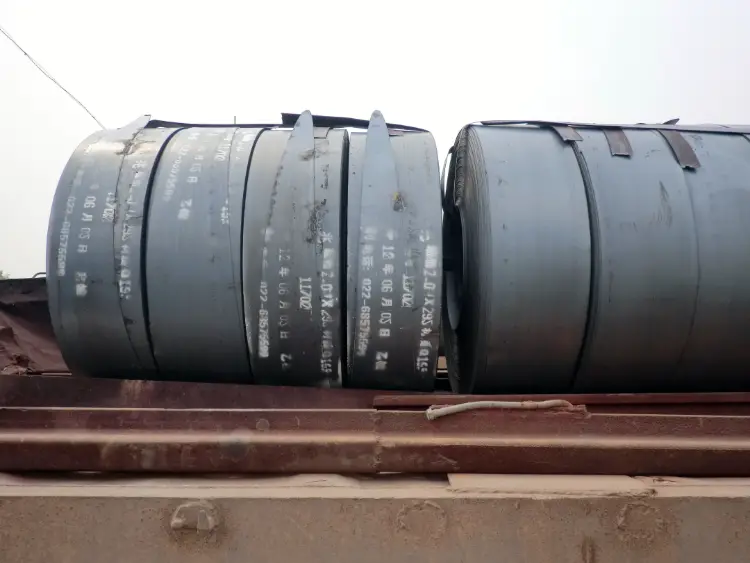
Q460F Carbon and Low-alloy High-Strength Steel Coil
GB/T 16270 Q460F Quenched & Tempered High-Strength Steel Coil – Material Data & Applications
Complete reference for Q460F steel plate and coil to GB/T 16270: chemistry, mechanical properties, physical constants, international equivalents (S460QL1), and engineering uses.
Quenching and tempering, hot rolling, cold forming, gas cutting, welding, machining
- Phone : +8618037372205
- Email : [email protected]
- WhatsApp: Contact via Whtsapp
- WeChat: +8618037372205
Q460F Carbon and Low-alloy High-Strength Steel Coil Introduction
Q460F is a high-strength low-alloy structural steel grade delivered in the quenched and tempered condition according to Chinese standard GB/T 16270. It offers a minimum yield strength of 460 MPa, excellent tensile properties, and outstanding low-temperature impact toughness down to -60°C. The chemistry is designed with microalloying elements (Nb, V, Ti) and controlled carbon equivalent to ensure good weldability while maintaining high strength. Typical delivery form is hot-rolled coil or plate, suitable for heavy welded structures operating in severe cold environments. Its combination of strength and toughness makes it a preferred choice for crane booms, bridge components, offshore platforms, and mining machinery where both load-bearing capacity and resistance to brittle fracture are critical.
Q460F Carbon and Low-alloy High-Strength Steel Coil Chemical Composition
The chemical composition of Q460F steel is tightly controlled to achieve the required strength and -60°C impact toughness. Microalloying elements such as niobium, vanadium and titanium provide grain refinement and precipitation hardening. The maximum carbon equivalent (CEV) is specified to guarantee adequate weldability without excessive preheating.
| Element | Standard Value (wt%) | Remarks |
|---|---|---|
| Carbon (C) | ≤0.18 | |
| Silicon (Si) | ≤0.60 | |
| Manganese (Mn) | 1.00 – 1.60 | |
| Phosphorus (P) | ≤0.020 | |
| Sulfur (S) | ≤0.010 | |
| Chromium (Cr) | ≤0.80 | |
| Nickel (Ni) | ≤0.80 | |
| Molybdenum (Mo) | ≤0.30 | |
| Vanadium (V) | ≤0.10 | |
| Niobium (Nb) | ≤0.06 | |
| Titanium (Ti) | ≤0.06 | |
| Boron (B) | ≤0.005 | |
| Aluminum (Als) | ≥0.015 | acid soluble |
| Carbon Equivalent (CEV) | ≤0.47 | Typical maximum |
Q460F Carbon and Low-alloy High-Strength Steel Coil Thermal and Electrical Physical Properties
The following physical properties are typical for quenched and tempered low-alloy steel of the Q460 type. They are not specification requirements but serve as reliable data for thermal, structural and electrical calculations. Actual values may slightly vary depending on the exact heat chemistry and tempering temperature.
| Property | Typical Value | Unit | Condition / Remarks |
|---|---|---|---|
| Density (ρ) | 7.85 | g/cm³ | Room temperature |
| Modulus of elasticity (E) | 205 | GPa | Room temperature |
| Shear modulus (G) | 79.3 | GPa | Calculated from E and ν |
| Poisson's ratio (ν) | 0.3 | - | Room temperature |
| Thermal expansion coefficient (α) | 11.1 | 10^-6/K | 20 – 100°C |
| Thermal expansion coefficient (α) | 12.1 | 10^-6/K | 20 – 200°C |
| Thermal expansion coefficient (α) | 12.9 | 10^-6/K | 20 – 300°C |
| Thermal conductivity (λ) | 50 | W/(m·K) | at 20°C |
| Specific heat capacity (c) | 460 | J/(kg·K) | at 20°C |
| Electrical resistivity (ρ_e) | 0.13 | 10^-6 Ω·m | at 20°C |
Q460F Carbon and Low-alloy High-Strength Steel Coil Mechanical Properties
Mechanical tests are performed on quenched and tempered specimens taken from the product. Tensile and impact properties are mandatory, with Charpy V-notch tests carried out at -60°C for the F quality grade. Bend test requirements depend on the product thickness. Values listed are the specified minima unless a range is given.
| Property | Value | Unit | Test Condition |
|---|---|---|---|
| Yield Strength (ReH) | ≥460 | MPa | thickness ≤50 mm |
| Yield Strength (ReH) | ≥440 | MPa | 50 < thickness ≤100 mm |
| Yield Strength (ReH) | ≥400 | MPa | 100 < thickness ≤150 mm |
| Tensile Strength (Rm) | 550 – 720 | MPa | thickness ≤50 mm |
| Tensile Strength (Rm) | 500 – 670 | MPa | 50 < thickness ≤100 mm |
| Tensile Strength (Rm) | 500 – 670 | MPa | 100 < thickness ≤150 mm |
| Elongation after fracture (A) | ≥17 | % | thickness ≤50 mm, gauge length 5.65√So |
| Elongation after fracture (A) | ≥16 | % | 50 < thickness ≤100 mm |
| Elongation after fracture (A) | ≥15 | % | 100 < thickness ≤150 mm |
| Impact energy (KV) | ≥47 | J | -60°C, longitudinal V-notch |
| Bend test, bend diameter | d=3a | - | thickness ≤16 mm, 180° bend |
| Bend test, bend diameter | d=4a | - | thickness >16 mm, 180° bend |
Q460F Carbon and Low-alloy High-Strength Steel Coil Fully Equivalent Material Standards and Alternative Grades
| Region / Country | Standard | Grade | Remarks |
|---|---|---|---|
| Europe | EN 10025-6 | S460QL1 | Identical concept: minimum yield 460 MPa, impact at -60°C (27 J min. vs. 47 J). The Japanese and Korean markets also reference this grade. |
| International | ISO 630-6 | S460QL1 | Technically equivalent to EN 10025-6 S460QL1. |
Q460F Carbon and Low-alloy High-Strength Steel Coil Application Introduction
With its 460 MPa yield strength and guaranteed toughness at -60°C, Q460F is engineered for demanding welded structures. It allows weight reduction compared to conventional mild steel while ensuring safety against brittle fracture. The steel is typically delivered as quenched and tempered coil or heavy plate, and can be processed by plasma/laser cutting, cold forming (with adequate bend radii), and all common arc welding processes. Preheating and controlled heat input are recommended to preserve the heat-affected zone properties.
Product Applications: Mobile crane telescopic booms and lattice sections, Excavator arms, booms and frames, Off-road dump truck bodies, Bridge main girders, arches and orthotropic decks, Jack-up rig legs and spud cans, Heavy-duty structural beams, columns and trusses
Processed into products: Welded box sections and torque tubes, Boom segments and connection lugs, High-load pin joints and shackle plates, Reinforcing ribs and doubler plates, Axle beams and bearing housings, Structural nodes, gusset plates and transition pieces
Application industries: Construction machinery, Bridge and structural engineering, Shipbuilding and marine construction, Offshore oil & gas platforms, Mining and earth-moving equipment, Pressure vessels and storage tanks (where toughness is critical)
Q460F Carbon and Low-alloy High-Strength Steel Coil Similar / Comparable Material Recommendations
| Region / Country | Standard | Grade | Remarks |
|---|---|---|---|
| China | GB/T 16270 | Q460E | Same strength level but impact test only at -40°C; suitable if the extreme low temperature toughness of Q460F is not required. |
| Europe | EN 10025-6 | S460QL | Quenched and tempered, -40°C impact, otherwise equivalent mechanical values. |
| Europe | EN 10025-6 | S460Q | 0°C impact; can be used where low-temperature toughness is not critical. Lower cost than QL/QL1 grades. |
| USA | ASTM A572/A572M | Grade 65 [450] | Yield strength 450 MPa, as-rolled or normalized; lower strength but widely available for structural use. |
Notes:
For thicknesses above 30 mm, a preheating temperature of 100–150°C is often recommended before welding. Post-weld heat treatment is generally not required for this grade but may be applied for stress relief when specified by the design code. When cold forming, maintain a minimum internal bend radius of 3 times the plate thickness (t ≤16 mm) and 4 times for thicker material. The carbon equivalent is controlled to ≤0.47 to reduce hydrogen cracking risk. All data conform to GB/T 16270; always refer to the original standard for the latest revisions.
- Share



