
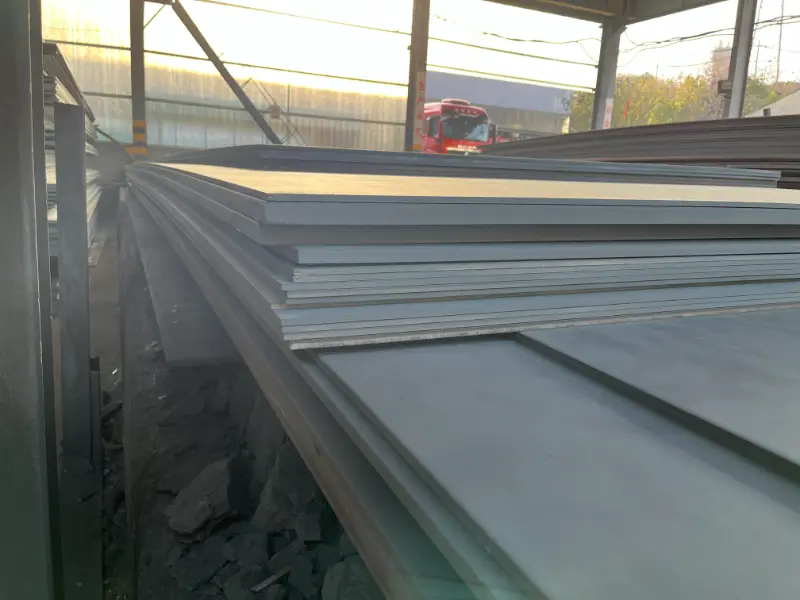
Q460E Quenched and Tempered High Strength Steel
Q460E High-Strength Quenched and Tempered Steel Plate per GB/T 16270 - Properties & Equivalents
Comprehensive technical data for Q460E carbon and low-alloy high-strength steel coil under GB/T 16270, including chemical composition, mechanical properties, thermal and electrical physical properties, international equivalents, and application guidance.
Quenching and tempering (Q&T), hot rolling, cold forming, welding, machining
- Phone : +8618037372205
- Email : [email protected]
- WhatsApp: Contact via Whtsapp
- WeChat: +8618037372205
Q460E Quenched and Tempered High Strength Steel Introduction
Q460E is a high-strength quenched and tempered structural steel grade defined in Chinese standard GB/T 16270, intended for use in welded, bolted, or riveted structures. It delivers a minimum yield strength of 460 MPa and exhibits excellent low-temperature toughness down to -40°C. The steel is produced in the form of plates, coils, and wide flats, primarily supplied in the quenched and tempered condition. Typical applications include heavy machinery, bridges, offshore platforms, and pressure vessels where high load-bearing capacity and good weldability are essential. The chemical composition is carefully designed with microalloying elements (Nb, V, Ti) to ensure fine-grain strengthening and precipitation hardening, while maintaining sufficient formability and weldability.
Q460E Quenched and Tempered High Strength Steel Chemical Composition per Ladle Analysis
The chemical composition of Q460E conforms to GB/T 16270-2009. Maximum limits are given for key elements to ensure hardenability and toughness. Microalloying elements Nb, V, Ti, and B may be added individually or in combination to achieve the required mechanical properties after quenching and tempering.
| Element | Specified Value (max, %) | Remarks |
|---|---|---|
| C (Carbon) | 0.18 | Ladle analysis |
| Si (Silicon) | 0.50 | Ladle analysis |
| Mn (Manganese) | 1.70 | Ladle analysis |
| P (Phosphorus) | 0.020 | Ladle analysis |
| S (Sulfur) | 0.010 | Ladle analysis |
| Cr (Chromium) | 0.70 | Ladle analysis |
| Ni (Nickel) | 1.50 | Ladle analysis |
| Mo (Molybdenum) | 0.50 | Ladle analysis |
| Cu (Copper) | 0.50 | Ladle analysis |
| Nb (Niobium) | 0.06 | Ladle analysis |
| V (Vanadium) | 0.08 | Ladle analysis |
| Ti (Titanium) | 0.05 | Ladle analysis |
| B (Boron) | 0.005 | Ladle analysis |
Q460E Quenched and Tempered High Strength Steel Thermal and Electrical Physical Properties
The following values are typical for quenched and tempered low-alloy high-strength steels like Q460E and are not part of the GB/T 16270 specification. They are provided as general engineering reference data at room temperature unless otherwise specified.
| Property | Typical Value | Unit | Test Condition |
|---|---|---|---|
| Density (ρ) | 7.85 | g/cm³ | Room temperature |
| Modulus of elasticity (E) | 205 – 210 | GPa | Room temperature, static test |
| Shear modulus (G) | 80 – 81 | GPa | Room temperature |
| Poisson ratio (ν) | 0.30 | – | Room temperature |
| Thermal expansion coefficient (α) | 11.7 | 10⁻⁶/K | 20–100 °C |
| Thermal expansion coefficient (α) | 12.3 | 10⁻⁶/K | 20–200 °C |
| Thermal expansion coefficient (α) | 13.1 | 10⁻⁶/K | 20–300 °C |
| Thermal conductivity (λ) | 50 | W/(m·K) | 20 °C |
| Thermal conductivity (λ) | 46 | W/(m·K) | 100 °C |
| Specific heat capacity (cₚ) | 460 – 480 | J/(kg·K) | Room temperature |
| Electrical resistivity (ρₑ) | 0.22 – 0.25 | μΩ·m | Room temperature |
Q460E Quenched and Tempered High Strength Steel Mechanical Properties
The mechanical properties are valid for plates/coils with thickness ≤ 50 mm in transverse direction unless otherwise noted. Impact energy is measured on standard Charpy V-notch specimens. Bending tests are performed at room temperature with 180° bending angle.
| Property | Specified Value | Unit | Test Condition |
|---|---|---|---|
| Yield Strength (ReH) | ≥ 460 | MPa | Thickness ≤ 50 mm |
| Tensile Strength (Rm) | 550 – 720 | MPa | Thickness ≤ 50 mm |
| Elongation after fracture (A) | ≥ 17 | % | Gauge length 5.65√S₀, thickness ≤ 50 mm |
| Impact energy (KV₂) | ≥ 34 | J | At -40 °C, longitudinal direction |
| Bend test (mandrel diameter) | 2a | – | Thickness ≤ 16 mm, bending angle 180° |
| Bend test (mandrel diameter) | 3a | – | Thickness > 16 mm to 50 mm, bending angle 180° |
Q460E Quenched and Tempered High Strength Steel International Equivalent Standards and Grades for Q460E
| Country/Region | Standard | Grade | Remarks |
|---|---|---|---|
| China | GB/T 16270-2009 | Q460E | Original grade, quenched & tempered, -40°C impact |
| Europe | EN 10025-6:2019 | S460QL1 (1.8908) | Quenched & tempered, ≤150 mm, -40°C impact energy 30 J min (long.) |
| Europe | EN 10025-6:2019 | S460QL (1.8906) | Quenched & tempered, -20°C impact; slightly lower toughness than Q460E, but may be used with caution |
| International | ISO 4950-2 | S460QL1 | High yield strength flat products, quenched & tempered |
Q460E Quenched and Tempered High Strength Steel Application Introduction
Q460E is designed for heavy-load, welded structures that require high strength and good low-temperature toughness. Its quenched and tempered condition ensures uniform mechanical properties across the thickness, making it suitable for critical safety components. Welding procedures must follow low-hydrogen practices to avoid cold cracking, and preheat may be required depending on thickness and carbon equivalent. The steel is readily available in coil and plate form, enabling efficient fabrication by cutting, cold forming, and machining.
Product Applications: Crane booms and lattice structures, Bridge girders and decks, Offshore platform legs and decks, High-pressure storage tanks, Excavator buckets and arms, Heavy-duty truck frames, Wind turbine tower sections
Processed into products: Welded H-beams and box columns, Boom sections for mobile cranes, Chords for offshore jackets, Reinforcement ribs and stiffeners, Pinned joints and connection plates, Roller shells for heavy machinery, Frame rails for mining trucks
Application industries: Construction machinery, Bridge engineering, Offshore and marine engineering, Pressure vessel and boiler manufacturing, Mining and earthmoving equipment, Railway vehicle structures, Wind tower manufacturing
Q460E Quenched and Tempered High Strength Steel Similar Grades with Comparable Yield Strength
| Country/Region | Standard | Grade | Remarks |
|---|---|---|---|
| China | GB/T 1591-2018 | Q460D | Hot-rolled high-strength low-alloy, normalized/rolled, -20°C impact, not quenched & tempered; lower strength consistency in thick sections |
| Europe | EN 10025-3:2019 | S460N / S460NL | Normalized fine-grain structural steel, -20°C / -50°C impact, different production route, lower yield strength at thicker sections |
| USA | ASTM A572/A572M | Grade 65 (Type 1/M) | High-strength low-alloy, not quenched, 450 MPa yield, uses different chemistry; requires modification for -40°C toughness |
| Japan | JIS G3106 | SM570 | Welding structural steel, 460 MPa tensile class, typically used normalized, impact test temperature specified by purchaser |
Notes:
Delivery condition: The steel is supplied in the quenched and tempered state. Surface quality complies with GB/T 14977 Class A or as agreed. Weldability: Good weldability with low-hydrogen electrodes (AWS E11018 or similar) and appropriate preheat (typically 100–150 °C for thicknesses above 20 mm). Forming: Cold bending radius should be at least 3t for thicker plates to avoid cracking. Further processing: The material may be subjected to stress relief heat treatment after welding at temperatures around 550–600 °C, holding time based on thickness. The user should validate the final properties through procedure qualification tests.
- Share



