
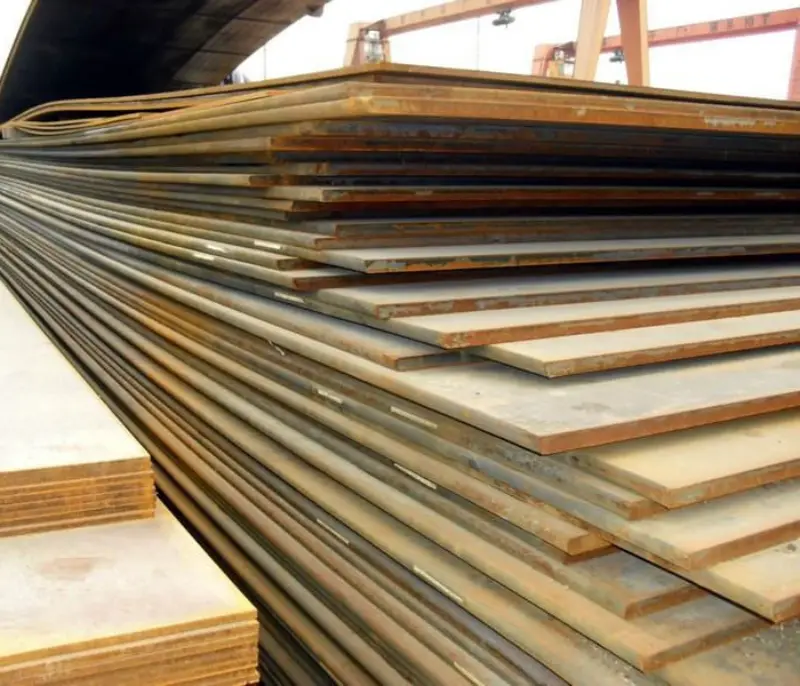
Q460D High-Strength Quenched and Tempered Steel
Q460D High-Strength Quenched and Tempered Steel - GB/T 16270 Grade for Heavy-Duty Structures
Q460D is a low-alloy high-strength structural steel with minimum yield strength 460 MPa and excellent low-temperature toughness, supplied in the quenched and tempered condition under GB/T 16270.
Hot rolling, quenching and tempering (Q+T), cold forming, welding, machining
- Phone : +8618037372205
- Email : [email protected]
- WhatsApp: Contact via Whtsapp
- WeChat: +8618037372205
Q460D High-Strength Quenched and Tempered Steel Introduction
Q460D is a low-alloy high-strength structural steel specified in GB/T 16270, designed for heavy welded structures requiring high load-bearing capacity and good ductility. With a minimum yield strength of 460 MPa, it is supplied in the quenched and tempered (Q+T) condition, providing a balance of strength, toughness, and weldability.
Key features:
- Grade D guarantees impact energy ≥47 J at -20 °C, ensuring reliable service in cold environments.
- Controlled chemical composition with microalloying elements (Nb, V, Ti, B) refines grain structure and enhances strength without compromising weldability.
- Typical applications include bridges, construction machinery, offshore platforms, and pressure vessels.
- Available in plate, coil, and strip forms with thickness-dependent mechanical properties.
Q460D High-Strength Quenched and Tempered Steel Chemical Composition
The chemical composition of Q460D ensures high strength, good toughness, and weldability. Microalloying elements Nb, V, Ti, and B are added for grain refinement and precipitation strengthening. Phosphorus and sulfur are kept low for cleanliness and toughness.
| Element | Standard Value (max unless range) | Remarks |
|---|---|---|
| C | ≤0.18 | Typical 0.10–0.16 |
| Si | ≤0.50 | Deoxidizer, typical 0.20–0.40 |
| Mn | ≤1.70 | Typical 1.20–1.60 |
| P | ≤0.020 | Low impurity for toughness |
| S | ≤0.010 | Strict control for weldability |
| Cr | ≤0.70 | Optional, improves hardenability |
| Ni | ≤0.80 | Optional, enhances low-temp toughness |
| Mo | ≤0.20 | Optional, reduces temper embrittlement |
| Cu | ≤0.50 | Residual or added for corrosion resistance |
| Nb | ≤0.06 | Grain refiner, typical 0.02–0.05 |
| V | ≤0.08 | Precipitation strengthener, typical 0.02–0.08 |
| Ti | ≤0.05 | Grain refiner, typical 0.01–0.03 |
| B | ≤0.004 | Enhances hardenability at low levels |
| Al (total) | ≥0.015 | For grain refining and deoxidation |
Q460D High-Strength Quenched and Tempered Steel Thermal & Electrical Physical Properties
Typical physical properties of Q460D steel at room temperature and elevated temperatures. These values are based on low-alloy quenched and tempered steels of similar composition and may vary slightly with actual heat treatment.
| Property | Reference Value | Unit | Test Condition / Remarks |
|---|---|---|---|
| Density (ρ) | 7850 | kg/m³ | Room temperature |
| Modulus of Elasticity (E) | 210 | GPa | 20 °C |
| Shear Modulus (G) | 81 | GPa | 20 °C |
| Poisson's Ratio (ν) | 0.3 | — | 20 °C |
| Thermal Expansion Coefficient (α) | 12.1 | 10⁻⁶/K | 20–100 °C |
| Thermal Expansion Coefficient (α) | 13.0 | 10⁻⁶/K | 20–200 °C |
| Thermal Expansion Coefficient (α) | 13.8 | 10⁻⁶/K | 20–400 °C |
| Thermal Conductivity (λ) | ~45 | W/(m·K) | 20 °C |
| Thermal Conductivity (λ) | ~38 | W/(m·K) | 200 °C |
| Specific Heat Capacity | ~460 | J/(kg·K) | 20 °C |
| Electrical Resistivity (ρ_e) | ~0.22 | 10⁻⁶ Ω·m | 20 °C |
Q460D High-Strength Quenched and Tempered Steel Mechanical Properties
Mechanical properties of Q460D are thickness-dependent. The values below represent minimum requirements according to GB/T 16270. Impact energy is guaranteed at -20°C. Bend tests are performed with specified mandrel diameters.
| Property | Required Value | Unit | Test Condition |
|---|---|---|---|
| Yield Strength (ReH) | ≥460 | MPa | t ≤ 50 mm |
| Yield Strength (ReH) | ≥440 | MPa | 50 < t ≤ 100 mm |
| Yield Strength (ReH) | ≥400 | MPa | 100 < t ≤ 150 mm |
| Tensile Strength (Rm) | 550 – 720 | MPa | t ≤ 50 mm |
| Tensile Strength (Rm) | 530 – 700 | MPa | 50 < t ≤ 100 mm |
| Tensile Strength (Rm) | 510 – 680 | MPa | 100 < t ≤ 150 mm |
| Elongation (A) | ≥17 | % | t ≤ 50 mm, gauge length 5.65√S₀ |
| Elongation (A) | ≥16 | % | 50 < t ≤ 100 mm |
| Elongation (A) | ≥15 | % | 100 < t ≤ 150 mm |
| Impact Energy (KV₂) | ≥47 | J | -20 °C, longitudinal |
| Bend Test (d = mandrel diameter, a = thickness) | d = 3a | — | 180° bending, t ≤ 50 mm |
Q460D High-Strength Quenched and Tempered Steel Completely Equivalent Standards and Substitute Grades
| Country/Region | Standard | Grade | Remarks |
|---|---|---|---|
| China | GB/T 16270 | Q460D | Original standard, quenched & tempered, -20 °C impact |
| Europe | EN 10025-6 | S460QL | Closest fully equivalent; Q+T, L = impact at -40 °C, higher toughness than Q460D |
| Europe | EN 10025-6 | S460QL1 | Q+T, L1 = impact at -20 °C, identical toughness grade to Q460D |
| International (ISO) | ISO 4950-2 | E460DD | High yield strength flat products, Q+T, impact at -20 °C |
Q460D High-Strength Quenched and Tempered Steel Application Introduction
Q460D is ideally suited for heavy welded structures requiring high strength, good formability, and reliable low-temperature toughness. The quench-and-tempered condition guarantees consistent mechanical properties through the thickness, enabling weight reduction in design. Typical applications include:
- Structural components in high-rise buildings and long-span bridges.
- Load-bearing beams, columns, and chords in mobile cranes and excavators.
- Offshore platform legs, jack-up rig parts, and subsea structural nodes.
- Pressure vessels and storage tanks operating at moderate temperatures.
- Heavy-duty transport vehicles and rail wagon frames.
Available processing includes cold bending, shearing, flame cutting, and welding with low-hydrogen procedures.
Product Applications: Welded H-beams and box columns, Bridge girder flanges and webs, Crane booms and jib sections, Jack-up rig legs and spudcans, Mining dump truck frames, Hydraulic excavator arms, Pressure vessel shells
Processed into products: Girder flanges and web stiffeners, Welded T-joints and K-joints in tubular structures, Pinned connections and gusset plates, Bogie frames for heavy-duty trailers, Lifting lugs and pad eyes, Cutting edges and wear plates (when surface hardened), Transition cones in silos and hoppers
Application industries: Building & Infrastructure Construction, Bridge Engineering, Heavy Machinery & Earthmoving Equipment, Offshore Oil & Gas, Shipbuilding (hull reinforcement), Pressure Vessel Manufacturing, Railway Vehicles
Q460D High-Strength Quenched and Tempered Steel Similar/Approximate Substitute Materials
| Country/Region | Standard | Grade | Remarks |
|---|---|---|---|
| China | GB/T 16270 | Q460C | Same strength, impact at 0 °C (lower toughness than D) |
| China | GB/T 16270 | Q460E | Same strength, impact at -40 °C (higher toughness) |
| China | GB/T 1591 | Q460D | Different delivery (normalized/rolled), may have lower yield if not Q+T |
| Europe | EN 10025-6 | S460Q | Quenched & tempered, impact at -20 °C (L grade, slightly different chem.) |
| USA | ASTM A514/A514M | Grade E | Quenched & tempered, yield 620–690 MPa, higher strength; heavier alloying, different weldability |
| Japan | JIS G 3128 | SHY685 | High yield strength plate for bridges, yield ≥590 MPa, not exact match |
Notes:
- Welding: Preheat and interpass temperature typically 100–150 °C; use low-hydrogen electrodes (E7018 or ER70S-6) and follow qualified WPS to maintain joint toughness.
- Forming: Cold bending radii should be ≥3t for thickness up to 50 mm; stress relief annealing recommended after heavy forming at 550–600 °C.
- Surface condition: Supplied as-rolled, deseamed, or blasted and primed according to customer specifications.
- Certification: Material shall be delivered with inspection certificate according to EN 10204 type 3.1 or equivalent, including chemical analysis, tensile, impact, and bend test results.
- Share



