
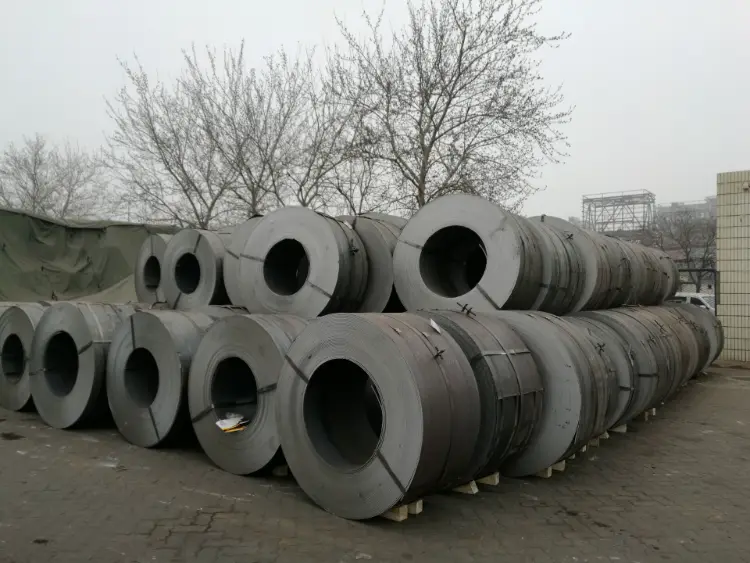
GB/T 16270 Q460C Carbon and Low-alloy High-strength Steel Coil
GB/T 16270 Q460C Carbon and Low-alloy High-strength Steel Coil - Properties and Equivalents
Comprehensive material data for Q460C carbon and low-alloy high-strength steel coil per GB/T 16270, including chemical composition, mechanical and physical properties, international equivalents, and application guidance.
Hot rolling, cold forming, welding, machining, heat treatment (quenching and tempering, normalizing)
- Phone : +8618037372205
- Email : [email protected]
- WhatsApp: Contact via Whtsapp
- WeChat: +8618037372205
GB/T 16270 Q460C Carbon and Low-alloy High-strength Steel Coil Introduction
Q460C is a low-alloy high-strength structural steel grade specified in GB/T 16270, designed for welded structures requiring high yield strength (minimum 460 MPa at ≤16 mm thickness) and good low-temperature toughness (impact energy ≥47 J at 0 °C). It belongs to the carbon and low-alloy high-strength steel category and is typically delivered in the quenched and tempered condition, ensuring uniform mechanical properties through thickness. The steel offers excellent weldability when proper procedures are followed, and its microalloying elements (Nb, V, Ti) provide grain refinement and precipitation hardening. With a carbon equivalent usually below 0.47%, it can be safely welded without excessive preheat. Q460C is widely used in heavy machinery, bridges, offshore structures, and pressure vessels, where weight savings and high strength are critical.
GB/T 16270 Q460C Carbon and Low-alloy High-strength Steel Coil Chemical Composition
Chemical composition limits for Q460C according to GB/T 16270, based on heat (ladle) analysis. The steel is low-carbon and microalloyed with niobium, vanadium, and titanium to achieve high strength and toughness. Residual elements are controlled to maintain weldability and through-thickness properties.
| Element | Standard Value (%) | Remarks |
|---|---|---|
| C | ≤0.20 | Carbon — contributes to strength and hardenability |
| Si | ≤0.60 | Silicon — deoxidizer, improves strength |
| Mn | ≤1.80 | Manganese — enhances hardenability and tensile strength |
| P | ≤0.030 | Phosphorus — impurity, kept low for toughness |
| S | ≤0.030 | Sulfur — impurity, kept low for ductility |
| Cr | ≤0.30 | Chromium — optional, increases hardenability |
| Ni | ≤0.80 | Nickel — optional, improves toughness at low temperature |
| Mo | ≤0.20 | Molybdenum — optional, enhances hardenability and creep strength |
| Cu | ≤0.55 | Copper — residual, may improve atmospheric corrosion resistance |
| Nb | ≤0.06 | Niobium — grain refiner, microalloying element |
| V | ≤0.15 | Vanadium — precipitation hardening element |
| Ti | ≤0.20 | Titanium — grain refiner, forms carbonitrides |
| Als | ≥0.015 | Acid-soluble aluminum — deoxidation and grain refinement |
| B | ≤0.004 | Boron — optional, powerful hardenability enhancer |
| CEV | ≤0.47 | Carbon equivalent CEV = C+Mn/6+(Cr+Mo+V)/5+(Ni+Cu)/15, typical limit for weldability |
GB/T 16270 Q460C Carbon and Low-alloy High-strength Steel Coil Thermal and Electrical Physical Properties
Typical physical properties for Q460C steel at ambient temperature. These values are not mandated by the standard but are provided for engineering calculations. They are similar to those of other low-alloy steels with a density of about 7.85 g/cm³ and a modulus of elasticity around 205 GPa.
| Property | Typical Value | Unit | Test Condition |
|---|---|---|---|
| Density (ρ) | 7.85 | g/cm³ | At 20 °C |
| Modulus of elasticity (E) | 205 – 210 | GPa | At 20 °C |
| Shear modulus (G) | 79 – 81 | GPa | Calculated from E and Poisson's ratio |
| Poisson's ratio (ν) | 0.28 – 0.30 | — | At 20 °C |
| Thermal expansion coefficient (α) | ~12.0 | 10⁻⁶ / K | Between 20 °C and 100 °C |
| Thermal conductivity (λ) | ~45 | W/(m·K) | At 20 °C |
| Specific heat capacity (cp) | ~460 | J/(kg·K) | At 20 °C |
| Electrical resistivity (ρe) | ~0.25 | μΩ·m (10⁻⁶ Ω·m) | At 20 °C |
GB/T 16270 Q460C Carbon and Low-alloy High-strength Steel Coil Mechanical Properties
Tensile and impact properties for Q460C steel as specified in GB/T 16270. Values apply to the transverse direction and are valid for quenched and tempered condition. Yield strength decreases with increasing thickness. Impact testing is performed at 0 °C (grade C).
| Property | Minimum Required Value | Unit | Test Condition |
|---|---|---|---|
| Yield Strength (ReH) | 460 | MPa | Thickness ≤ 16 mm |
| Yield Strength (ReH) | 440 | MPa | 16 mm < thickness ≤ 35 mm |
| Yield Strength (ReH) | 420 | MPa | 35 mm < thickness ≤ 50 mm |
| Yield Strength (ReH) | 400 | MPa | 50 mm < thickness ≤ 100 mm |
| Tensile Strength (Rm) | 550 – 720 | MPa | Thickness ≤ 100 mm |
| Elongation after fracture (A) | 17 | % | Gauge length L0=5.65√S0, thickness ≤ 100 mm |
| Impact energy (KV2, average) | 47 | J | Charpy V-notch, 0 °C, transverse, average of 3 specimens |
| Impact energy (KV2, single) | 34 | J | Charpy V-notch, 0 °C, transverse, minimum single value |
| Bend test (mandrel diameter D, specimen thickness a) | D = 3a | — | 180° bend, no cracks |
GB/T 16270 Q460C Carbon and Low-alloy High-strength Steel Coil Fully Equivalent Material Standards and Replaceable Grades
| Country/Region | Standard | Grade | Remarks |
|---|---|---|---|
| China | GB/T 16270 | Q460C | Original specification – quenched and tempered delivery |
| European Union | EN 10025-4 | S460M / S460ML | Thermomechanical rolled fine-grain steel; ML grade guarantees toughness at -50 °C, exceeding Q460C requirements |
| European Union | EN 10025-6 | S460QL / S460QL1 | Quenched and tempered structural steel; QL and QL1 have guaranteed impact at -40 °C and -60 °C respectively |
| Japan | JIS G3106 | SM570 | Welded structural steel with yield ≥460 MPa and tensile 570–720 MPa; impact test at 0 °C available |
| USA | ASTM A572 / A572M | Grade 65 | High-strength low-alloy structural steel with minimum yield 450 MPa; additional agreement needed to guarantee 460 MPa yield |
| International | ISO 4950-2 | E460D | Higher strength structural steel, yield ≥460 MPa, impact at -20 °C (D quality), close match |
GB/T 16270 Q460C Carbon and Low-alloy High-strength Steel Coil Application Introduction
Q460C steel is primarily used in welded structural applications where high strength and good low-temperature toughness are required. It is suitable for both static and dynamic loads. The quenched and tempered condition gives it a uniform fine-grained microstructure, allowing for thicknesses up to 100 mm while maintaining mechanical properties. Welding procedures should follow established guidelines (e.g., preheat 100–150 °C for thicker sections) to avoid hydrogen cracking. The steel can be formed, machined, and welded with standard practices, though its higher strength may require increased bending forces.
Product Applications: Welded H-beams and box columns for high-rise buildings, Bridge girders and structural supports, Crane booms and lifting arms, Offshore platform components (jack-up legs, deck frames), Penstocks and penstock liners in hydroelectric plants, Heavy-duty truck frames and trailer components, Reinforcement plates and stiffeners in mechanical engineering
Processed into products: Structural plates for high-rise building core columns, Booms and outriggers for mobile cranes, Chassis frames for heavy trucks and mining dumpers, Bearing plates and splice plates in bridges, Hinge pin plates and arm connections in excavators, Skid plates and wear strips for mining equipment, Brackets and bolster beams in railway bogies
Application industries: Construction and civil engineering, Bridge building, Heavy machinery and mining equipment, Offshore and marine structures, Pressure vessels and storage tanks, Automotive chassis and structural parts, Railway vehicles
GB/T 16270 Q460C Carbon and Low-alloy High-strength Steel Coil Similar / Substitution Materials
| Country/Region | Standard | Grade | Remarks |
|---|---|---|---|
| China | GB/T 1591 | Q460C | High-strength low-alloy structural steel with similar yield but slightly different alloy design; may have different production route |
| European Union | EN 10025-3 | S460N / S460NL | Normalized or normalized rolled fine-grain steel; similar yield strength, NL offers lower temperature toughness than Q460C |
| USA | ASTM A709 / A709M | Grade 50W / 50S | Weathering steel (50 ksi yield = 345 MPa); not equivalent but can be used for lower strength requirements; Grade 70W (485 MPa) closer |
| Japan | JIS G3135 | SPFC 780Y | High-strength cold-rolled steel sheet for automotive, yield ≥460 MPa, limited to thinner gauges (≤3.2 mm) |
Notes:
- CEV (Carbon Equivalent Value) is routinely controlled ≤0.47% to ensure excellent weldability without cold cracking under normal conditions.
- Delivery condition: quenched and tempered (Q+T) is the default; normalized or normalized rolled may be supplied upon agreement, but mechanical properties must still meet the standard.
- Ultrasonic testing (UT): can be performed according to GB/T 2970 or EN 10160 to guarantee internal soundness for critical applications.
- Surface quality: shall comply with GB/T 14977 for hot-rolled steel plates/coils unless otherwise specified.
- Corrosion protection: for outdoor or marine environments, consider weathering grades (e.g., Q460NH) or apply protective coatings (painting, galvanizing).
- Forming: cold bending radii should be increased compared to mild steels; typically minimum inside bend radius ≥ 3t for higher thicknesses.
- Share



