
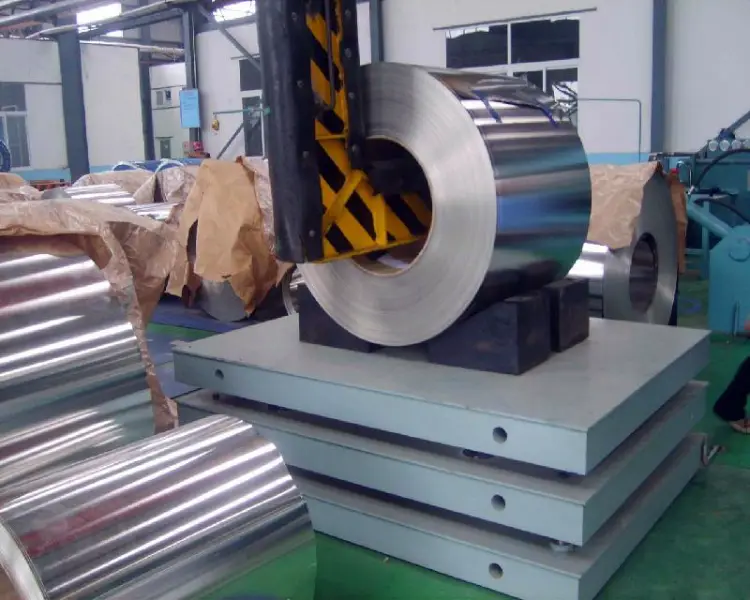
Q460E High-Strength Low-Alloy Steel Coil to GB/T 1591
Q460E High-Strength Low-Alloy Steel Coil to GB/T 1591 - Composition, Properties & Equivalents
Complete material data for Q460E carbon and low-alloy high-strength steel coil: chemical composition limits, mechanical properties by thickness, thermal and electrical properties, international cross-reference equivalents, and application guidelines.
Cutting, welding, bending, cold forming, machining, hot forming (with temperature control)
- Phone : +8618037372205
- Email : [email protected]
- WhatsApp: Contact via Whtsapp
- WeChat: +8618037372205
Q460E High-Strength Low-Alloy Steel Coil to GB/T 1591 Introduction
Q460E is a low-alloy high-strength structural steel grade specified in GB/T 1591-2018. It is engineered for heavy-duty structural applications demanding high strength and guaranteed low-temperature toughness. With a minimum yield strength of 460 MPa and Charpy V-notch impact energy of at least 34 J at -40°C (E-quality level), this steel offers an excellent balance of strength, ductility, and weldability. Key characteristics include:
- High yield and tensile strength combined with good elongation
- Excellent low-temperature impact toughness (E-grade, -40°C)
- Good weldability with conventional processes, usually requiring preheat only for thicker sections
- Formability suitable for cold bending and forming
- Available in multiple delivery conditions: hot-rolled, normalized, or thermomechanically rolled
- Microalloyed with Nb, V, Ti for grain refinement and precipitation strengthening
Q460E High-Strength Low-Alloy Steel Coil to GB/T 1591 Chemical Composition
Chemical composition limits according to GB/T 1591-2018 for Q460E. These values represent the ladle analysis. The steel is microalloyed with niobium, vanadium, and titanium to achieve the required strength and toughness. Strict control of phosphorus and sulfur ensures the -40°C impact toughness of grade E.
- Als refers to acid-soluble aluminum content.
- Residual elements such as boron and residual Cu, Ni, Cr may be present but are not deliberately added unless agreed.
| Element | Content (max %) | Notes |
|---|---|---|
| C | ≤ 0.20 | Carbon equivalent (CEV) to be calculated as agreed for weldability |
| Si | ≤ 0.60 | |
| Mn | ≤ 1.80 | Higher Mn for strength and hardenability |
| P | ≤ 0.020 | Strict limit for E-grade low-temperature toughness |
| S | ≤ 0.010 | Reduced sulfur for improved through-thickness properties |
| Nb | ≤ 0.11 | Microalloying for grain refinement |
| V | ≤ 0.20 | Precipitation strengthening element |
| Ti | ≤ 0.20 | Grain refinement and nitrogen fixation |
| Cr | ≤ 0.30 | |
| Ni | ≤ 0.80 | Improves low-temperature toughness |
| Cu | ≤ 0.55 | |
| Mo | ≤ 0.20 | Optional microalloy |
| N | ≤ 0.015 | Maximum total nitrogen |
| Als | ≥ 0.015 | Minimum acid-soluble aluminum for grain size control |
Q460E High-Strength Low-Alloy Steel Coil to GB/T 1591 Thermal & Electrical Physical Properties
Typical room-temperature physical properties for low-alloy steels of this class. These values are not part of the delivery specification but are widely used for engineering calculations. They may vary slightly with chemical composition and heat treatment condition.
- Thermal expansion coefficient given for 20°C to 100°C range.
- Thermal conductivity decreases, and electrical resistivity increases with temperature.
| Property | Typical Value | Unit | Test Conditions / Remarks |
|---|---|---|---|
| Density (ρ) | 7.85 | g/cm³ | At 20°C |
| Modulus of Elasticity (E) | 200 | GPa | Ambient temperature |
| Shear Modulus (G) | ≈ 80 | GPa | Calculated from E and Poisson's ratio |
| Poisson's Ratio (ν) | 0.3 | — | In elastic range |
| Thermal Expansion Coefficient (α) | 12.0 | 10⁻⁶/K | 20°C to 100°C |
| Thermal Conductivity (λ) | 45 | W/(m·K) | At 20°C |
| Specific Heat Capacity (cp) | 460 | J/(kg·K) | At 20°C |
| Electrical Resistivity (ρe) | ≈ 0.20 × 10⁻⁶ | Ω·m | At 20°C |
Q460E High-Strength Low-Alloy Steel Coil to GB/T 1591 Mechanical Properties
Mechanical properties for Q460E steel as specified in GB/T 1591-2018, determined on transverse test pieces. Values vary with product thickness. The listed properties are minimum requirements unless a range is given.
- Yield strength (ReH or Rp0.2), tensile strength (Rm), and elongation (A) percentages correspond to gauge length L0 = 5.65√S0.
- Charpy V-notch impact tests at -40°C (E-grade) require an average of three tests ≥ 34 J, with one individual value ≥ 27 J.
- Bend tests to 180° over a specified mandrel diameter; no cracking permitted.
| Property | Specified Value | Unit | Test Conditions / Thickness Range |
|---|---|---|---|
| Yield Strength ReH | ≥ 460 | MPa | Thickness ≤ 16 mm |
| ≥ 440 | MPa | 16 < thickness ≤ 40 mm | |
| ≥ 420 | MPa | 40 < thickness ≤ 63 mm | |
| ≥ 400 | MPa | 63 < thickness ≤ 80 mm | |
| ≥ 400 | MPa | 80 < thickness ≤ 100 mm | |
| Tensile Strength Rm | 550 – 720 | MPa | Thickness ≤ 100 mm |
| Elongation A | ≥ 17 | % | Thickness ≤ 16 mm |
| ≥ 17 | % | 16 < thickness ≤ 40 mm | |
| ≥ 17 | % | 40 < thickness ≤ 63 mm | |
| ≥ 17 | % | 63 < thickness ≤ 80 mm | |
| ≥ 17 | % | 80 < thickness ≤ 100 mm | |
| Charpy Impact (KV2) | ≥ 34 (≥ 27 single) | J | -40°C, transverse, V-notch, average of three |
| Bend Test (180°) | D = 3a | - | Thickness ≤ 16 mm (a = specimen thickness) |
| D = 4a | - | 16 < thickness ≤ 40 mm | |
| D = 5a | - | 40 < thickness ≤ 63 mm | |
| D = 6a | - | 63 < thickness ≤ 80 mm | |
| D = 7a | - | 80 < thickness ≤ 100 mm |
Q460E High-Strength Low-Alloy Steel Coil to GB/T 1591 Direct Equivalent Standards & Substitutable Grades
| Country/Region | Standard | Grade | Remarks |
|---|---|---|---|
| Europe | EN 10025-3 | S460NL | Normalized/normalized rolled, impact at -50°C ≥27J; similar strength and toughness, fully comparable to Q460E. |
| Europe | EN 10025-4 | S460ML | Thermomechanically rolled, impact at -50°C ≥27J; can replace Q460E in TMCP condition. |
| Japan | JIS G3106 | SM570 | Yield ≥460 MPa, tensile 570–720 MPa; impact toughness classification by additional suffix (e.g., SM570TMC with agreement). Low-temperature capability must be confirmed. |
| USA | ASTM A572/A572M | Grade 65 [450] | Minimum yield 450 MPa (65 ksi) – slightly lower; not a direct equivalent but sometimes used as an alternative after engineering evaluation. Impact requirements must be specified separately. |
| International | ISO 4950-2 / ISO 4950-3 | S460Q / S460QL1 | Quenched & tempered grades with yield 460 MPa, -40°C or -60°C impact; applicable if QT condition is acceptable. |
Q460E High-Strength Low-Alloy Steel Coil to GB/T 1591 Application Introduction
Q460E provides a robust solution for heavy structural applications where high strength and reliable low-temperature performance are essential. It is commonly used in welded assemblies and replaces lower-strength steels to reduce weight and cross-sectional dimensions. Typical processing includes welding (with proper preheat and interpass temperature control), bending, and forming. The steel is suitable for both static and dynamic loading scenarios.
Product Applications: Hot-rolled steel coils and cut sheets for welded structures, Structural plates for girders, columns, and base plates, H-beams, I-beams, channels, and angles for heavy frameworks, Welded pipes and tubular profiles for structural and mechanical applications, Formed and welded components for cranes and lifting devices, Prefabricated modules for offshore and marine construction
Processed into products: Bridge main girders, cross beams, and orthotropic decks, Offshore platform legs, braces, and decks, Ship hull stiffeners and deck plating, Crane booms, jibs, and chassis frames, Mining dump truck frames and load-bearing structural parts, Wind turbine tower sections and flanges, Heavy-duty lifting brackets and welded fabrications, Pump bodies and high-pressure manifolds where strength and toughness are required
Application industries: Civil engineering and infrastructure, Bridge construction, Shipbuilding and marine engineering, Offshore oil and gas platforms, Wind energy and turbine towers, Heavy machinery and transport equipment, Mining and earthmoving equipment, Pressure vessel and boiler manufacturing
Q460E High-Strength Low-Alloy Steel Coil to GB/T 1591 Similar / Comparable Material Grades for Reference
| Country/Region | Standard | Grade | Remarks |
|---|---|---|---|
| China | GB/T 1591 | Q420E | Lower yield strength (420 MPa) but similar low-alloy concept and low-temperature grade; may be sufficient for less demanding designs. |
| China | GB/T 1591 | Q500E | Higher strength (500 MPa yield) with similar toughness; suitable when weight reduction is critical, but welding procedures need adjustment. |
| Europe | EN 10025-3 | S460N | Normalized, but impact only at -20°C (N-grade); not suitable for -40°C requirements. Use S460NL instead. |
| Japan | JIS G3106 | SM520C | Yield 365 MPa, much lower strength; not a substitute for Q460E. |
| USA | ASTM A913/A913M | Grade 65 [450] | High-strength low-alloy structural steel with yield 450 MPa; impact properties must be agreed upon; close alternative after verification. |
Notes:
Additional considerations:
- Carbon equivalent (CEV) should be calculated and reported when welding is intended; typical CEV ≤ 0.45% for Q460E (TMCP) can be achieved.
- Normalizing or TMCP delivery improves weldability and low-temperature toughness consistency.
- Preheating before welding is generally recommended for thicknesses > 30 mm; specific preheat and interpass temperatures depend on CEV and applied welding process.
- Post-weld heat treatment (PWHT) is seldom required but can be applied with care to avoid deterioration of mechanical properties.
- For through-thickness loading (Z-direction), additional requirements per GB/T 5313 (Z25, Z35) may be specified.
- This material data sheet is based on GB/T 1591-2018; always consult the latest revision of the standard and supplementary specifications in project documents.
- Share



