
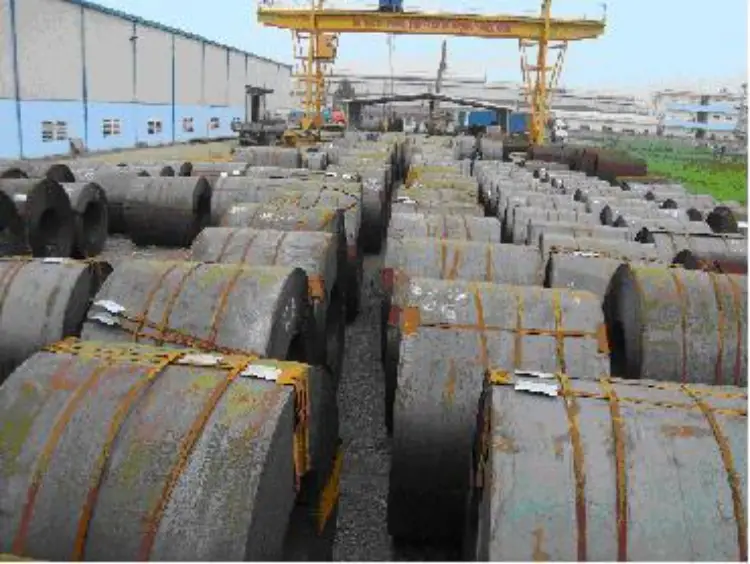
Q460D Low-Alloy High-Strength Steel Coil per GB/T 1591
Q460D Low-Alloy High-Strength Steel Coil per GB/T 1591: Properties & Equivalents
Detailed material data for Q460D carbon and low-alloy high-strength steel coil according to GB/T 1591. Includes chemical composition, mechanical properties, thermal and electrical physical properties, international equivalent grades, and application guide.
Welding, gas cutting, plasma cutting, cold forming, hot forming, machining, hot rolling, controlled rolling, normalizing, TMCP
- Phone : +8618037372205
- Email : [email protected]
- WhatsApp: Contact via Whtsapp
- WeChat: +8618037372205
Q460D Low-Alloy High-Strength Steel Coil per GB/T 1591 Introduction
Q460D is a low-alloy high-strength structural steel defined in Chinese standard GB/T 1591-2018. It belongs to quality grade D, which guarantees a minimum impact energy of 34 J at -20°C, making it suitable for welded structures used in low-temperature environments. The minimum yield strength is 460 MPa for thicknesses up to 16 mm, and the tensile strength ranges from 550 to 720 MPa. Q460D exhibits good weldability, formability, and toughness, and can be supplied in various delivery conditions such as hot-rolled, normalized, or thermo-mechanically rolled (TMCP). It is widely applied in bridges, buildings, offshore platforms, engineering machinery, and pressure vessels where high strength and good low-temperature toughness are required. Compared with ordinary carbon steels, Q460D allows lighter structural designs and better load-bearing capacity.
Q460D Low-Alloy High-Strength Steel Coil per GB/T 1591 Chemical Composition
Chemical composition according to GB/T 1591-2018 for Q460D. Elements such as Nb, V, Ti, Ni, Cr, Cu, and Mo are optionally added for grain refinement, precipitation hardening, or to enhance specific properties. The values below are maximum limits unless a range is given. Aluminium total (Alt) or other fine grain elements are required to ensure fine grain practice.
| Element | Specification (%) | Remarks |
|---|---|---|
| C | ≤ 0.20 | Carbon |
| Si | ≤ 0.60 | Silicon |
| Mn | ≤ 1.80 | Manganese |
| P | ≤ 0.030 | Phosphorus |
| S | ≤ 0.025 | Sulfur |
| Nb | ≤ 0.11 | Niobium |
| V | ≤ 0.20 | Vanadium |
| Ti | ≤ 0.20 | Titanium |
| Cr | ≤ 0.30 | Chromium |
| Ni | ≤ 0.80 | Nickel |
| Cu | ≤ 0.55 | Copper |
| Mo | ≤ 0.20 | Molybdenum |
| N | ≤ 0.015 | Nitrogen |
| Alt | ≥ 0.015 | Total aluminium (for fine grain practice) or equivalent |
Q460D Low-Alloy High-Strength Steel Coil per GB/T 1591 Thermal and Electrical Physical Properties
The physical properties are typical for low-alloy structural steels of this strength level at room temperature unless otherwise noted. They are not part of the mandatory requirements in GB/T 1591 but are useful for design calculations. Values may vary slightly with actual chemical composition and heat treatment condition.
| Property | Typical Value | Unit | Test Condition / Temperature |
|---|---|---|---|
| Density (ρ) | 7.85 | g/cm³ | 20°C |
| Modulus of elasticity (E) | 206 | GPa | 20°C |
| Shear modulus (G) | 79 | GPa | 20°C |
| Poisson's ratio (ν) | 0.3 | – | 20°C |
| Thermal expansion coefficient (α) | 12.0 | 10⁻⁰ /K | 20-100°C |
| Thermal expansion coefficient (α) | 12.5 | 10⁻⁰ /K | 20-200°C |
| Thermal expansion coefficient (α) | 13.0 | 10⁻⁰ /K | 20-300°C |
| Thermal conductivity (λ) | 45 | W/(m·K) | 100°C |
| Thermal conductivity (λ) | 42 | W/(m·K) | 200°C |
| Thermal conductivity (λ) | 38 | W/(m·K) | 300°C |
| Specific heat capacity (cp) | 460 | J/(kg·K) | 20°C |
| Specific heat capacity (cp) | 500 | J/(kg·K) | 100°C |
| Electrical resistivity (ρe) | 0.22 | 10⁻⁰ Ω·m | 20°C |
Q460D Low-Alloy High-Strength Steel Coil per GB/T 1591 Mechanical Properties
Tensile and impact properties for Q460D steels in delivery condition. The yield strength and tensile strength depend on the product thickness. Impact energy is measured on longitudinal Charpy V-notch specimens at -20°C. Bend test is a simple forming requirement. All values are minimum unless a range is given. Values apply to flat and long products.
| Property | Requirement | Unit | Test Condition |
|---|---|---|---|
| Upper yield strength (ReH) for t ≤ 16 mm | ≥ 460 | MPa | Transverse or longitudinal; as specified |
| Upper yield strength (ReH) for 16 < t ≤ 40 mm | ≥ 440 | MPa | Same as above |
| Upper yield strength (ReH) for 40 < t ≤ 63 mm | ≥ 420 | MPa | Same as above |
| Upper yield strength (ReH) for 63 < t ≤ 80 mm | ≥ 400 | MPa | Same as above |
| Upper yield strength (ReH) for 80 < t ≤ 100 mm | ≥ 400 | MPa | Same as above |
| Upper yield strength (ReH) for 100 < t ≤ 150 mm | ≥ 380 | MPa | Same as above |
| Tensile strength (Rm) for t ≤ 100 mm | 550 - 720 | MPa | Transverse or longitudinal |
| Tensile strength (Rm) for 100 < t ≤ 150 mm | 530 - 700 | MPa | Transverse or longitudinal |
| Elongation (A) for t ≤ 100 mm | ≥ 17 | % | Gauge length 5.65√So, transverse or longitudinal |
| Elongation (A) for 100 < t ≤ 150 mm | ≥ 17 | % | Same as above |
| Charpy-V impact energy (KV2) at -20°C | ≥ 34 | J | Longitudinal; average of 3 tests, one individual min. 0.7× average |
| Bend test (t ≤ 16 mm) | 180° bend, d=3a | – | Bend diameter on transverse specimen; no cracks |
Q460D Low-Alloy High-Strength Steel Coil per GB/T 1591 Full Equivalents and Replaceable Grades
| Country / Region | Standard | Grade | Remarks |
|---|---|---|---|
| Europe | EN 10025-4 | S460M | TMCP delivery, -20°C impact test (27-40 J min). Strength ranges comparable. Substitute after agreement on toughness and welding. |
| Europe | EN 10025-3 | S460N | Normalized delivery, -20°C impact test (40 J min). Similar yield and tensile levels. Good substitutes for Q460D in normalized condition. |
| International (ISO) | ISO 630-3 | S460M / S460N | ISO standard harmonized with EN 10025; identical to EN grades. |
| USA | ASTM A572/A572M | Grade 65 [450] | Yield 450 MPa, not 460 MPa. Impact properties must be added (e.g., Charpy at -20°C per ASTM A6 supplementary requirements). Partial substitute only. |
| USA | ASTM A913/A913M | Grade 65 [450] | High-strength low-alloy structural shapes. Yield 450 MPa. Not full equivalent; impact toughness by agreement. |
Q460D Low-Alloy High-Strength Steel Coil per GB/T 1591 Application Introduction
Q460D is a versatile high-strength steel primarily used in welded structures where weight savings and low-temperature toughness are critical. It can substitute conventional S355 or S235 grades to reduce structural weight while maintaining safety. Recommended for static and dynamic loads in civil, marine, and mechanical engineering applications.
Product Applications: Hot-rolled steel plates and coils used in welded structural components, Fabricated sections (welded box girders, built-up columns), Heavy welded pipes and HSS (hollow structural sections) for trusses, Pressure vessel shells and heads for moderate temperatures, Storage tanks for low-temperature liquids (with proper welding procedures)
Processed into products: Bridge main girders, cross-beams, and connection plates, Offshore platform leg chords and bracings, Telescopic crane boom sections and jib components, Excavator arms, buckets, and chassis frames, Wind turbine tower shell sections and base rings, Penstock pipes and bifurcation for hydropower plants, Railway wagon bolsters and side frames
Application industries: Bridge construction (plate girders, box girders, arch ribs), Building and infrastructure (high-rise columns, stadium trusses), Offshore and marine engineering (platform decks, jack-up rig legs, hull stiffeners), Energy and power (wind turbine towers, penstocks, pressure vessels), Heavy machinery and transport (crane booms, excavator arms, truck frames, rail cars), Mining and earthmoving equipment (dump truck bodies, shovel buckets)
Q460D Low-Alloy High-Strength Steel Coil per GB/T 1591 Similar / Alternative Materials
| Country / Region | Standard | Grade | Remarks |
|---|---|---|---|
| China | GB/T 1591 | Q420D | Lower yield strength (420 MPa min). Same -20°C impact quality. Suitable for less demanding loads. |
| China | GB/T 1591 | Q500D | Higher yield strength (500 MPa). Higher strength-weight ratio, requires careful welding. |
| Europe | EN 10025-4 | S420M | Lower strength (420 MPa). Same toughness class (-20°C). Cost-effective alternative for lower loads. |
| Europe | EN 10025-6 | S460QL | Quenched and tempered steel, high toughness at -20°C. Yield 460 MPa. Different production route and slightly different weldability. |
| USA | ASTM A572 Gr. 60 [415] | Grade 60 | Yield 415 MPa. Impact test optional. Lower strength but widely available. |
| Japan | JIS G 3106 | SM490B / C | Yield ~325-365 MPa, lower than Q460D. Impact at 0°C or -20°C available. Not direct substitute. |
Notes:
1. Weldability: Q460D has a carbon equivalent (Ceq) typically below 0.45-0.48%. Preheating to 100-150°C may be required for thicker sections to avoid cold cracking. Low-hydrogen welding consumables are recommended. 2. Forming: Cold bending is possible with generous radii (r ≥ 3t recommended). Hot forming above 900°C followed by normalizing may be necessary for heavy deformation. 3. The material can be ordered with option Z15/Z25/Z35 for through-thickness properties (EN 10164 or GB/T 5313) when lamellar tearing resistance is required. 4. All mechanical test results are based on samples taken from the delivery condition; properties after further processing (such as welding or hot bending) must be verified. 5. For components designed according to Eurocode 3 or AISC, the nominal yield and tensile values need to be compatible with the chosen standard; supplementary tests might be required to confirm compliance.
- Share



