
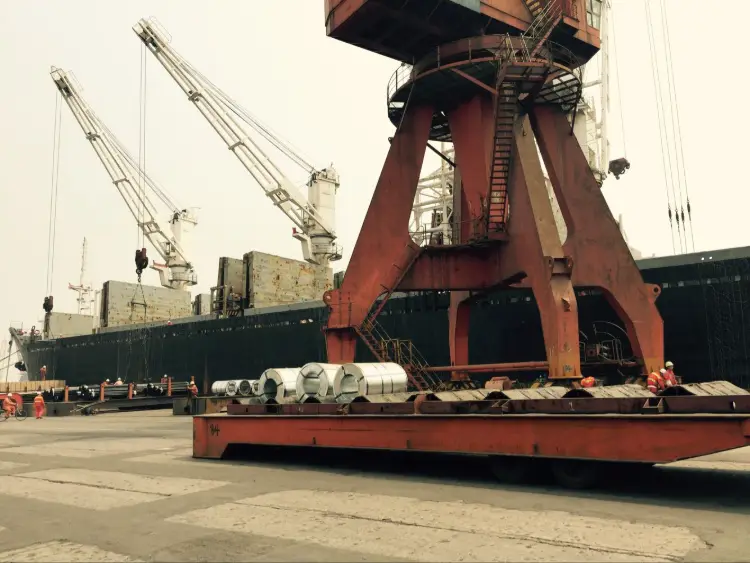
GB/T 1591 Q460C High-Strength Low-Alloy Steel Coil
GB/T 1591 Q460C High-Strength Low-Alloy Steel Coil - Complete Material Data & Equivalents
Comprehensive material data for Q460C steel coil per GB/T 1591 standard, including chemical composition, mechanical properties, thermal & electrical physical properties, equivalent grades, and application guide.
Hot rolling, normalizing, thermomechanical rolling (TMCP), welding, cold forming, machining
- Phone : +8618037372205
- Email : [email protected]
- WhatsApp: Contact via Whtsapp
- WeChat: +8618037372205
GB/T 1591 Q460C High-Strength Low-Alloy Steel Coil Introduction
Q460C is a Chinese standard high-strength low-alloy structural steel defined in GB/T 1591-2018. It belongs to the Q460 strength class, with a minimum yield strength of 460 MPa for thin sections. The grade designation 'C' indicates impact toughness guaranteed at 0°C. This steel offers an excellent combination of high strength, good weldability, and satisfactory low-temperature toughness, making it suitable for heavy-load structures and dynamic applications.
Key features:
- High yield/tensile strength ratio, enabling weight savings in welded constructions.
- Controlled carbon content (≤0.20%) and microalloy additions (Nb, V, Ti) for fine grain strengthening and precipitation hardening.
- Good formability and cold bending ability, with bend radius requirements specified for different thicknesses.
- Reliable impact energy (≥34 J at 0°C, longitudinal) ensures safety in cold climates.
Q460C is typically supplied in as-rolled, normalized, or thermomechanically rolled condition, depending on thickness and producer, and is available in coils, plates, and sections.
GB/T 1591 Q460C High-Strength Low-Alloy Steel Coil Chemical Composition
The chemical composition of Q460C is defined in GB/T 1591-2018. The standard specifies maximum limits for most elements to ensure consistent mechanical properties and weldability. Microalloying elements such as Nb, V, and Ti are used for grain refinement and precipitation strengthening. The minimum aluminum content (0.015%) ensures fine grain size through aluminum nitride formation. Actual composition is typically adjusted by the manufacturer to meet the required mechanical properties.
| Chemical Element | Standard Value (max, unless stated) | Remarks |
|---|---|---|
| Carbon (C) | ≤0.20 | Key strength element |
| Silicon (Si) | ≤0.60 | Deoxidizer |
| Manganese (Mn) | ≤1.80 | Strength and toughness |
| Phosphorus (P) | ≤0.030 | Maximum for quality 'C' |
| Sulfur (S) | ≤0.030 | Maximum for quality 'C' |
| Niobium (Nb) | ≤0.11 | Grain refiner & precipitation strengthener |
| Vanadium (V) | ≤0.20 | Precipitation strengthening |
| Titanium (Ti) | ≤0.20 | Grain refinement & sulfide shape control |
| Chromium (Cr) | ≤0.30 | Hardenability, optional |
| Nickel (Ni) | ≤0.30 | Toughness, optional |
| Copper (Cu) | ≤0.40 | Corrosion resistance, optional |
| Aluminum (Al) | ≥0.015 | Minimum for grain size control |
| Molybdenum (Mo) | ≤0.10 | Optional |
| Nitrogen (N) | ≤0.015 | For microalloy balance |
| Boron (B) | ≤0.0005 | If added, not typical |
GB/T 1591 Q460C High-Strength Low-Alloy Steel Coil Thermal & Electrical Physical Properties
The following physical properties are typical for Q460C/HSLA steel and are not explicitly specified in GB/T 1591-2018. They may vary slightly depending on exact composition and processing condition. These values are suitable for engineering calculations such as thermal expansion, heat transfer, and structural analysis. Electrical resistivity is representative of low-alloy steels.
| Property Item | Typical Value | Unit | Test Condition |
|---|---|---|---|
| Density (ρ) | 7.85 | g/cm³ | At room temperature |
| Elastic modulus (E) | 200–210 | GPa | At room temperature |
| Shear modulus (G) | ~80 | GPa | Calculated from E and Poisson |
| Poisson's ratio (ν) | 0.3 | — | Within elastic range |
| Thermal expansion coefficient (α) | 12.0 ×10⁻⁶ | /K | 20–100°C |
| Thermal expansion coefficient (α) | 12.5 ×10⁻⁶ | /K | 20–200°C |
| Thermal conductivity (λ) | ~50 | W/(m·K) | At 20°C |
| Specific heat capacity (cp) | ~460 | J/(kg·K) | At 20°C |
| Electrical resistivity (ρe) | 0.15–0.25 | µΩ·m | At 20°C |
GB/T 1591 Q460C High-Strength Low-Alloy Steel Coil Mechanical Properties
The mechanical properties of Q460C depend on the product thickness. The values below are minimum requirements for tensile and impact tests unless specified as a range. Impact test is performed on Charpy V-notch specimens at 0°C, longitudinal direction. Bend test is conducted at 180° with a specified former diameter. Thicker sections may show slightly reduced strength due to slower cooling.
| Property Item | Standard Requirement Value | Unit | Test Condition |
|---|---|---|---|
| Yield Strength (ReH) | ≥460 | MPa | Thickness ≤16 mm |
| Yield Strength (ReH) | ≥450 | MPa | Thickness >16–40 mm |
| Yield Strength (ReH) | ≥430 | MPa | Thickness >40–63 mm |
| Yield Strength (ReH) | ≥410 | MPa | Thickness >63–80 mm |
| Yield Strength (ReH) | ≥395 | MPa | Thickness >80–100 mm |
| Tensile Strength (Rm) | 550–720 | MPa | Thickness ≤16 mm |
| Tensile Strength (Rm) | 550–720 | MPa | Thickness >16–40 mm |
| Tensile Strength (Rm) | 550–720 | MPa | Thickness >40–63 mm |
| Tensile Strength (Rm) | 550–720 | MPa | Thickness >63–80 mm |
| Tensile Strength (Rm) | 540–710 | MPa | Thickness >80–100 mm |
| Elongation after fracture (A) | ≥17 | % | Thickness ≤16 mm, gauge length 5.65√S₀ |
| Elongation after fracture (A) | ≥17 | % | Thickness >16–40 mm |
| Elongation after fracture (A) | ≥17 | % | Thickness >40–63 mm |
| Elongation after fracture (A) | ≥16 | % | Thickness >63–80 mm |
| Elongation after fracture (A) | ≥16 | % | Thickness >80–100 mm |
| Bend Test (180°) | d = 3a (thickness) | — | Thickness ≤16 mm |
| Bend Test (180°) | d = 4a | — | Thickness >16–40 mm |
| Bend Test (180°) | d = 5a | — | Thickness >40–63 mm |
| Bend Test (180°) | d = 6a | — | Thickness >63–80 mm |
| Bend Test (180°) | d = 7a | — | Thickness >80–100 mm |
| Charpy Impact Energy (KV₂) | ≥34 (longitudinal) | J | Tested at 0°C |
| Charpy Impact Energy (KV₂) | ≥27 (transverse) | J | Tested at 0°C, optional |
GB/T 1591 Q460C High-Strength Low-Alloy Steel Coil Complete Equivalent Material Standards & Replaceable Grades
| Country/Region | Standard | Grade | Remarks |
|---|---|---|---|
| China | GB/T 1591-2018 | Q460C | Reference material |
| European Union | EN 10025-3 | S460N | Normalized condition, similar strength & low-temp. toughness (optional 0°C impact) |
| European Union | EN 10025-4 | S460M | TMCP condition, optional 0°C impact, close match |
| European Union | EN 10025-4 | S460ML | TMCP, guaranteed impact at -50°C, overqualified |
| Japan | JIS G3106 | SM570 | Comparable tensile strength (min 570 MPa), impact test optional |
| USA | ASTM A572/A572M | Grade 65 [Type 7] | Yield 450 MPa, tensile 550 MPa; Q460C slightly higher strength |
| International | ISO 4950-2 | E460 | High yield strength flat products, similar requirements |
| Russia | GOST 19281 | 17G1S-U | Approximate, yield ~440-460 MPa; verify composition |
GB/T 1591 Q460C High-Strength Low-Alloy Steel Coil Application Introduction
Q460C steel coil is primarily used in heavy-duty welded structures where high strength and reasonable toughness at 0°C are required. It is commonly supplied as hot-rolled coil or cut-to-length plates and can be further processed by cold forming, welding, and machining. The material is well-suited for static and dynamic loading conditions.
Typical applications include:
Product Applications: Welded H-beams and box columns, Bridge girders and trusses, Pressure vessel shells and heads, Offshore platform legs and decks, Dump truck bodies, excavator arms, Wind turbine towers (transition pieces), Pipe piles and tubular structures
Processed into products: Main load-bearing beams and columns in high-rise buildings, Flanges and webs of heavy plate girders, Crane jib sections and booms, Heavy-duty chassis frames for trucks and trailers, Support rings and flanges in penstocks, Excavator bucket shells and cutting edges, Ship hull stiffeners and deck plates (secondary structures)
Application industries: Bridge construction, Offshore and marine engineering, Pressure vessel and storage tank manufacturing, Heavy machinery and vehicle manufacturing, Power plant and structural engineering, Mining equipment, Crane and lifting equipment
GB/T 1591 Q460C High-Strength Low-Alloy Steel Coil Similar / Near-Equivalent Materials
| Country/Region | Standard | Grade | Remarks |
|---|---|---|---|
| China | GB/T 1591 | Q420C | Lower strength, similar toughness |
| China | GB/T 1591 | Q500D | Higher strength, impact at -20°C |
| USA | ASTM A656/A656M | Grade 80 | HSLA with improved formability, yield ~550 MPa |
| USA | ASTM A709/A709M | Grade 65 (Type 7) | Bridge steel, yield 450 MPa, notch tough |
| Europe | EN 10025-6 | S550Q | Quenched and tempered, higher strength, different delivery condition |
| Japan | JIS G3128 | SHY685 | High tensile strength steel for welded structures, yield ≥685 MPa |
Notes:
- Welding: Preheating (50–100°C) may be required for sections thicker than 30 mm to avoid cold cracking; low-hydrogen consumables are recommended.
- Availability: Q460C is typically produced as coils of thickness 1.6–25 mm and as heavy plates up to 100 mm. Minimum order quantities may apply.
- Certification: Must be accompanied by a mill test certificate per EN 10204 Type 3.1, detailing ladle analysis, mechanical properties, and impact test results.
- Corrosion: This steel has no inherent atmospheric corrosion resistance; protective coatings or weathering steel (e.g., S355J2W) should be considered for exposed structures.
- Share



