
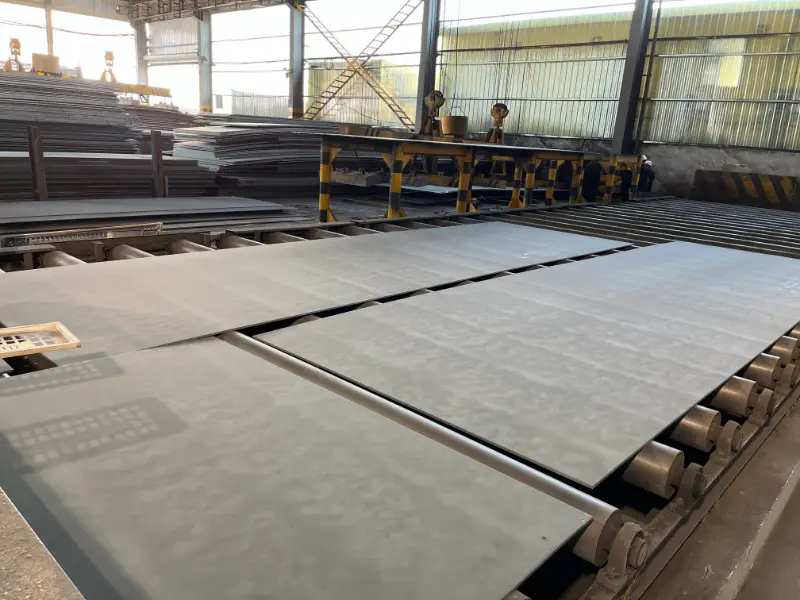
Q420B Low Alloy High Strength Structural Steel
Q420B Low Alloy High Strength Structural Steel - GB/T 1591 Standard
Detailed material data for Q420B carbon and low-alloy high-strength steel coil/plate according to Chinese standard GB/T 1591, including chemical composition, mechanical properties, thermal and electrical properties, equivalent international grades, and application guidance.
Hot rolling, thermomechanical controlled rolling (TMCP), normalizing
- Phone : +8618037372205
- Email : [email protected]
- WhatsApp: Contact via Whtsapp
- WeChat: +8618037372205
Q420B Low Alloy High Strength Structural Steel Introduction
Q420B is a high-strength low-alloy (HSLA) structural steel delivered in hot-rolled or normalized condition under the Chinese standard GB/T 1591. The 'Q' denotes yield strength, and '420' indicates a minimum yield strength of 420 MPa for thicknesses up to 16 mm. Grade B ensures impact toughness at +20°C. This steel combines excellent strength, good weldability, and moderate cold-bending formability. It is widely used in weight-critical welded structures such as bridges, construction machinery, pressure vessels, and heavy transport vehicles. Typical plate/coil thickness ranges from a few millimeters up to 150 mm, with mechanical properties varying by thickness.
Q420B Low Alloy High Strength Structural Steel Chemical Composition
Heat analysis according to GB/T 1591-2018. Maximum limits unless a range is specified. Niobium, vanadium and titanium may be added individually or in combination, with the sum of Nb+V+Ti ≤ 0.22%. For improved weldability, carbon equivalent CEV is usually ≤0.45% (typical).
| Element | Standard Value (max, %) | Remarks |
|---|---|---|
| Carbon (C) | ≤0.20 | |
| Silicon (Si) | ≤0.50 | |
| Manganese (Mn) | ≤1.70 | Higher Mn can be supplied upon agreement |
| Phosphorus (P) | ≤0.030 | |
| Sulfur (S) | ≤0.030 | |
| Niobium (Nb) | ≤0.07 | |
| Vanadium (V) | ≤0.20 | |
| Titanium (Ti) | ≤0.20 | |
| Chromium (Cr) | ≤0.30 | |
| Nickel (Ni) | ≤0.80 | |
| Copper (Cu) | ≤0.55 | |
| Molybdenum (Mo) | ≤0.30 | |
| Nitrogen (N) | ≤0.015 | |
| Aluminum (Al) | ≥0.015 | Total aluminum, acid-soluble |
Q420B Low Alloy High Strength Structural Steel Thermal and Electrical Physical Properties
These values are typical for low-alloy high-strength structural steels and can be used for design calculations. Actual values may vary slightly depending on specific composition and heat treatment.
| Property | Typical Value | Unit | Test Condition / Comment |
|---|---|---|---|
| Density (ρ) | 7.85 | g/cm³ | Ambient temperature |
| Elastic modulus (E) | 210 | GPa | Room temperature |
| Shear modulus (G) | 80–82 | GPa | Room temperature (typical 81) |
| Poisson's ratio (ν) | 0.3 | – | Elastic region |
| Thermal expansion coefficient (α) | 12.0 × 10⁻⁶ | K⁻¹ | 20–100°C |
| Thermal expansion coefficient (α) | 12.8 × 10⁻⁶ | K⁻¹ | 20–200°C |
| Thermal conductivity (λ) | 50–55 | W/(m·K) | At 20°C |
| Specific heat capacity (cₚ) | 460–480 | J/(kg·K) | At 20°C |
| Electrical resistivity (ρₑ) | 0.20–0.25 × 10⁻⁶ | Ω·m | At 20°C |
Q420B Low Alloy High Strength Structural Steel Mechanical Properties
Minimum requirements for tensile and impact properties per GB/T 1591-2018. Values refer to longitudinal test pieces unless otherwise stated. Impact energy is the average of three Charpy‑V specimens (single minimum 70% of specified average). Bend test is performed on a 180° mandrel with diameter (d) multiples of specimen thickness (a).
| Property | Standard Requirement | Unit | Test Condition |
|---|---|---|---|
| Upper yield strength (ReH) | ≥420 | MPa | Thickness ≤16 mm |
| Upper yield strength (ReH) | ≥400 | MPa | Thickness >16–40 mm |
| Upper yield strength (ReH) | ≥380 | MPa | Thickness >40–63 mm |
| Upper yield strength (ReH) | ≥360 | MPa | Thickness >63–80 mm |
| Upper yield strength (ReH) | ≥340 | MPa | Thickness >80–100 mm |
| Upper yield strength (ReH) | ≥330 | MPa | Thickness >100–150 mm |
| Tensile strength (Rm) | 520–680 | MPa | All thicknesses |
| Elongation after fracture (A) | ≥18 | % | L₀ = 5.65√S₀, thickness ≤40 mm |
| Elongation after fracture (A) | ≥18 | % | L₀ = 5.65√S₀, thickness >40–63 mm |
| Elongation after fracture (A) | ≥18 | % | L₀ = 5.65√S₀, thickness >63–100 mm |
| Elongation after fracture (A) | ≥18 | % | L₀ = 5.65√S₀, thickness >100–150 mm |
| Charpy-V impact energy (KV₂) | ≥31 (long.) / ≥27 (transv.) | J | +20°C, B grade |
| 180° bend test (d = mandrel dia., a = thickness) | No cracks | – | d = 3a, a ≤16 mm |
| 180° bend test | No cracks | – | d = 4a, a >16–40 mm |
| 180° bend test | No cracks | – | d = 5a, a >40–63 mm |
| 180° bend test | No cracks | – | d = 6a, a >63–80 mm |
Q420B Low Alloy High Strength Structural Steel Equivalent Standards and Replaceable Grade Recommendations
| Country/Region | Standard | Grade | Remarks |
|---|---|---|---|
| China | GB/T 1591-2018 | Q420B | Base standard; B = +20°C impact |
| Europe | EN 10025-4 | S420M (S420ML) | Thermomechanically rolled; ML gives longitudinal option, impact similar |
| International | ISO 4951-2 | E420 B (or C) | Yield 420 MPa min for t ≤16 mm; comparable impact classes |
| USA | ASTM A572/A572M | Grade 60 [415] | Yield 415 MPa min, close but slightly lower; often accepted |
| Japan | JIS G3106 | SM570 | Yield 420 MPa for t ≤16 mm, tensile 570–720 MPa; prefer consult |
| Germany (former) | DIN 17102 | StE420 | Historical; replaced by EN 10025-4 |
| Russia | GOST 19281 | 09G2S (10HSND) a/o 14G2 | Similar strength level but compositional differences |
Q420B Low Alloy High Strength Structural Steel Application Introduction
Q420B is designed for welded, bolted or riveted structures where weight saving and high strength are essential. With yield strengths up to 420 MPa it permits lighter sections compared to ordinary carbon steels. The B grade guarantees reliable toughness at +20°C, making it suitable for ambient temperature applications. It can be processed by thermal cutting, cold forming, welding and machining. Preheating and post-weld heat treatment should be evaluated based on carbon equivalent and section thickness.
Product Applications: Steel plates and coils for welded structural beams and columns, Hot-rolled strips for cold-formed hollow sections, Cut-to-length sheets for gusset plates and stiffeners, Wide flats for crane girders
Processed into products: Bridge main girders and cross-beams, Boom sections for mobile cranes, Excavator arms and chassis frames, Offshore structural nodes and pipe racks, Heavy vehicle longitudinal beams and subframes, Pressure vessel shell plates (mono-wall), Pylon & mast structures
Application industries: Building & Construction (high-rise frames, bridges, stadium roofs), Heavy Engineering (cranes, earthmoving machinery, mining equipment), Transportation (railway wagons, truck chassis, containers), Shipbuilding (deck structures and secondary members), Energy (offshore platform topsides, pressure vessel shells under moderate conditions), Infrastructure (transmission towers, lighting poles)
Q420B Low Alloy High Strength Structural Steel Similar / Alternative Material Recommendations
| Country/Region | Standard | Grade | Remarks |
|---|---|---|---|
| China | GB/T 1591 | Q390B | Lower min yield (390 MPa), otherwise very similar; may be substituted if design allows |
| China | GB/T 1591 | Q460C | Higher strength (460 MPa), impact 0°C; upgrade option |
| Europe | EN 10025-4 | S420N/NL | Normalized condition, equivalent impact classes N at -20°C |
| USA | ASTM A572 | Grade 65 | Yield 450 MPa, stronger than Q420B; direct substitution requires strength check |
| Japan | JIS G3106 | SM520 | Yield 365 MPa, lower strength; may be used with increased thickness |
| International | ISO 4951-2 | E355 | Lower yield, similar welding characteristics, widely available |
Notes:
The above properties refer to the minimum requirements of GB/T 1591-2018 for Q420B. For thicknesses beyond 150 mm, mechanical properties must be agreed upon between the purchaser and manufacturer. Carbon equivalent CEV = C + Mn/6 + (Cr+Mo+V)/5 + (Ni+Cu)/15 should be controlled for good weldability, typically ≤0.45%. Surface condition and dimensional tolerances are usually according to EN 10029 or equivalent. Impact test specimens are Charpy‑V with a 2 mm striker, with the notch perpendicular to the surface.
- Share



