
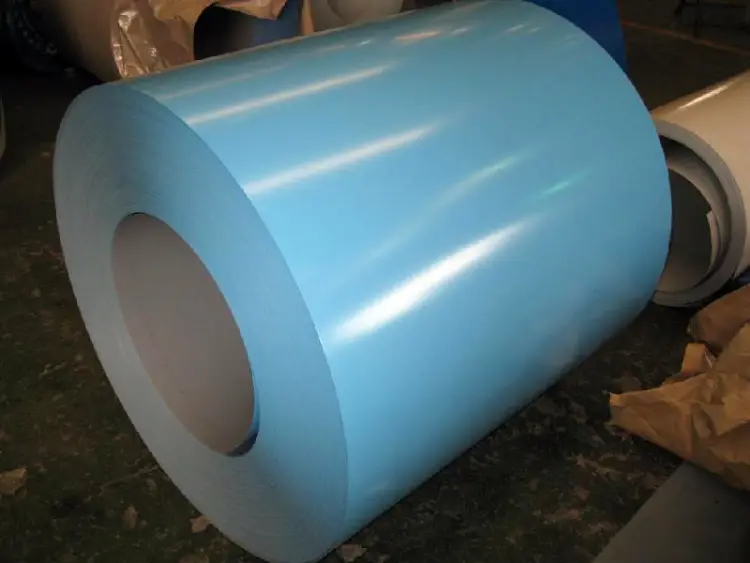
GB/T1591 Q420C Carbon & Low-Alloy High-Strength Steel Coil
GB/T1591 Q420C Carbon & Low-Alloy High-Strength Steel Coil - Properties & Equivalents
Comprehensive datasheet for Q420C low-alloy high-strength structural steel under GB/T1591, including chemical composition, mechanical properties, thermal and electrical data, international equivalents, and application guidance.
Hot rolling, normalizing, welding, cold forming, machining
- Phone : +8618037372205
- Email : [email protected]
- WhatsApp: Contact via Whtsapp
- WeChat: +8618037372205
GB/T1591 Q420C Carbon & Low-Alloy High-Strength Steel Coil Introduction
Q420C is a low-alloy high-strength structural steel grade specified in GB/T 1591-2018. It offers a minimum yield strength of 420 MPa and excellent low-temperature toughness down to 0 °C, making it suitable for welded structures in bridges, buildings, and heavy machinery.
- Key Features: High strength, good weldability, superior impact toughness at 0 °C, atmospheric corrosion resistance.
- Delivery Conditions: As-rolled, normalized or other conditions as agreed.
- International Equivalents: Closely matches EN S420J0, ISO S420N.
GB/T1591 Q420C Carbon & Low-Alloy High-Strength Steel Coil Chemical Composition
Based on ladle analysis according to GB/T 1591-2018. The steel is microalloyed with niobium, vanadium, titanium, and aluminum for grain refinement and precipitation strengthening.
- Fine grain practice is required (Al≥0.015 % total).
- Ceq and Pcm may be agreed for welding.
| Element | Standard Value (%) | Remarks |
|---|---|---|
| C | ≤ 0.20 | For thickness ≤ 100 mm |
| Si | ≤ 0.50 | |
| Mn | ≤ 1.60 | |
| P | ≤ 0.030 | |
| S | ≤ 0.030 | |
| Cr | ≤ 0.30 | Residual |
| Ni | ≤ 0.30 | Residual |
| Cu | ≤ 0.30 | Residual |
| Mo | ≤ 0.10 | Residual |
| Nb | ≤ 0.07 | Or as agreed |
| V | ≤ 0.20 | Or as agreed |
| Ti | ≤ 0.20 | Or as agreed |
| Nb+V+Ti | ≤ 0.22 | Sum for grain refinement |
| Al (total) | ≥ 0.015 | Grain refining |
| N | ≤ 0.015 | If not bound by Al or V |
| Ceq | ≤ 0.47–0.53* | *Calculated; exact value per agreement |
GB/T1591 Q420C Carbon & Low-Alloy High-Strength Steel Coil Thermal and Electrical Physical Properties
Typical physical properties for ferritic-pearlitic structural steels. Actual values may vary slightly with heat treatment and composition.
- Recommended maximum service temperature for structural applications is below 300 °C.
- These values are derived from standard references for similar C-Mn steels.
| Property | Typical Value | Unit | Test Condition |
|---|---|---|---|
| Density (ρ) | 7.85 | g/cm³ | Room temperature |
| Elastic modulus (E) | 210 | GPa | Room temperature |
| Shear modulus (G) | 81 | GPa | Room temperature |
| Poisson's ratio (ν) | 0.3 | - | Room temperature |
| Thermal expansion (α) | 10.5–12.2 | 10⁻⁶/K | 20–300 °C range |
| Thermal conductivity (λ) | 50–60 | W/(m·K) | Room temperature |
| Specific heat capacity (cp) | 460–480 | J/(kg·K) | Room temperature |
| Electrical resistivity (ρe) | 0.15–0.25 | µΩ·m | Room temperature |
GB/T1591 Q420C Carbon & Low-Alloy High-Strength Steel Coil Mechanical Properties
Longitudinal tensile and Charpy V-notch impact properties according to GB/T 1591-2018. Impact test temperature is 0 °C for quality C.
- Bend test: 180° over mandrel diameter (d) as specified.
- For transverse specimens, values are 70% of the longitudinal impact energy.
| Property | Typical Value | Unit | Test Condition |
|---|---|---|---|
| Yield strength (ReH) | ≥ 420 | MPa | Thickness ≤ 16 mm |
| Yield strength (ReH) | ≥ 400 | MPa | Thickness 16–40 mm |
| Yield strength (ReH) | ≥ 380 | MPa | Thickness 40–63 mm |
| Yield strength (ReH) | ≥ 370 | MPa | Thickness 63–80 mm |
| Yield strength (ReH) | ≥ 360 | MPa | Thickness 80–100 mm |
| Tensile strength (Rm) | 520–680 | MPa | All thicknesses (≤ 100 mm) |
| Elongation (A) | ≥ 18 | % | Thickness ≤ 100 mm, L0=5.65√S0 |
| Elongation (A) | ≥ 17 | % | Thickness 100–150 mm, L0=5.65√S0 |
| Charpy impact (KV2) | ≥ 47 (mean) | J | 0 °C, longitudinal, V-notch, 3 samples |
| Charpy impact (KV2) | ≥ 33 (single min.) | J | 0 °C, longitudinal, V-notch |
| Bend test (d = 2a) | No cracks | - | 180°, thickness ≤ 16 mm, longitudinal |
| Bend test (d = 3a) | No cracks | - | 180°, thickness > 16–100 mm, longitudinal |
GB/T1591 Q420C Carbon & Low-Alloy High-Strength Steel Coil Fully Equivalent Material Standards and Potential Substitutes
| Country/Region | Standard | Grade | Remarks |
|---|---|---|---|
| China | GB/T 1591-2018 | Q420C | Base grade, 0°C impact |
| Europe | EN 10025-2 | S420J0 | Yield 420 MPa, impact 0°C, very close substitute |
| International | ISO 630-2 | S420N | Normalized or normalizing rolled, impact 0°C equivalent; S420M thermomechanical also applicable |
GB/T1591 Q420C Carbon & Low-Alloy High-Strength Steel Coil Application Introduction
Q420C is widely used in welded, bolted and riveted structures where high strength and good low-temperature toughness are required. It is suitable for various processing methods including hot forming, cold bending, and machining.
- Construction & Infrastructure: Bridges, high-rise building frames, stadiums, transmission towers.
- Heavy Machinery: Crane booms, excavator arms, truck chassis, trailers.
- Energy & Offshore: Wind turbine towers, offshore platforms, pressure vessel supports.
- Shipbuilding: Structural components in vessels (non-marine grades require supplementary certification).
Product Applications: Steel plates and coils for bridge girders, Structural steel sections (H-beams, I-beams, channels), Welded pipes and hollow sections, Heavy-duty vehicle frame rails, Wind turbine tower sections, Crane and lifting equipment components
Processed into products: Welded I-girders and box girders, Columns and truss members, Flanges and webs of heavy beams, Boom segments for mobile cranes, Support brackets and base plates, Excavator arms and buckets
Application industries: Civil Engineering & Construction, Heavy Machinery Manufacturing, Energy & Offshore Engineering, Transportation & Shipbuilding, Mining & Material Handling
GB/T1591 Q420C Carbon & Low-Alloy High-Strength Steel Coil Similar / Alternative Material Recommendations
| Country/Region | Standard | Grade | Remarks |
|---|---|---|---|
| USA | ASTM A572/A572M | Grade 60 | Min yield 415 MPa; impact not specified in standard but can be agreed |
| Japan | JIS G 3106 | SM490A/B/C | Min yield 325–365 MPa; SM490C has 0°C impact, lower strength than Q420C |
| India | IS 2062 | E450BR/CR | Min yield 450 MPa; various quality grades available |
| Russia | GOST 19281 | 09G2S (C440 equivalent) | Yield ~345–440 MPa depending on thickness |
Notes:
The properties provided are based on the latest GB/T 1591-2018 standard. For thicknesses beyond 150 mm, properties should be agreed upon. Welding procedures must consider carbon equivalent (Ceq) and preheating to avoid cold cracking. This grade can be ordered with additional requirements such as improved Z-direction ductility (Z15, Z25) per GB/T 5313.
- Share



