
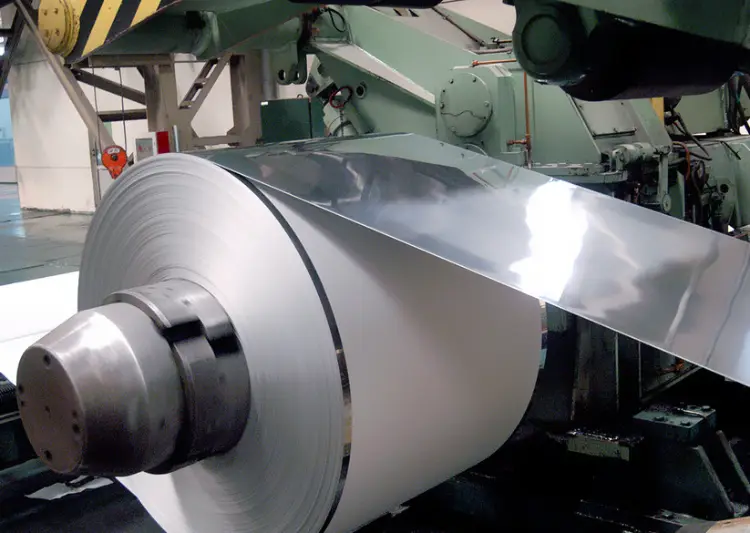
Q420A High-Strength Low-Alloy Steel Coil
Q420A Carbon and Low-Alloy High-Strength Steel Coil | GB/T 1591 Grade
Q420A is a Chinese standard low-alloy high-strength structural steel with minimum yield strength 420 MPa. Supplied as hot-rolled coil, it offers good weldability, formability, and moderate atmospheric corrosion resistance for general structural applications.
Cutting, cold forming, bending, welding, machining, hot-dip galvanizing
- Phone : +8618037372205
- Email : [email protected]
- WhatsApp: Contact via Whtsapp
- WeChat: +8618037372205
Q420A High-Strength Low-Alloy Steel Coil Introduction
Q420A is a low-alloy high-strength structural steel grade defined in GB/T 1591. It belongs to the Q420 series with a minimum yield strength of 420 MPa for thicknesses up to 16 mm. The 'A' designation indicates that no impact energy requirement is specified at room temperature or lower.
Key characteristics:
- Excellent strength-to-weight ratio for structural weight reduction.
- Good weldability with conventional methods (preheating may be needed for thick sections).
- Moderate atmospheric corrosion resistance.
- Available in various delivery conditions: as-rolled, normalized, or thermo-mechanically rolled.
The steel is widely used in bridges, buildings, vehicles, and machinery where high strength and general ductility are needed.
Q420A High-Strength Low-Alloy Steel Coil Chemical Composition
Chemical composition limits according to GB/T 1591-2018 for Q420A. The addition of microalloying elements such as Nb, V, Ti is permitted to refine grain structure and improve strength. The carbon equivalent (CEV) is typically controlled to ensure weldability.
| Element | Standard Value (max, %) | Remarks |
|---|---|---|
| Carbon (C) | ≤ 0.20 | Heat analysis |
| Silicon (Si) | ≤ 0.55 | |
| Manganese (Mn) | ≤ 1.70 | |
| Phosphorus (P) | ≤ 0.035 | |
| Sulfur (S) | ≤ 0.035 | |
| Niobium (Nb) | ≤ 0.07 | Microalloying element |
| Vanadium (V) | ≤ 0.20 | Microalloying element |
| Titanium (Ti) | ≤ 0.20 | Microalloying element |
| Chromium (Cr) | ≤ 0.30 | Residual element |
| Nickel (Ni) | ≤ 0.80 | Residual element |
| Copper (Cu) | ≤ 0.40 | Residual element |
| Molybdenum (Mo) | ≤ 0.20 | Residual element |
| Nitrogen (N) | ≤ 0.015 | Residual element |
| Aluminum (Als) | ≥ 0.015 | Acid-soluble aluminum for grain refinement |
Q420A High-Strength Low-Alloy Steel Coil Thermal and Electrical Physical Properties
Physical properties for low-alloy structural steel similar to Q420A. These values are typical for engineering design and are not part of the product standard. Actual values may vary slightly with composition and processing.
| Property | Typical Value | Unit | Test Condition / Remarks |
|---|---|---|---|
| Density (ρ) | 7.85 | g/cm³ | At 20 °C |
| Modulus of Elasticity (E) | 206 | GPa | At room temperature |
| Shear Modulus (G) | 79.4 | GPa | At room temperature |
| Poisson's Ratio (ν) | 0.3 | – | Elastic range |
| Thermal Expansion Coefficient (α) | 12.0 × 10⁻⁶ | 1/K | Temperature range 20 – 100 °C |
| Thermal Expansion Coefficient (α) | 12.8 × 10⁻⁶ | 1/K | 20 – 200 °C |
| Thermal Expansion Coefficient (α) | 13.5 × 10⁻⁶ | 1/K | 20 – 300 °C |
| Thermal Conductivity (λ) | 44 | W/(m·K) | At 100 °C |
| Specific Heat Capacity (c) | 0.46 | J/(g·K) | Around 20 °C |
| Electrical Resistivity (ρe) | 0.23 | Ω·mm²/m | At 20 °C, typical for low-alloy steel |
Q420A High-Strength Low-Alloy Steel Coil Mechanical Properties
Mechanical properties specified in GB/T 1591-2018 for Q420A in the as-delivered condition. Impact energy is not required for grade A. Values depend on nominal thickness (t) of the product.
| Property | Standard Requirement | Unit | Test Condition / Remarks |
|---|---|---|---|
| Yield Strength (ReH) | ≥ 420 | MPa | t ≤ 16 mm |
| Yield Strength (ReH) | ≥ 400 | MPa | 16 mm < t ≤ 40 mm |
| Yield Strength (ReH) | ≥ 380 | MPa | 40 mm < t ≤ 63 mm |
| Yield Strength (ReH) | ≥ 360 | MPa | 63 mm < t ≤ 80 mm |
| Yield Strength (ReH) | ≥ 340 | MPa | 80 mm < t ≤ 100 mm |
| Tensile Strength (Rm) | 520 – 680 | MPa | All thicknesses |
| Elongation after fracture (A) | ≥ 18 | % | t ≤ 40 mm, gauge length L₀ = 5.65√S₀ |
| Elongation after fracture (A) | ≥ 18 | % | 40 mm < t ≤ 63 mm |
| Elongation after fracture (A) | ≥ 18 | % | 63 mm < t ≤ 100 mm |
| Bend Test (bending angle 180°) | d = 2a | – | t ≤ 16 mm (a = specimen thickness) |
| Bend Test (bending angle 180°) | d = 3a | – | 16 mm < t ≤ 100 mm |
| Impact Energy (KV₂, longitudinal) | No requirement | J | Grade A does not require impact test |
Q420A High-Strength Low-Alloy Steel Coil Internationally Equivalent Standards and Substitute Grades
| Country / Region | Standard | Grade | Remarks |
|---|---|---|---|
| European Union | EN 10025-3 | S420N | Normalized condition, similar strength, impact testing required for some qualities |
| European Union | EN 10025-4 | S420M | Thermo-mechanically rolled, comparable yield and tensile strength |
| USA | ASTM A572 / A572M | Grade 60 [415] | Minimum yield 415 MPa (60 ksi); chemistry and welding differ; often used as substitute |
| International | ISO 4950-2 | E420 | High yield strength flat products, comparable strength level |
| Japan | JIS G 3106 | SM490A/B/C | Yield strength ~325-365 MPa; lower strength but often used for similar applications |
| China | GB/T 1591 | Q420B/C/D/E | Higher quality grades of same base composition with specified impact energy (e.g., Q420E -40°C impact) |
Q420A High-Strength Low-Alloy Steel Coil Application Introduction
Q420A steel coil is suitable for a wide range of structural applications where high strength and good formability are required without impact toughness guarantees. It is typically used in as-rolled or normalized condition. Key application considerations:
- Preheating is recommended for thick sections before welding to avoid cold cracking.
- Galvanizing is possible; silicon content should be controlled if hot-dip galvanizing is intended.
- For dynamic loads or low-temperature service, higher quality grades (D, E) are preferred.
Product Applications: High-rise building structural frameworks, Highway and railway bridge girders, Crane booms and lifting equipment, Storage tanks and pressure vessels (with appropriate design codes), Heavy-duty truck chassis and trailer frames, Wind turbine tower sections, Mining equipment support structures
Processed into products: Wide-flange beams (H-beams) and columns, Welded box columns, Plate girders and stiffeners, Flanges and webs for built-up sections, Brackets and base plates, Cold-formed rectangular hollow sections (RHS), Spiral-welded pipes for piling
Application industries: Civil Engineering & Construction, Bridge Building, Heavy Machinery Manufacturing, Shipbuilding and Offshore Structures (non-critical parts), Transportation and Automotive (chassis, frames), Energy (wind turbine towers, power transmission poles)
Q420A High-Strength Low-Alloy Steel Coil Similar Alternative Materials for Structural Use
| Country / Region | Standard | Grade | Remarks |
|---|---|---|---|
| China | GB/T 1591 | Q390A | Slightly lower yield (390 MPa), otherwise similar; may be used when 420 MPa not required |
| China | GB/T 1591 | Q460A | Higher yield strength (460 MPa), for weight reduction, but requires careful forming/welding |
| European Union | EN 10025-2 | S355J2 | Lower strength (355 MPa), widely available, good toughness, often used in general structures |
| USA | ASTM A572 | Grade 50 [345] | Common structural steel; lower strength but excellent availability and weldability |
| Russia | GOST 19281 | 09G2S (09Г2С) | Yield ~345 MPa; similar low-alloy concept, widely used in pipelines and structures |
Notes:
- This data is based on GB/T 1591-2018 (supersedes GB/T 1591-2008). For older projects, confirm the applicable standard edition.
- For coil products, the maximum thickness is typically ≤ 25 mm; plate products may be up to 100 mm or more.
- Equivalent grades listed are approximate; full grade substitution should be verified against the design specification and service conditions.
- If improved toughness is required, consider Q420C (0°C impact) or Q420E (-40°C impact) from the same standard.
- Weldability: CEV typically ≤ 0.45% for thicknesses ≤ 40 mm, but must be confirmed from the mill certificate.
- Share



