
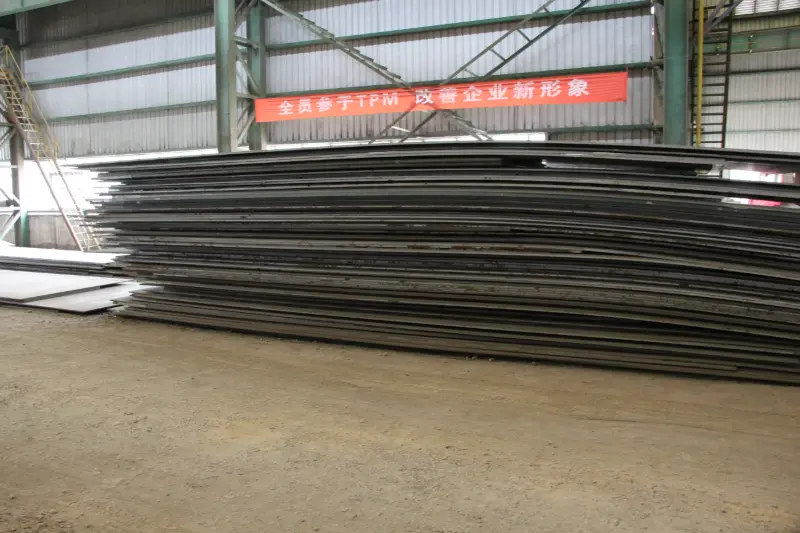
Q390E Low-Alloy High-Strength Structural Steel
Q390E Low-Alloy High-Strength Structural Steel: Complete Properties & International Equivalents
Comprehensive data for Q390E carbon and low-alloy high-strength steel according to GB/T 1591, including chemical composition, mechanical and physical properties, international equivalents, and application guidance.
Hot rolling, controlled rolling, normalizing rolling, TMCP (thermo-mechanical controlled processing)
- Phone : +8618037372205
- Email : [email protected]
- WhatsApp: Contact via Whtsapp
- WeChat: +8618037372205
Q390E Low-Alloy High-Strength Structural Steel Introduction
Q390E is a high-strength low-alloy structural steel defined in China's GB/T 1591 standard. It offers a minimum yield strength of 390 MPa and excellent low-temperature toughness (impact energy ≥34 J at -40°C), making it suitable for demanding welded structures. Its balanced chemistry of C, Mn, Si, and microalloying elements (Nb, V, Ti) ensures good weldability and formability.
Key Features:
- High strength-to-weight ratio
- Superior notch toughness down to -40°C
- Good weldability with low carbon equivalent
- Excellent resistance to brittle fracture in cold environments
Q390E Low-Alloy High-Strength Structural Steel Chemical Composition
Typical ladle analysis according to GB/T 1591. Microalloying elements (Nb, V, Ti) can be used singly or in combination to achieve the required mechanical properties. The carbon equivalent (CEV) is generally low to ensure good weldability.
| Element | Standard Value (max unless range stated) | Remarks |
|---|---|---|
| C | ≤0.20 | Carbon |
| Si | ≤0.50 | Silicon |
| Mn | ≤1.70 | Manganese |
| P | ≤0.020 | Phosphorus |
| S | ≤0.010 | Sulfur |
| Nb | ≤0.07 | Niobium |
| V | ≤0.20 | Vanadium |
| Ti | ≤0.20 | Titanium |
| Cr | ≤0.30 | Chromium |
| Ni | ≤0.30 | Nickel |
| Cu | ≤0.30 | Copper |
| Mo | ≤0.10 | Molybdenum |
| N | ≤0.015 | Nitrogen |
| Als | ≥0.015 (or Alt ≥0.020) | Total aluminium (acid soluble or total) |
Q390E Low-Alloy High-Strength Structural Steel Thermal and Electrical Physical Properties
Physical properties are typical for low-alloy structural steels at room temperature and are not covered by GB/T 1591. They are provided as design guidance only. Values may vary depending on the exact composition and heat treatment.
| Property | Typical Value | Unit | Test Condition / Remarks |
|---|---|---|---|
| Density (ρ) | 7.85 | g/cm³ | At 20°C |
| Elastic Modulus (E) | 200 – 210 | GPa | At 20°C |
| Shear Modulus (G) | ~80 | GPa | Calculated from E and ν |
| Poisson's Ratio (ν) | 0.27 – 0.30 | – | At 20°C |
| Thermal Expansion Coefficient (α) | 11 – 13 | ×10⁻⁶ /K | Between 20°C and 100°C |
| Thermal Conductivity (λ) | 45 – 55 | W/(m·K) | At 20°C |
| Specific Heat Capacity (c) | ~460 | J/(kg·K) | At 20°C |
| Electrical Resistivity (ρₑ) | 0.15 – 0.25 | µΩ·m | At 20°C |
Q390E Low-Alloy High-Strength Structural Steel Mechanical Properties
Mechanical properties as specified in GB/T 1591 for flat and long products. Tensile tests are transverse for plates/strips and longitudinal for sections/bars. Impact tests are performed on Charpy V-notch longitudinal specimens at -40°C.
Note: Values vary with product thickness. When multiple standard requirements exist, they are listed separately.
| Property | Standard Requirement | Unit | Test Condition |
|---|---|---|---|
| Yield Strength (ReH) | ≥390 | MPa | Thickness ≤ 16 mm |
| Yield Strength (ReH) | ≥380 | MPa | Thickness > 16 mm and ≤ 40 mm |
| Yield Strength (ReH) | ≥370 | MPa | Thickness > 40 mm and ≤ 63 mm |
| Yield Strength (ReH) | ≥350 | MPa | Thickness > 63 mm and ≤ 80 mm |
| Yield Strength (ReH) | ≥330 | MPa | Thickness > 80 mm and ≤ 100 mm |
| Tensile Strength (Rm) | 470 – 630 | MPa | Thickness ≤ 100 mm |
| Elongation (A) | ≥20 | % | Thickness ≤ 16 mm, gauge length 5.65√S₀ |
| Elongation (A) | ≥19 | % | Thickness > 16 mm and ≤ 40 mm |
| Elongation (A) | ≥18 | % | Thickness > 40 mm and ≤ 63 mm |
| Elongation (A) | ≥17 | % | Thickness > 63 mm and ≤ 100 mm |
| Bend Test (Bend Diameter) | d = 2a | – | Thickness ≤ 16 mm, bending angle 180° |
| Bend Test (Bend Diameter) | d = 3a | – | Thickness > 16 mm and ≤ 100 mm, bending angle 180° |
| Impact Energy (KV₂) | ≥34 (longitudinal) | J | At -40°C, Charpy V-notch |
Q390E Low-Alloy High-Strength Structural Steel Completely Equivalent Standards and Substitutable Grades
| Country/Region | Standard | Grade | Remarks |
|---|---|---|---|
| China | GB/T 1591 | Q390E | Original grade; TMCP or normalizing rolling, -40°C impact |
| Europe | EN 10025-4 | S355ML | Similar strength level (min 355 MPa), -50°C impact, TMCP delivery; design comparison required |
| Europe | EN 10025-3 | S355NL | Normalized/normalizing rolled, -50°C impact; slightly lower yield, good weldability |
| USA | ASTM A572/A572M | Grade 60 [415] | Minimum yield 415 MPa, but no specified low-temperature impact requirement; supplementary S5 may be needed |
| USA | ASTM A709/A709M | Grade 50W [345W] or HPS 50W | Weathering steel option for bridges, but lower yield; needs impact class agreement |
| Japan | JIS G 3106 | SM490A/B/C (with impact specification) | Yield 325-365 MPa, C offers 0°C impact; not directly equivalent, higher thickness adjustment possible |
| International | ISO 4950-2 | S355ML | Similar to EN, yield 355 MPa, impact at -50°C, TMCP |
Q390E Low-Alloy High-Strength Structural Steel Application Introduction
Q390E steel combines high strength with excellent low-temperature toughness, making it suitable for a wide range of heavy-load and cold-environment applications. Its good weldability and formability (with appropriate preheat and forming parameters) allow cost-effective fabrication.
Product Applications: Steel girders and box sections for bridges, Welded built-up H-beams for columns and trusses, Ship hull plates and superstructure components, Legs and rack parts for jack-up rigs, Telescopic crane booms and lattice masts, Earthquake-resistant frames, Pressure vessel shells and heads, Railway carriage frames and bolster beams, Wind tower shell courses and flanges
Processed into products: Welded box columns and lateral bracing members, Crane runway beams and lifting brackets, Penstocks and spiral casings for hydro-power, Suspension bridge cable bands and saddles, Pedestal crane pedestals and slew rings, Chassis side rails and cross members for heavy trucks, Bucket arms and booms for excavators, Transition pieces and foundation piles for offshore wind, Tunnel boring machine structural shells
Application industries: Bridge engineering, High-rise and long-span building construction, Shipbuilding and marine structures, Offshore oil & gas platforms, Pressure vessel and boiler manufacturing, Heavy machinery (cranes, excavators, bulldozers), Railway vehicles and automotive chassis, Wind turbine towers, Mining and earth-moving equipment
Q390E Low-Alloy High-Strength Structural Steel Close or Similar Substitute Materials
| Country/Region | Standard | Grade | Remarks |
|---|---|---|---|
| China | GB/T 1591 | Q345E | Lower yield strength (345 MPa), same toughness class (-40°C); widely available |
| China | GB/T 1591 | Q420E | Higher yield strength (420 MPa), similar toughness; can replace Q390E where higher strength is acceptable |
| China | GB/T 19879 | Q390GJE | High-strength building structure steel with improved seismic performance |
| Europe | EN 10025-4 | S420ML | Higher strength (420 MPa) with -50°C impact; often used as an upgrade alternative |
| Europe | EN 10025-6 | S460QL | Quenched and tempered; higher strength, good toughness, but different welding procedure |
| USA | ASTM A572/A572M | Grade 65 [450] | Higher yield (450 MPa), may be used with impact test agreement |
| Japan | JIS G 3106 | SM520B/C | Yield 355-365 MPa, higher tensile; can be considered with design adjustment |
| India | IS 2062 | E410 Grade C | Yield 410 MPa, C-class has 0°C impact; requires special agreement for -40°C |
Notes:
Welding: Preheat and interpass temperature control may be necessary based on thickness and carbon equivalent. Low-hydrogen welding processes are recommended.
Forming: Cold forming with generous bending radii is preferred; for severe forming, hot forming or stress-relief annealing may be considered.
Surface protection: The steel is not inherently weather-resistant; appropriate coating or painting systems are required for outdoor use.
Inspection: Verify the test certificate for CEV, impact, and through-thickness properties (Z-grade) if required for restrained joints.
- Share



