
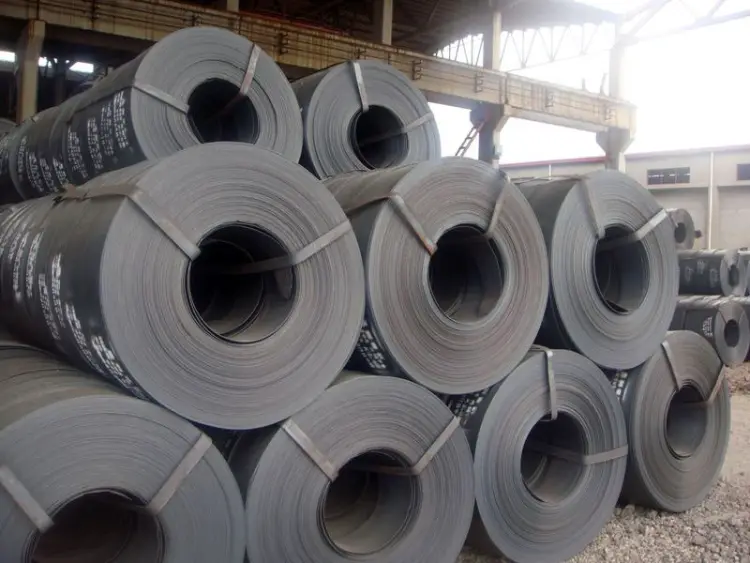
GB/T 1591 Q390D High-Strength Low-Alloy Steel Coil
Q390D High-Strength Low-Alloy Steel Coil per GB/T 1591
Q390D is a Chinese standard high-strength low-alloy structural steel with a minimum yield strength of 390 MPa, offering good weldability, formability, and low-temperature toughness (impact tested at -20°C). Commonly supplied as coil, it is widely used in heavy structures, bridges, and machinery.
Hot rolling, controlled rolling, normalizing, thermomechanical processing, welding, bending, forming, machining, thermal cutting
- Phone : +8618037372205
- Email : [email protected]
- WhatsApp: Contact via Whtsapp
- WeChat: +8618037372205
GB/T 1591 Q390D High-Strength Low-Alloy Steel Coil Introduction
Q390D is a grade defined in the Chinese standard GB/T 1591 for high-strength low-alloy structural steels. It features a minimum yield strength of 390 MPa for thicknesses up to 16 mm and is designated with quality D, indicating guaranteed Charpy V-notch impact energy of at least 47 J at -20°C.
Key attributes include:
- Excellent combination of high strength and good ductility
- Good weldability with appropriate preheating and filler metals
- Suitable for cold forming processes
- Often delivered in hot-rolled or normalized condition to meet toughness requirements
- Widely available as coils, plates, and sections
This steel is a popular choice in structural engineering, heavy machinery, and construction due to its balanced properties and cost-effectiveness.
GB/T 1591 Q390D High-Strength Low-Alloy Steel Coil Chemical Composition
The following chemical composition limits apply to Q390D steel as specified in GB/T 1591-2018 for thicknesses up to 250 mm. Values are maximum unless a range is given. Microalloying elements such as Nb, V, Ti may be used singly or in combination to achieve the required mechanical properties.
| Chemical Element | Standard Value (mass %) | Remarks |
|---|---|---|
| Carbon (C) | ≤ 0.20 | Heat analysis |
| Silicon (Si) | ≤ 0.55 | Heat analysis |
| Manganese (Mn) | 1.00 - 1.70 | Heat analysis |
| Phosphorus (P) | ≤ 0.025 | For Quality D |
| Sulfur (S) | ≤ 0.015 | For Quality D |
| Niobium (Nb) | ≤ 0.07 | Optional microalloy element |
| Vanadium (V) | ≤ 0.20 | Optional microalloy element |
| Titanium (Ti) | ≤ 0.20 | Optional microalloy element |
| Chromium (Cr) | ≤ 0.30 | Residual or optional |
| Nickel (Ni) | ≤ 0.50 | Residual or optional |
| Copper (Cu) | ≤ 0.30 | Residual or optional |
| Molybdenum (Mo) | ≤ 0.10 | Residual or optional |
| Nitrogen (N) | ≤ 0.015 | For normalized products |
| Aluminium (Altot) | ≥ 0.015 | Minimum total aluminium required for fine grain practice |
GB/T 1591 Q390D High-Strength Low-Alloy Steel Coil Thermal and Electrical Physical Properties
Physical properties are not specified in the standard but are provided as typical values for low-alloy structural steels at room temperature unless otherwise noted. These may vary with exact composition and heat treatment condition.
| Property | Standard Value | Unit | Test Condition |
|---|---|---|---|
| Density (ρ) | 7.83 | g/cm³ | 20°C |
| Modulus of Elasticity (E) | 206 | GPa | Room temperature |
| Shear Modulus (G) | 79 | GPa | Room temperature, estimated from E and Poisson ratio |
| Poisson's Ratio (ν) | 0.30 | — | Room temperature |
| Thermal Expansion Coefficient (α) | 11.5 | 10⁻⁶/K | 20–100°C |
| Thermal Expansion Coefficient (α) | 12.5 | 10⁻⁶/K | 20–200°C |
| Thermal Expansion Coefficient (α) | 13.5 | 10⁻⁶/K | 20–400°C |
| Thermal Conductivity (λ) | 47 | W/(m·K) | 20°C |
| Thermal Conductivity (λ) | 43 | W/(m·K) | 100°C |
| Specific Heat Capacity (c) | 460 | J/(kg·K) | 20°C |
| Electrical Resistivity (ρe) | 0.23 | 10⁻⁶ Ω·m | 20°C |
GB/T 1591 Q390D High-Strength Low-Alloy Steel Coil Mechanical Properties
Mechanical properties are derived from GB/T 1591-2018 and are valid for hot-rolled or normalized condition. The values vary with product thickness. Impact test is performed on Charpy V-notch specimens at -20°C. Bend test is 180° around a mandrel with specified diameter.
| Property | Required Value | Unit | Test Condition |
|---|---|---|---|
| Yield Strength (ReH) | ≥ 390 | MPa | Thickness ≤ 16 mm, transverse |
| Yield Strength (ReH) | ≥ 370 | MPa | Thickness > 16 mm ≤ 40 mm, transverse |
| Yield Strength (ReH) | ≥ 350 | MPa | Thickness > 40 mm ≤ 63 mm, transverse |
| Yield Strength (ReH) | ≥ 330 | MPa | Thickness > 63 mm ≤ 80 mm, transverse |
| Yield Strength (ReH) | ≥ 310 | MPa | Thickness > 80 mm ≤ 100 mm, transverse |
| Tensile Strength (Rm) | 490 - 650 | MPa | All thicknesses, transverse |
| Elongation (A) | ≥ 20 | % | Thickness ≤ 40 mm, gauge length 5.65√So |
| Elongation (A) | ≥ 19 | % | Thickness > 40 mm ≤ 100 mm |
| Elongation (A) | ≥ 18 | % | Thickness > 100 mm ≤ 250 mm |
| Charpy Impact Energy (KV₂) | ≥ 47 | J | Longitudinal, -20°C, V-notch |
| Bend Test (180°) | d = 2a | — | Thickness ≤ 16 mm, a = specimen thickness |
| Bend Test (180°) | d = 3a | — | Thickness > 16 mm ≤ 40 mm |
| Bend Test (180°) | d = 3.5a | — | Thickness > 40 mm ≤ 63 mm |
GB/T 1591 Q390D High-Strength Low-Alloy Steel Coil Closest Equivalent International Standards and Grades
| Country/Region | Standard | Grade | Remarks |
|---|---|---|---|
| Europe | EN 10025-3 | S420N | Yield 420 MPa, -20°C impact, fine grain normalized; slightly higher strength |
| Europe | EN 10149-2 | S390MC | Thermomechanically rolled, high yield for cold forming, -20°C variant available, suitable for coil |
| USA | ASTM A572 | Grade 60 [415 MPa] or Grade 65 [450 MPa] | Yield strength overlaps; Charpy requirements can be specified supplementary; closest match may be Grade 60 with notch toughness |
| Japan | JIS G3106 | SM490YA | Yield 365 MPa for ≤16 mm; -20°C impact option (YB) gives similar toughness but lower strength |
| International | ISO 4950-2 | E390D | Designation with 390 MPa yield and -20°C impact; partly aligned |
GB/T 1591 Q390D High-Strength Low-Alloy Steel Coil Application Introduction
Q390D steel is engineered for heavy-duty structural applications that demand high static and dynamic loads combined with reliable low-temperature toughness. Its balanced chemistry permits easy processing, and the material is a standard choice for critical construction projects.
Typical industries, products, and components are listed below.
Product Applications: Steel coils and cut-to-length sheets, Hot-rolled plates and strips, Structural sections (H-beams, I-beams, channels, angles), Welded beams and box girders, Pressure vessel shells, Tubular structures and hollow sections, Prefabricated building frames and modules
Processed into products: Bridge girders, diaphragms, and stiffeners, Offshore jacket legs and topside structure members, Crane booms, jibs, and outriggers, Excavator arms and bulldozer blades, Heavy-duty vehicle chassis and frames, Wind turbine tower shells and flanges, Ship hull plates and stiffeners, Boiler drums and pressure vessel heads, Mining dump truck bodies, Transmission line poles and lattice towers
Application industries: Civil engineering and construction, Bridge and highway engineering, Heavy machinery and equipment manufacturing, Shipbuilding and marine structures, Offshore platforms and wind energy towers, Mining and earthmoving equipment, Pressure vessel and boiler fabrication, Railway vehicle and rolling stock, Crane and lifting industries, Pipe line and structural tubing
GB/T 1591 Q390D High-Strength Low-Alloy Steel Coil Similar or Substitute Materials in Neighboring Strength Grades
| Country/Region | Standard | Grade | Remarks |
|---|---|---|---|
| China | GB/T 1591 | Q390B/Q390C/Q390E | Different impact test temperatures (B=+20°C, C=0°C, E=-40°C), otherwise same base composition and strength |
| China | GB/T 1591 | Q420D | Higher strength (420 MPa) with similar low-temperature toughness; often interchangeable with design adjustments |
| China | GB/T 1591 | Q345D (Grade S355 equivalent) | Lower strength (345 MPa), widely used; may be considered for downgrading if stresses allow |
| Europe | EN 10025-2 | S355J2+N | Normally used as closest European structural steel, but yield is 355 MPa; often used in similar applications |
Notes:
Welding: Q390D can be welded by all common processes. Preheating (50–150°C depending on thickness) and low-hydrogen electrodes are recommended to avoid cold cracking.
Forming: Suitable for cold bending with appropriate radius (≥2t for thin gauges).
Traceability: Mill test certificates (EN 10204 type 3.1 or 3.2) should be requested to confirm impact values and chemical composition.
Corrosion protection: As a low-alloy steel, surface coating (painting, galvanizing) is required for outdoor exposure.
- Share



