
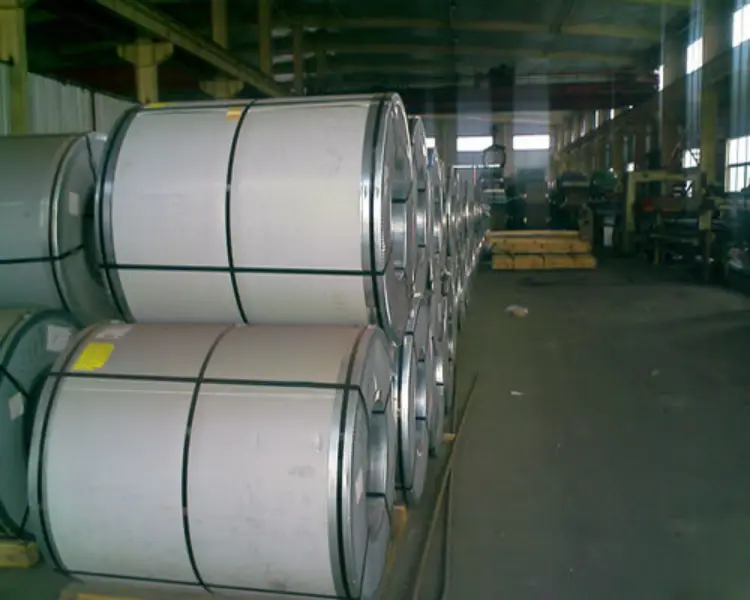
GB/T 1591 Q390C High-Strength Low-Alloy Structural Steel Coil
GB/T 1591 Q390C High-Strength Low-Alloy Structural Steel Coil - Properties & Equivalents
Comprehensive technical data for Q390C carbon and low-alloy high-strength steel coil according to GB/T 1591, including chemical composition, mechanical properties, thermal and electrical properties, international equivalents, and application guidance.
Hot rolling, controlled rolling, normalizing, TMCP, welding, bending, machining
- Phone : +8618037372205
- Email : [email protected]
- WhatsApp: Contact via Whtsapp
- WeChat: +8618037372205
GB/T 1591 Q390C High-Strength Low-Alloy Structural Steel Coil Introduction
Q390C is a low-alloy high-strength structural steel specified in GB/T 1591-2018. With a minimum yield strength of 390 MPa at room temperature, it belongs to the high-strength category for general structural purposes. The designation 'C' indicates that the material guarantees a minimum impact energy of 34 J at 0 °C, making it suitable for structures exposed to moderate low temperatures. The steel exhibits good weldability, formability, and toughness, often used in heavy welded structures, bridges, pressure vessels, and machinery. Typical supply form includes hot-rolled coils, plates, and sections in the as-rolled, normalized, or thermo-mechanically controlled processed (TMCP) condition.
GB/T 1591 Q390C High-Strength Low-Alloy Structural Steel Coil Chemical Composition
The chemical composition of Q390C according to GB/T 1591-2018 is based on ladle analysis. All values are maximum unless a range is specified. The steel may contain grain-refining elements such as Nb, V, Ti; the sum of these elements shall not exceed 0.22%. Residual elements like Cr, Ni, Cu, and Mo are limited to ensure weldability and toughness.
| Element | Standard Value (max. %) | Remarks |
|---|---|---|
| C | 0.20 | Carbon, main hardening element |
| Si | 0.50 | Silicon, deoxidizer |
| Mn | 1.70 | Manganese, strengthens and improves hardenability |
| P | 0.030 | Phosphorus, impurity |
| S | 0.025 | Sulfur, impurity |
| Nb | 0.07 | Niobium, grain refiner (if added) |
| V | 0.20 | Vanadium, grain refiner (if added) |
| Ti | 0.20 | Titanium, grain refiner (if added) |
| Cr | 0.30 | Chromium, residual element |
| Ni | 0.50 | Nickel, residual element |
| Cu | 0.30 | Copper, residual element |
| Mo | 0.10 | Molybdenum, residual element |
| N | 0.015 | Nitrogen, limited for toughness |
| Als | 0.015 (min.) | Total aluminum, for grain size control (if used) |
GB/T 1591 Q390C High-Strength Low-Alloy Structural Steel Coil Thermal and Electrical Physical Properties
The thermal and electrical properties listed below are typical for low-alloy structural steels like Q390C at room temperature unless otherwise noted. These values are not specified in GB/T 1591 but are based on general material behavior of similar carbon-manganese low-alloy steels.
| Property | Typical Value | Unit | Test Condition |
|---|---|---|---|
| Density (ρ) | 7.85 | g/cm³ | 20 °C |
| Elastic Modulus (E) | 205 | GPa | 20 °C |
| Shear Modulus (G) | 80 | GPa | 20 °C |
| Poisson's Ratio (ν) | 0.30 | – | 20 °C |
| Thermal Expansion (α) | 11.7 | 10⁻⁶/K | 20–100 °C |
| Thermal Expansion (α) | 12.5 | 10⁻⁶/K | 20–200 °C |
| Thermal Expansion (α) | 13.2 | 10⁻⁶/K | 20–300 °C |
| Thermal Conductivity (λ) | 51 | W/(m·K) | 20 °C |
| Specific Heat Capacity (c) | 460 | J/(kg·K) | 20 °C |
| Electrical Resistivity (ρₑ) | 0.19 | μΩ·m | 20 °C |
GB/T 1591 Q390C High-Strength Low-Alloy Structural Steel Coil Mechanical Properties
Mechanical properties of Q390C in the as-delivered condition as per GB/T 1591-2018. Tensile test specimens are taken transverse to the rolling direction for flat products. Impact test temperature is 0 °C on longitudinal Charpy-V specimens. Bend test mandrel diameter depends on thickness and sample orientation.
| Property | Standard Requirement | Unit | Test Condition / Thickness Range |
|---|---|---|---|
| Yield Strength (ReH) Upper | ≥390 | MPa | Thickness ≤ 16 mm |
| Yield Strength (ReH) Upper | ≥370 | MPa | Thickness 16–40 mm |
| Yield Strength (ReH) Upper | ≥350 | MPa | Thickness 40–63 mm |
| Yield Strength (ReH) Upper | ≥330 | MPa | Thickness 63–80 mm |
| Yield Strength (ReH) Upper | ≥330 | MPa | Thickness 80–100 mm |
| Yield Strength (ReH) Upper | ≥310 | MPa | Thickness 100–150 mm |
| Tensile Strength (Rm) | 470–650 | MPa | Thickness ≤ 100 mm |
| Tensile Strength (Rm) | 450–630 | MPa | Thickness 100–150 mm |
| Elongation after Fracture (A) | ≥20 | % | Thickness ≤ 16 mm, L₀=5.65√S₀ |
| Elongation after Fracture (A) | ≥19 | % | Thickness 16–40 mm |
| Elongation after Fracture (A) | ≥19 | % | Thickness 40–63 mm |
| Elongation after Fracture (A) | ≥19 | % | Thickness 63–80 mm |
| Elongation after Fracture (A) | ≥19 | % | Thickness 80–100 mm |
| Elongation after Fracture (A) | ≥18 | % | Thickness 100–150 mm |
| Impact Energy (KV₂) | ≥34 | J | Longitudinal, 0 °C |
| Bend Test (Mandrel Diameter) | d = 3a | – | Thickness ≤ 16 mm, transverse or longitudinal |
| Bend Test (Mandrel Diameter) | d = 4a | – | Thickness 16–100 mm, transverse or longitudinal |
GB/T 1591 Q390C High-Strength Low-Alloy Structural Steel Coil Full Equivalents – International Standards and Substitute Grades
| Country/Region | Standard | Grade | Remarks |
|---|---|---|---|
| Europe | EN 10025-2 | S420J0 (+N/+M) | Minimum yield 420 MPa, impact 0°C, closest match |
| International | ISO 630-2 | S420J0 | Same basis as EN 10025-2 |
| China | GB/T 1591 | Q390C | Original grade |
| USA | ASTM A572/A572M | Grade 60 [415] | Yield 415 MPa; Charpy impact 0°C must be agreed upon as supplementary requirement |
| Japan | JIS G 3106 | SM520C | Yield ~355 MPa minimum, slightly lower yield strength; requires verification for substitution |
| India | IS 2062 | E390 (Fe 540) | Similar strength level, impact properties need checking |
GB/T 1591 Q390C High-Strength Low-Alloy Structural Steel Coil Application Introduction
Q390C steel is designed for structural applications requiring high strength combined with good ductility and weldability. The guaranteed impact toughness at 0°C makes it suitable for outdoor and moderately cold environments. It can be supplied as hot-rolled coils and subsequently processed into various components.
Product Applications: Welded bridge girders and box sections, High-rise building frames and columns, Excavator booms, crane booms, and heavy equipment chassis, Pressure vessel shells and heads (subject to appraisals), Transmission towers and communication towers, Railway wagons and rolling stock components
Processed into products: Bridge main beams, crossbeams, and stiffeners, Welded H-beams, I-beams, and tubular sections, Machinery parts: booms, arms, brackets, frames, Storage tank plates and pipe fittings, Wind turbine tower sections, Structural components in heavy transport vehicles
Application industries: Construction and infrastructure (buildings, stadiums, bridges), Shipbuilding and marine engineering (moderate requirements), Pressure vessel and storage tank fabrication (when supplemented by standard requirements), Heavy machinery and equipment manufacturing, Offshore engineering (secondary structural parts)
GB/T 1591 Q390C High-Strength Low-Alloy Structural Steel Coil Similar and Comparable Materials – Alternative Recommendations
| Country/Region | Standard | Grade | Remarks |
|---|---|---|---|
| China | GB/T 1591 | Q390D | Improved low-temperature impact (≥-20°C), all other properties identical |
| China | GB/T 1591 | Q390E | Impact at -40°C, highest toughness in the Q390 series |
| China | GB/T 1591 | Q420C | Higher strength grade (420 MPa min yield), 0°C impact |
| Europe | EN 10025-2 | S355J0 (+N/+M) | Lower strength (355 MPa) but same 0°C impact; may be acceptable if strength margin allows |
| Europe | EN 10025-3 | S420N/NL | Normalized fine-grain steel, impact -20°C or -50°C, higher toughness |
| USA | ASTM A709/A709M | Grade 50W [345] | Weathering steel with lower strength, but 0°C impact available |
Notes:
The chemical composition limits are for ladle analysis; product analysis tolerances apply according to GB/T 1591. Mechanical properties are tested on samples taken from the delivered condition; for normalized or TMCP conditions, properties may differ slightly. Weldability: Carbon equivalent (CEV) is typically at or below 0.45%, ensuring good low-hydrogen weld procedures. Preheating may be required for thickness above 30–40 mm. For specific applications such as pressure vessels, additional tests and certifications might be necessary beyond this standard.
- Share



