
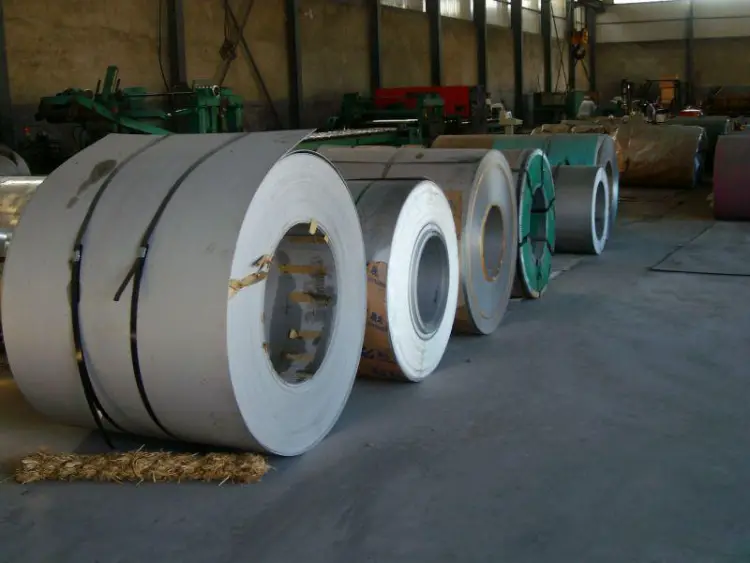
GB/T 1591 Q390B Carbon and Low-alloy High-strength Steel Coil
GB/T 1591 Q390B Carbon and Low-alloy High-strength Steel Coil - Expert Data Hub
Comprehensive material data for Q390B steel coil according to GB/T 1591, including chemical composition, mechanical properties, thermal-physical characteristics, international equivalents, and application guidance for structural engineering.
Hot rolling, controlled rolling, normalizing, cold forming, welding, cutting, bending
- Phone : +8618037372205
- Email : [email protected]
- WhatsApp: Contact via Whtsapp
- WeChat: +8618037372205
GB/T 1591 Q390B Carbon and Low-alloy High-strength Steel Coil Introduction
GB/T 1591 Q390B is a Chinese standard carbon and low-alloy high-strength structural steel delivered in coil form. It is characterized by a minimum yield strength of 390 MPa and good weldability, making it suitable for heavy-duty welded structures. The 'B' designation indicates impact toughness at 20°C with a minimum absorbed energy of 34 J. It is microalloyed with elements such as Nb, V, or Ti to achieve fine grain strengthening and controlled rolling.
- High strength-to-weight ratio
- Excellent formability and toughness
- Cost-effective alternative to higher alloyed steels
Commonly used in bridges, buildings, and machinery where weight reduction and durability are critical.
GB/T 1591 Q390B Carbon and Low-alloy High-strength Steel Coil Chemical Composition
The chemical composition limits for Q390B steel coil as specified in GB/T 1591-2018. All values are maximum unless otherwise indicated. Microalloying elements Nb, V, Ti may be added singly or in combination to achieve the required properties.
- Nb+ V + Ti combined addition ≤ 0.22%
- Aluminum is added as a grain refiner (minimum Al soluble).
| Element | Limit (wt%) | Remarks |
|---|---|---|
| C | ≤0.20 | Max |
| Si | ≤0.50 | Max |
| Mn | ≤1.70 | Max |
| P | ≤0.035 | Max |
| S | ≤0.035 | Max |
| Nb | ≤0.07 | Max |
| V | ≤0.20 | Max |
| Ti | ≤0.20 | Max |
| Cr | ≤0.30 | Max |
| Ni | ≤0.50 | Max |
| Cu | ≤0.30 | Max |
| Mo | ≤0.10 | Max |
| N | ≤0.015 | Max |
| Als | ≥0.015 | Min (acid-soluble Al) |
GB/T 1591 Q390B Carbon and Low-alloy High-strength Steel Coil Thermal and Electrical Physical Properties
The following physical properties are typical for low-carbon low-alloy structural steels and are not specified as mandatory requirements in GB/T 1591. These values may vary slightly depending on exact composition and processing history.
- Room temperature data unless noted otherwise.
- Density used for weight calculations.
| Property | Typical Value | Unit | Test Condition / Remarks |
|---|---|---|---|
| Density (ρ) | 7.85 | g/cm³ | At 20°C |
| Modulus of Elasticity (E) | 205 | GPa | At 20°C |
| Shear Modulus (G) | 80 | GPa | At 20°C, typical for steel |
| Poisson's Ratio (ν) | 0.29 | — | At 20°C |
| Thermal Expansion Coefficient (α) | 11.5 × 10⁻⁶ | /K | Between 20°C and 200°C |
| Thermal Conductivity (λ) | 45 | W/(m·K) | At 20°C |
| Specific Heat Capacity | 460 | J/(kg·K) | At 20°C |
| Electrical Resistivity (ρ_e) | 0.22 × 10⁻⁶ | Ω·m | At 20°C |
GB/T 1591 Q390B Carbon and Low-alloy High-strength Steel Coil Mechanical Properties
Mechanical properties are dependent on thickness as per GB/T 1591-2018. For thicknesses ≤ 16 mm, yield strength is ≥ 390 MPa. Impact test temperature for grade B is +20°C with minimum longitudinal Charpy V-notch absorbed energy of 34 J. Bend test uses d=2a or 3a depending on thickness.
- Transverse specimens may have lower elongation requirements.
- All values are for longitudinal direction unless stated.
| Property | Required Value | Unit | Test Condition / Thickness |
|---|---|---|---|
| Yield Strength (ReH) | ≥390 | MPa | t ≤ 16 mm |
| Yield Strength (ReH) | ≥370 | MPa | 16 < t ≤ 40 mm |
| Yield Strength (ReH) | ≥350 | MPa | 40 < t ≤ 63 mm |
| Yield Strength (ReH) | ≥330 | MPa | 63 < t ≤ 80 mm |
| Yield Strength (ReH) | ≥310 | MPa | 80 < t ≤ 100 mm |
| Yield Strength (ReH) | ≥290 | MPa | 100 < t ≤ 150 mm |
| Tensile Strength (Rm) | 490 – 650 | MPa | All thicknesses |
| Elongation (A) | ≥20 | % | t ≤ 40 mm, gauge length 5.65√So |
| Elongation (A) | ≥19 | % | 40 < t ≤ 63 mm |
| Elongation (A) | ≥18 | % | 63 < t ≤ 100 mm |
| Elongation (A) | ≥17 | % | 100 < t ≤ 150 mm |
| Impact Energy (KV2) | ≥34 | J | Longitudinal, +20°C |
| Bend Test | d=2a | — | t ≤ 16 mm, 180° bend |
| Bend Test | d=3a | — | 16 < t ≤ 100 mm, 180° bend |
GB/T 1591 Q390B Carbon and Low-alloy High-strength Steel Coil Full Equivalent Standards and Substitution Grades
| Country/Region | Standard | Grade | Remarks |
|---|---|---|---|
| International (ISO) | ISO 4951-2:1999 | E390B | High yield strength flat products; similar chemical and mechanical requirements. |
| Europe | EN 10025-3:2004 | S420N | Normalized/normalizing rolled weldable fine grain structural steels; slightly higher yield strength but comparable. |
| Japan | JIS G3106:2015 | SM490YB | Rolled steels for welded structure; 490 MPa tensile class, may require adjustment for thickness. |
| USA | ASTM A572/A572M | Grade 60 [415] | High-strength low-alloy columbium-vanadium structural steel; yield ≥ 415 MPa, approximate substitute. |
GB/T 1591 Q390B Carbon and Low-alloy High-strength Steel Coil Application Introduction
Q390B steel coil is extensively utilized in structural engineering where a combination of high strength, good toughness, and economical fabrication is essential. It can be processed by hot rolling, cold forming, and welding. Typical applications include:
- Welded bridge girders and trusses
- Multi-story building frames and columns
- Heavy machinery frames and booms
- Ship hulls and offshore platform components
- Pressure vessel shells (if approved by design codes)
The steel is delivered as coil, then cut into sheets or slit strips for subsequent manufacturing.
Product Applications: Welded H-beams and I-beams, Box columns, Truss members, Bridge decks, Crane booms, Pressure vessel shells, Piling pipes, Structural tubes
Processed into products: Bridge girder flanges and webs, High-rise building columns and beams, Offshore platform braces, Load-bearing chassis of heavy vehicles, Wind turbine tower sections, Ship longitudinal stiffeners, Mining truck frames
Application industries: Bridge construction, Building and civil engineering, Shipbuilding and marine engineering, Heavy machinery and equipment, Transportation (rail vehicles, trailers), Energy (wind towers, offshore structures)
GB/T 1591 Q390B Carbon and Low-alloy High-strength Steel Coil Similar Alternative Materials with Close Mechanical Performance
| Country/Region | Standard | Grade | Comparison Analysis |
|---|---|---|---|
| China | GB/T 1591 | Q345B | Lower yield strength (≥345 MPa), but widely available; suitable when design allows reduced strength. |
| China | GB/T 1591 | Q420B | Higher yield strength (≥420 MPa), more alloying cost, may be over-qualified for Q390 applications. |
| Europe | EN 10025-2 | S355J0 | 355 MPa yield; requires thicker sections to match load, but good weldability and toughness at 0°C. |
| USA | ASTM A572 | Grade 55 [380] | Yield 380 MPa, close to Q390; readily available in coil and plate. |
| International | ISO 630-2 | S355 | Similar to S355J0, structural steel with good toughness. |
Notes:
Welding considerations: Preheat and interpass temperatures may be required depending on thickness and heat input. Low-hydrogen welding processes are recommended to avoid cold cracking. Formability: The minimum cold bending radius should not be less than 2 times the thickness for transverse bends. For critical applications, it is recommended to verify the specific mechanical and impact properties in the final product standard and to consider through-thickness properties if Z-quality is required. Certification: Can be supplied with inspection certificate according to EN 10204 type 3.1 or 3.2 upon agreement.
- Share



