
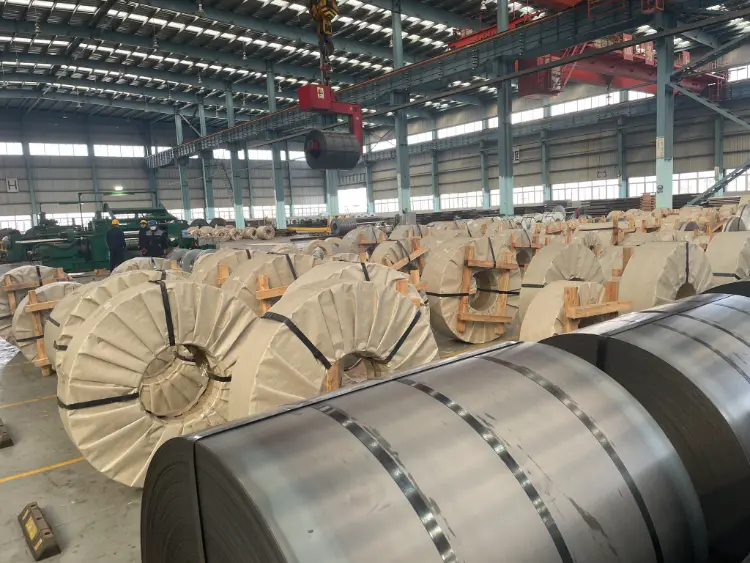
GB/T1591 Q390A Low-Alloy High-Strength Structural Steel Coil
GB/T1591 Q390A Low-Alloy High-Strength Structural Steel Coil - Key Properties & Equivalent Grades
Explore the chemical composition, mechanical properties, thermal performance, and international equivalents of GB/T1591 Q390A low-alloy high-strength steel coil. Ideal for welded structures, bridges, and machinery.
Hot rolling, normalizing, cold forming, welding, machining
- Phone : +8618037372205
- Email : [email protected]
- WhatsApp: Contact via Whtsapp
- WeChat: +8618037372205
GB/T1591 Q390A Low-Alloy High-Strength Structural Steel Coil Introduction
Q390A is a Chinese low-alloy high-strength structural steel grade defined under GB/T 1591-2008 (superseded version, still widely used). It offers a minimum yield strength of 390 MPa in the as-rolled or normalized condition. The steel contains microalloying elements such as vanadium, niobium, and titanium to refine grain size and enhance strength without excessive carbon content.
- Excellent weldability with low carbon equivalent
- Good forming and cold bending properties
- Economical choice for heavy-load structures
Q390A is typically supplied as hot-rolled coil, plate, or section, and does not require impact testing, making it suitable for ambient-temperature structural applications where toughness specifications are not critical.
GB/T1591 Q390A Low-Alloy High-Strength Structural Steel Coil Chemical Composition of Q390A
The chemical composition of Q390A is defined in GB/T 1591-2008. Residual elements are strictly controlled to ensure weldability. At least one of the microalloying elements (V, Nb, Ti) shall be present. The steel may also contain altentive additions like Al. The values are for heat analysis unless otherwise noted.
| Element | Standard Value (%) | Remarks |
|---|---|---|
| Carbon (C) | ≤0.20 | |
| Manganese (Mn) | 1.00–1.60 | |
| Silicon (Si) | ≤0.55 | |
| Phosphorus (P) | ≤0.045 | A-grade limit; lower for higher grades |
| Sulfur (S) | ≤0.045 | A-grade limit |
| Vanadium (V) | 0.02–0.15 | At least one microalloy present |
| Niobium (Nb) | 0.015–0.060 | |
| Titanium (Ti) | 0.02–0.20 | |
| Chromium (Cr) | ≤0.30 | Residual |
| Nickel (Ni) | ≤0.30 | Residual |
| Copper (Cu) | ≤0.30 | Residual |
| Nitrogen (N) | ≤0.015 | |
| Aluminum (Als) | ≥0.015 | Acid-soluble aluminum, if added |
GB/T1591 Q390A Low-Alloy High-Strength Structural Steel Coil Thermal and Electrical Physical Properties
Physical properties are generic for low carbon low-alloy steels and are provided as engineering approximations at room temperature unless specified otherwise. These values are not part of GB/T 1591 specification but are widely accepted for design calculations.
| Property | Typical Value | Unit | Test Condition |
|---|---|---|---|
| Density (ρ) | 7.85 | g/cm³ | 20°C |
| Elastic Modulus (E) | 200–210 | GPa | 20°C |
| Shear Modulus (G) | 79.3–81 | GPa | 20°C (calculated from E and ν) |
| Poisson's ratio (ν) | 0.30 | 20°C | |
| Thermal expansion coefficient (α) | 12.0 | 10⁻⁶/K | 20–100°C |
| Thermal expansion coefficient (α) | 12.8 | 10⁻⁶/K | 20–200°C |
| Thermal conductivity (λ) | 50 | W/(m·K) | 20°C |
| Specific heat capacity (c) | 470 | J/(kg·K) | 20°C |
| Electrical resistivity (ρ_e) | 0.13 | 10⁻⁶ Ω·m | 20°C |
GB/T1591 Q390A Low-Alloy High-Strength Structural Steel Coil Mechanical Properties of Q390A
Mechanical properties depend on product thickness and delivery condition. The values below are guaranteed by GB/T 1591-2008 for tensile test at room temperature. Q390A has no impact toughness requirement (grade A). Bending test is mandatory. Strength reduces with increasing thickness; specific values are shown for common thickness ranges.
| Property | Standard Requirement | Unit | Test Condition / Thickness (mm) |
|---|---|---|---|
| Yield Strength (ReH) | ≥390 | MPa | t ≤ 16 |
| Yield Strength (ReH) | ≥370 | MPa | 16 < t ≤ 40 |
| Yield Strength (ReH) | ≥350 | MPa | 40 < t ≤ 63 |
| Yield Strength (ReH) | ≥330 | MPa | 63 < t ≤ 100 |
| Tensile Strength (Rm) | 490–650 | MPa | t ≤ 100 |
| Elongation after fracture (A) | ≥20 | % | t ≤ 40 (gauge 5.65√S₀) |
| Elongation after fracture (A) | ≥19 | % | 40 < t ≤ 63 |
| Elongation after fracture (A) | ≥19 | % | 63 < t ≤ 100 |
| Bend test (180° bend) | d = 3a | t ≤ 16 (d = bend diameter, a = thickness) | |
| Bend test (180° bend) | d = 4a | 16 < t ≤ 100 | |
| Impact energy (KV₂) | Not required | J | Grade A: no impact test |
GB/T1591 Q390A Low-Alloy High-Strength Structural Steel Coil Standards and Grades with Full Equivalence to Q390A
Due to unique Chinese standard requirements and the A-grade (no impact) specification, there is no direct international standard fully equivalent to Q390A. However, some national standards list grades with similar strength level but typically include impact requirements. The table below shows the closest standard designations for reference – they are not identical.
| Country/Region | Standard | Grade | Remarks |
|---|---|---|---|
| China | GB/T 1591-2008 | Q390A | Original grade |
| China | GB/T 1591-2018 | Q390B (implied) | 2018 revision does not include A grade; B grade adds 20°C impact |
| International (ISO) | ISO 630-3:2021 | S420N (approximate) | Yield 420 MPa; requires impact energy ≥40J at -20°C |
| European Union | EN 10025-3:2019 | S420N | Fine grain steel; impact test at -20°C mandatory; cannot replace A grade without impact relaxation |
| Japan | JIS G 3106:2015 | SM490A | Yield ≥325 MPa (t≤16), tensile 490–610; not equivalent in strength or impact class |
| United States | ASTM A572/A572M | Grade 60 (415 MPa) | Higher strength; impact testing optional by supplementary requirement |
GB/T1591 Q390A Low-Alloy High-Strength Structural Steel Coil Application Introduction
Q390A is designed for welded structures and general construction where elevated strength allows weight savings compared to plain carbon steels (e.g., Q235). Its guaranteed yield strength up to 390 MPa (for thinner sections) makes it suitable for heavy machinery frames, bridges, and building frameworks. The material can be easily cut, formed, and joined using common welding methods. Because of its low carbon equivalent, it exhibits good weldability with minimal preheat requirements.
Product Applications: Welded H-beams, I-beams, and box columns, Structural steel frames and trusses, Bridge girders and orthotropic deck plates, Heavy-duty truck chassis and trailer frames, Boom sections for telescopic cranes, Wind turbine tower internal platforms, Mining dump truck bodies and buckets
Processed into products: Welded structural nodes and gusset plates, Column base plates and stiffeners, Crane runway beams, Cargo container corner castings (thick plate), Pipe supports and flanges in industrial plants, Steel arch ribs for tunnel support
Application industries: Building and civil engineering (high-rise structures, stadiums, bridges), Heavy machinery manufacturing (cranes, earthmoving equipment), Shipbuilding and marine structures (internal non-classed members), Railway vehicles and freight wagons, Offshore platform topsides (secondary structural members), Storage tanks and pressure vessels (ambient temperature service), Prefabricated steel buildings and modular construction
GB/T1591 Q390A Low-Alloy High-Strength Structural Steel Coil Similar or Substitute Materials with Performance Close to Q390A
If Q390A is unavailable, the following grades offer comparable strength and weldability but may have different impact class or carbon equivalent. Selection should consider project specifications and thickness requirements.
| Country/Region | Standard | Grade | Remarks |
|---|---|---|---|
| China | GB/T 1591-2008 | Q390B | Same base composition with added 20°C impact test requirement (KV₂ ≥34J) |
| China | GB/T 16270 | Q500D | Higher strength quenched and tempered steel; only for thicker gauges if toughness is needed |
| Europe | EN 10025-3 | S420N | Slightly higher strength, -20°C impact, limited by Ni and Cr residuals |
| Europe | EN 10149-2 | S420MC | Thermomechanical rolled, automotive use, similar yield but thinner gauge norm |
| Japan | JIS G 3135 | SPFC 590 | High-strength cold-rolled sheet (not structural sections) |
| USA | ASTM A572/A572M | Grade 55 (380 MPa) | Slightly lower yield; may be acceptable with thickness adjustment |
Notes:
- Q390A supplied under GB/T 1591-2008 is often produced as killed steel (fully killed).
- Optional normalizing heat treatment can refine grain structure and improve low-temperature ductility, though not required by the standard.
- When ordering, specify thickness tolerance, edge condition (mill edge or trimmed), and surface quality class.
- For welded structures subject to dynamic loading or low temperatures, consider upgrading to Q390C/D/E with guaranteed impact toughness.
- Steel coils may be processed by decoiling, leveling, and cutting to length for sheet or plate production.
- Share



