
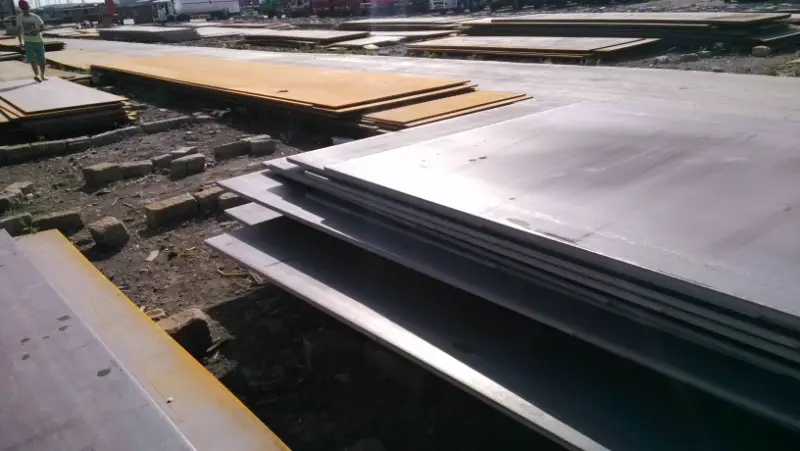
Q345E Carbon & Low-Alloy High-Strength Steel to GB/T 1591
Q345E Carbon & Low-Alloy High-Strength Steel to GB/T 1591: Comprehensive Property Data
Detailed material data for Q345E low-alloy structural steel including chemical composition, mechanical properties at various thicknesses, thermal and electrical physical properties, international equivalents, and application guidance.
Hot rolling, controlled rolling, normalizing, cold forming, welding, machining
- Phone : +8618037372205
- Email : [email protected]
- WhatsApp: Contact via Whtsapp
- WeChat: +8618037372205
Q345E Carbon & Low-Alloy High-Strength Steel to GB/T 1591 Introduction
Q345E is a Chinese standard carbon low-alloy high-strength structural steel grade defined in GB/T 1591-2008 (now partially superseded by GB/T 1591-2018, where Q345E corresponds to Q355NE). The 'E' designation indicates guaranteed impact toughness of at least 34 J at -40 °C, making it suitable for low-temperature service. The steel is typically supplied in hot-rolled or normalized condition.
- Minimum yield strength of 345 MPa for thickness ≤16 mm
- Tensile strength in the range of 470–630 MPa
- Excellent weldability with low carbon equivalent
- Good atmospheric corrosion resistance and formability
- Widely used in bridges, buildings, vehicles, ships, and pressure vessels
Q345E Carbon & Low-Alloy High-Strength Steel to GB/T 1591 Chemical Composition
The chemical composition of Q345E steel is controlled to ensure adequate strength and low-temperature toughness. Limits are as per GB/T 1591-2008. Elements such as Nb, V, Ti are added individually or in combination for grain refinement. A minimum aluminum content is specified to guarantee fine grain practice.
| Element | Standard Value (max, unless range specified) | Remarks |
|---|---|---|
| C | ≤0.18 | |
| Si | ≤0.50 | |
| Mn | ≤1.70 | |
| P | ≤0.020 | |
| S | ≤0.010 | |
| Nb | ≤0.07 | Fine grain element |
| V | ≤0.15 | Grain refinement / precipitation strengthening |
| Ti | ≤0.20 | Grain refinement / nitrogen fixation |
| Cr | ≤0.30 | Residual element |
| Ni | ≤0.50 | Residual element; improves toughness |
| Cu | ≤0.30 | Residual element |
| Mo | ≤0.10 | Residual element |
| N | ≤0.012 | Nitrogen content limitation |
| Als | ≥0.015 | Acid-soluble aluminum for full deoxidation and grain refinement |
Q345E Carbon & Low-Alloy High-Strength Steel to GB/T 1591 Thermal and Electrical Physical Properties
The following physical properties are typical for low-alloy structural steels similar to Q345E. They are not specified by the material standard but are derived from experimental data for carbon‑manganese steels with a density of approx. 7850 kg/m³. Thermal expansion, conductivity, and specific heat are given for room temperature to elevated temperatures.
| Property | Typical Value | Unit | Test Conditions / Remarks |
|---|---|---|---|
| Density (ρ) | 7850 | kg/m³ | At 20 °C |
| Elastic modulus (E) | 206 | GPa | At 20 °C |
| Shear modulus (G) | 79.3 | GPa | Calculated from E and Poisson's ratio |
| Poisson's ratio (ν) | 0.30 | At 20 °C, elastic range | |
| Thermal expansion coefficient (α) | 11.8 × 10⁻⁶ | K⁻¹ | 20–100 °C |
| Thermal expansion coefficient (α) | 12.5 × 10⁻⁶ | K⁻¹ | 20–200 °C |
| Thermal conductivity (λ) | 45 | W/(m·K) | At 20 °C |
| Thermal conductivity (λ) | 41 | W/(m·K) | At 200 °C |
| Specific heat capacity (c) | 470 | J/(kg·K) | At 20 °C |
| Electrical resistivity (ρ_e) | 0.23 × 10⁻⁶ | Ω·m | At 20 °C |
Q345E Carbon & Low-Alloy High-Strength Steel to GB/T 1591 Mechanical Properties
The mechanical properties of Q345E depend on product thickness. The following table lists the minimum yield strength, tensile strength range, elongation, cold bending requirements, and Charpy impact energy at -40 °C in accordance with GB/T 1591-2008. Impact test direction is longitudinal. Bend test parameter d is the mandrel diameter, a is the specimen thickness.
| Property | Requirement | Unit | Test Conditions / Thickness |
|---|---|---|---|
| Yield strength (ReH) | ≥345 | MPa | t ≤ 16 mm |
| Yield strength (ReH) | ≥335 | MPa | 16 < t ≤ 40 mm |
| Yield strength (ReH) | ≥325 | MPa | 40 < t ≤ 63 mm |
| Yield strength (ReH) | ≥315 | MPa | 63 < t ≤ 80 mm |
| Yield strength (ReH) | ≥305 | MPa | 80 < t ≤ 100 mm |
| Tensile strength (Rm) | 470–630 | MPa | t ≤ 100 mm |
| Tensile strength (Rm) | 450–600 | MPa | 100 < t ≤ 150 mm |
| Elongation (A) | ≥21 | % | t ≤ 40 mm, gauge length 5.65√S₀ |
| Elongation (A) | ≥20 | % | 40 < t ≤ 63 mm |
| Elongation (A) | ≥19 | % | 63 < t ≤ 100 mm |
| Elongation (A) | ≥18 | % | 100 < t ≤ 150 mm |
| Cold bending (180°) | d=2a | t ≤ 16 mm | |
| Cold bending (180°) | d=3a | 16 < t ≤ 100 mm | |
| Charpy impact energy (KV₂, longitudinal) | ≥34 | J | -40 °C, all thicknesses |
Q345E Carbon & Low-Alloy High-Strength Steel to GB/T 1591 Completely Equivalent Material Standards and Substitutable Grades
| Country/Region | Standard | Grade | Remarks |
|---|---|---|---|
| China | GB/T 1591-2018 | Q355NE | Direct successor; identical toughness class (-40 °C) with slightly higher strength minimum (355 MPa for t≤16 mm) |
| European Union | EN 10025-3 | S355NL | Fine-grain structural steel with -50°C impact energy ≥27J; chemistry adapted to European practices; closest match for low-temperature application |
| International | ISO 630-2 | S355NL | Equivalent to EN 10025-3 S355NL; suitable substitution |
Q345E Carbon & Low-Alloy High-Strength Steel to GB/T 1591 Application Introduction
Q345E low-alloy high-strength steel is ideal for welded structures operating in cold climates due to its guaranteed toughness at -40 °C. It offers an excellent balance of strength, formability, and weldability, which allows its use in a wide range of engineering and construction applications.
Product Applications: Steel coils, hot-rolled sheets and plates, Welded H-beams, I-beams, channels, angles, Rectangular and square hollow sections (tubes), Prefabricated building modules and containers, Offshore structural members (jacket legs, decks), Railway bogie frames and bolsters, Excavator arms, crane booms, dump truck bodies
Processed into products: Structural columns and girders, Bridge box girders and truss members, Ship hulls and deck plating, Pressure vessel shells (low temperature service), Heavy machinery frames and undercarriages, Welded steel pipes for low-temperature pipelines
Application industries: Building and infrastructure construction, Bridge engineering (especially in cold regions), Shipbuilding and marine structures, Offshore oil and gas platforms, Railway vehicle manufacturing (bogies, frames), Earth-moving and heavy machinery, Pressure vessel and storage tank fabrication, Wind power tower and foundation structures, Automotive chassis and structural components
Q345E Carbon & Low-Alloy High-Strength Steel to GB/T 1591 Similar / Alternative Material Recommendations
| Country/Region | Standard | Grade | Remarks |
|---|---|---|---|
| China | GB/T 1591-2008 | Q345D | -20°C impact, otherwise similar strength; can be used if service temperature is not below -20 °C |
| China | GB/T 1591-2018 | Q355D | Newer standard, -20°C impact; can replace Q345E if the toughness requirement is relaxed to -20 °C |
| European Union | EN 10025-2 | S355J2 | +20°C to -20°C impact depending on option; minimum yield 355 MPa ≤16 mm; widely available, but impact temperature is higher |
| USA | ASTM A572/A572M | Grade 50 [345] (Type 1) | Yield strength 345 MPa; toughness not guaranteed unless supplementary requirements; Charpy values at low temperature need separate specification |
| Japan | JIS G 3106 | SM490A / SM490B / SM490C | 375–500 MPa tensile; impact energy at 0°C (SM490B) or -10°C (SM490C); not fully equivalent to -40°C requirement |
| Russia | GOST 19281 | 345-3 or 09G2S | Similar low-alloy steel with -40°C toughness option, depending on specific grade |
Notes:
Q345E coils are usually supplied with thicknesses between 1.2 mm and 25 mm, but the material can be produced in thicker plates up to 200 mm.
- The impact test temperature of -40 °C is mandatory for the 'E' grade; longitudinal Charpy V-notch specimens are standard.
- For improved through-thickness properties (Z-quality), the steel can be ordered with Z15, Z25, or Z35 classification according to ISO 4996 or customer specification.
- Welding procedures should follow low-hydrogen practices; preheating is generally not required for thicknesses below 30 mm if the carbon equivalent (CEV) ≤0.42%.
- Standard delivery ex‑mill may include pickling and oiling for coil products to improve surface quality.
- Share



