
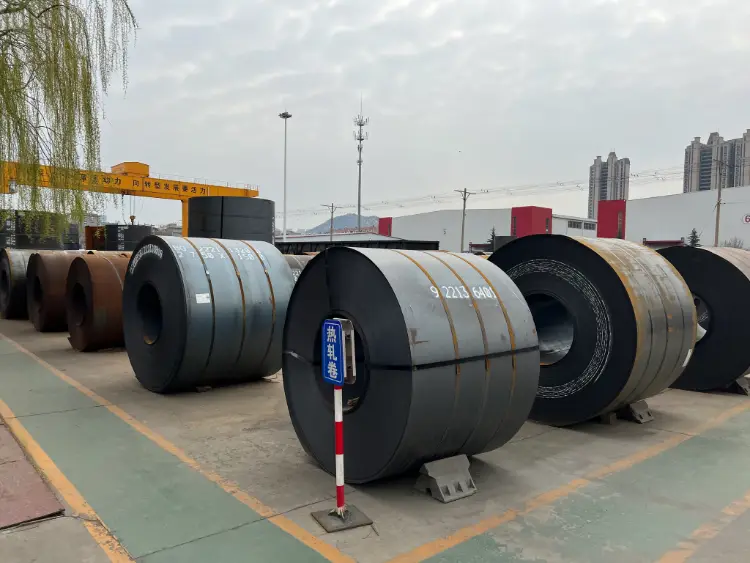
Q345D Carbon and Low-alloy High-strength Steel Coil Expert Analysis
Q345D Carbon and Low-alloy High-strength Steel Coil Expert Analysis | Full Data & Equivalents
Comprehensive reference for Q345D steel coil under GB/T 1591. Includes exact chemical composition, mechanical and physical properties, thermal/electrical data, international equivalents, and application guidance.
Hot rolling, controlled rolling, normalizing, thermomechanical rolling; suitable for cold bending, welding, cutting, and machining
- Phone : +8618037372205
- Email : [email protected]
- WhatsApp: Contact via Whtsapp
- WeChat: +8618037372205
Q345D Carbon and Low-alloy High-strength Steel Coil Expert Analysis Introduction
Q345D is a carbon and low-alloy high-strength structural steel grade defined in China's GB/T 1591 standard. As a quality grade "D" within the Q345 series, it guarantees minimum yield strength of 345 MPa and Charpy impact energy of 34 J at -20 °C (longitudinal). Key features:
- Excellent weldability and cold-forming capability
- Good low-temperature toughness for structural applications in cold regions
- Cost-effective combination of strength and ductility
- Delivered typically in hot-rolled, normalized or thermomechanical rolled condition
The steel is widely used in bridges, buildings, offshore structures, heavy machinery, and pressure vessels where reliable toughness at sub-zero temperatures is required.
Q345D Carbon and Low-alloy High-strength Steel Coil Expert Analysis Chemical Composition
Chemical limits for Q345D according to GB/T 1591-2008, heat analysis. Key points:
- Low carbon equivalent improves weldability
- Microalloying with Nb, V, Ti for grain refinement and precipitation strengthening
- Tight control on S and P enhances toughness and reduces hot shortness
- Maximum N limit prevents strain aging embrittlement
| Element | Standard Value (≤, %) | Notes |
|---|---|---|
| Carbon (C) | 0.18 | |
| Silicon (Si) | 0.50 | |
| Manganese (Mn) | 1.70 | |
| Phosphorus (P) | 0.030 | Lower P content improves ductility |
| Sulfur (S) | 0.025 | Low sulfur for better hot workability |
| Niobium (Nb) | 0.07 | Optional grain refiner |
| Vanadium (V) | 0.15 | Optional strengthening element |
| Titanium (Ti) | 0.20 | Optional grain refiner / deoxidizer |
| Chromium (Cr) | 0.30 | Residual element, max |
| Nickel (Ni) | 0.50 | Residual element, max |
| Copper (Cu) | 0.30 | Residual element, max; higher Cu may cause hot shortness |
| Nitrogen (N) | 0.012 | Limit prevents strain aging |
| Molybdenum (Mo) | 0.10 | Residual element, max |
| Aluminium (Al) | 0.015 (min) or others | Minimum acid-soluble Al if grain refinement is required |
Q345D Carbon and Low-alloy High-strength Steel Coil Expert Analysis Thermal and Electrical Properties
Typical physical data for Q345D steel at ambient temperature unless noted. Note: These values are not specified in GB/T 1591 but are commonly used for design calculations.
- Density varies slightly with composition but is generally 7.85 g/cm³
- Moduli are valid for static loading; dynamic moduli may be slightly higher
- Thermal expansion coefficient increases with temperature
- Thermal conductivity decreases as temperature rises
| Property | Reference Value | Unit | Condition / Remarks |
|---|---|---|---|
| Density (ρ) | 7.85 | g/cm³ | Room temperature |
| Elastic modulus (E) | 206 | GPa | 20 °C |
| Shear modulus (G) | 79.3 | GPa | Calculated from E and ν |
| Poisson's ratio (ν) | 0.3 | – | At room temperature |
| Thermal expansion coefficient (α) | 11.5 × 10⁻⁶ | 1/K | 20–100 °C |
| Thermal expansion coefficient (α) | 12.4 × 10⁻⁶ | 1/K | 20–200 °C |
| Thermal expansion coefficient (α) | 13.1 × 10⁻⁶ | 1/K | 20–300 °C |
| Thermal conductivity (λ) | 52 | W/(m·K) | At 20 °C |
| Thermal conductivity (λ) | 47 | W/(m·K) | At 100 °C |
| Specific heat capacity (c) | 460 | J/(kg·K) | 20–100 °C range |
| Electrical resistivity (ρₑ) | 0.22 × 10⁻⁶ | Ω·m | At 20 °C |
Q345D Carbon and Low-alloy High-strength Steel Coil Expert Analysis Mechanical Properties
Longitudinal tensile and impact properties according to GB/T 1591-2008. Note:
- Yield strength decreases as thickness increases
- Bend test: crack-free after 180° bending; mandrel diameter depends on thickness and test direction
- Charpy V-notch impact value is an average of three specimens; single individual minimum ≥ 70% of specified value
- Elongation measured on gauge length L₀ = 5.65√S₀ for flat products
| Property | Specified Value | Unit | Test Condition / Remarks |
|---|---|---|---|
| Upper yield strength (ReH) | ≥ 345 | MPa | Thickness ≤ 16 mm |
| Upper yield strength (ReH) | ≥ 335 | MPa | Thickness >16–40 mm |
| Upper yield strength (ReH) | ≥ 325 | MPa | Thickness >40–63 mm |
| Upper yield strength (ReH) | ≥ 315 | MPa | Thickness >63–80 mm |
| Upper yield strength (ReH) | ≥ 305 | MPa | Thickness >80–100 mm |
| Upper yield strength (ReH) | ≥ 285 | MPa | Thickness >100–150 mm |
| Upper yield strength (ReH) | ≥ 275 | MPa | Thickness >150–200 mm |
| Upper yield strength (ReH) | ≥ 265 | MPa | Thickness >200–250 mm |
| Tensile strength (Rm) | 470–630 | MPa | All thicknesses |
| Elongation (A) | ≥ 21 | % | Thickness ≤ 40 mm, gauge length 5.65√S₀ |
| Elongation (A) | ≥ 20 | % | Thickness >40–63 mm |
| Elongation (A) | ≥ 19 | % | Thickness >63–80 mm |
| Elongation (A) | ≥ 19 | % | Thickness >80–100 mm |
| Elongation (A) | ≥ 18 | % | Thickness >100–150 mm |
| Elongation (A) | ≥ 17 | % | Thickness >150–200 mm |
| Elongation (A) | ≥ 17 | % | Thickness >200–250 mm |
| Charpy impact energy (KV₂) | ≥ 34 | J | -20 °C, longitudinal, V-notch |
| Bend test (180°) | d=2a | – | Thickness ≤ 16 mm, specimen width b≥35 mm, longitudinal or transverse |
| Bend test (180°) | d=3a | – | Thickness >16–100 mm |
Q345D Carbon and Low-alloy High-strength Steel Coil Expert Analysis Fully Equivalent Material Standards and Replaceable Grades
| Country/Region | Standard | Grade | Remarks |
|---|---|---|---|
| China | GB/T 1591-2008 | Q345D | Original grade; widely used in domestic market |
| International | ISO 630-2:2011 | E355DD | Normalized/normalized rolled; similar strength level and -20 °C impact, minor composition differences |
| European Union | EN 10025-2:2019 | S355J2 | Very close in properties; yield min 355 MPa for t≤16 mm; impact 27 J at -20 °C |
| USA | ASTM A572/A572M | Grade 50 [50T] with CVN test at -20 °C | Specifying supplementary requirement S5 (Charpy V-notch) achieves similar toughness; A709 Grade 50 also equivalent |
| Japan | JIS G3106:2015 | SM490B / SM490C | SM490C has impact test at 0 °C; SM490B with additional agreement can test at -20 °C; yield strength 325 MPa for t≤16 mm, slightly lower |
| Russia | GOST 19281:2014 | 17G1S (17Г1С) | Common low-alloy steel; impact test at -20 °C possible, yield around 345 MPa for thin sections, but exact match requires confirmation |
Q345D Carbon and Low-alloy High-strength Steel Coil Expert Analysis Application Introduction
Q345D offers a balanced combination of strength, weldability, and low-temperature toughness, making it a versatile structural steel. Typical applications:
- Heavy steel structures in cold climates (e.g., bridges, stadiums, high-rise buildings)
- Offshore and marine engineering components where -20 °C impact resistance is specified
- Welded pressure vessels (when code allows), lifting equipment, and mining machinery
- Transportation vehicles such as railway wagons, heavy-duty trucks, and ship hulls (within classification society acceptance)
- Wind turbine towers and other renewable energy support structures
Its good formability also allows cold bending and profiling into structural sections.
Product Applications: Steel superstructures for bridges, gantries, and flyovers, Building frames, columns, and trusses for high-rise and industrial buildings, Offshore platform decks and jackets, Welded H-beams, box columns, and prefabricated structural elements, Lifting beams, crane rails, and heavy vehicle chassis, Storage tanks and silos (where notch toughness at -20 °C is required), Tubular poles for transmission lines and lighting
Processed into products: Bridge girders, diaphragms, and stiffeners, Welded built-up sections (plate girders), Heavy-duty machine frames and bed plates, Excavator booms and arms, Pressure vessel shells (as per design code), Wind tower sections and flanges, Ship frames and bulkhead stiffeners (subject to class approval)
Application industries: Construction & Civil Engineering, Bridge Building, Offshore & Marine Engineering, Pressure Vessel Manufacturing (limited), Heavy Machinery & Mining Equipment, Railway & Automotive, Wind Energy
Q345D Carbon and Low-alloy High-strength Steel Coil Expert Analysis Similar or Closely Related Material Recommendations
| Country/Region | Standard | Grade | Remarks |
|---|---|---|---|
| China | GB/T 1591-2018 | Q355D | New standard grade directly replacing Q345D, same -20 °C impact, yield 355 MPa, slightly higher strength |
| European Union | EN 10025-3 | S355NL | Normalized fine-grain steel, impact 27 J at -50 °C (better toughness), suitable for offshore and low-temperature applications |
| USA | ASTM A588 | Grade A / B (weathering) | Atmospheric corrosion resistant, yield 345 MPa, can be supplied with impact testing at -20 °C |
| China | GB/T 714 | Q345qD / Q345qE | Bridge structural steel, same strength level, specialized for bridge construction with improved weldability and toughness |
| International | ISO 4951-1 | E355 | High yield strength rolled structural steels; requires agreement on impact energy and temperature to match Q345D |
| South Korea | KS D 3515 | SM490A / SM490B | Similar to JIS SM490; verification of impact temperature needed for equivalence |
Notes:
Additional remarks:
- All mechanical property values are minimums; actual coil properties may be superior and should be verified through mill test certificates.
- For thicknesses outside the stated range, check GB/T 1591-2008 for extended requirements.
- When used in welded structures exposed to dynamic loading, post-weld stress relief or special welding procedures may be required to maintain toughness.
- The official transition to GB/T 1591-2018 (Q355D) is underway; Q345D remains available but procurement should confirm the applicable standard revision.
- Physical properties are typical values; specific conditions such as rolling direction and heat treatment may cause variations.
- Share



