
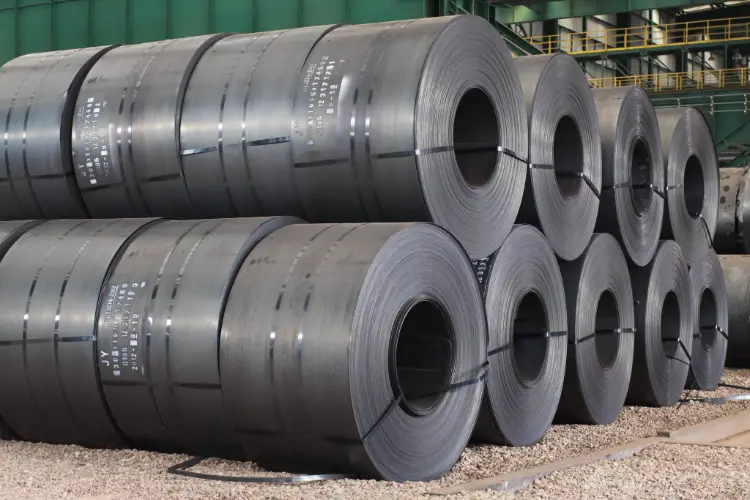
GB/T 1591 Q345C High-Strength Low-Alloy Structural Steel Coil
Q345C High-Strength Low-Alloy Structural Steel Coil to GB/T 1591
Comprehensive data for Q345C carbon and low-alloy high-strength steel coil under Chinese standard GB/T 1591, including chemical composition, mechanical and physical properties, international equivalents, and applications.
Hot rolling, controlled rolling, normalizing (optional), cutting, welding, bending, punching, forming, machining
- Phone : +8618037372205
- Email : [email protected]
- WhatsApp: Contact via Whtsapp
- WeChat: +8618037372205
GB/T 1591 Q345C High-Strength Low-Alloy Structural Steel Coil Introduction
Q345C is a Chinese standard low-alloy high-strength structural steel grade specified in GB/T 1591. It offers a minimum yield strength of 345 MPa and good notch toughness at 0°C (impact energy ≥34 J), making it suitable for welded structures in moderate to low temperature environments. The 'C' suffix designates its fine-grain quality and impact testing temperature of 0°C. Compared to Q345B, Q345C provides improved ductility and toughness, ensuring reliable performance in bridges, buildings, and heavy machinery. It is typically delivered in hot-rolled condition and exhibits good weldability with low carbon equivalent. As an upgrade from ordinary carbon structural steel, Q345C balances strength, toughness, and formability, enabling weight reduction without sacrificing safety.
GB/T 1591 Q345C High-Strength Low-Alloy Structural Steel Coil Chemical Composition
The following chemical requirements are based on GB/T 1591-2008 for grade Q345C. The ladle analysis limits are given. For certain elements a fine-grain practice is required (e.g., minimum aluminum or other grain-refining elements). The carbon equivalent (CEV) is typically controlled to ensure good weldability, CEV ≤ 0.45% or as agreed.
| Element | Standard Value (max unless range) | Remarks |
|---|---|---|
| C | ≤0.20 | For thickness ≤16 mm; CEV may be specified |
| Si | ≤0.50 | Added for deoxidation |
| Mn | ≤1.70 | Enhances strength and hardenability |
| P | ≤0.030 | Maximum; low phosphorus for weldability |
| S | ≤0.030 | Maximum; low sulfur for toughness |
| Nb | ≤0.07 | Grain refining microalloy |
| V | ≤0.15 | Optional microalloy |
| Ti | ≤0.20 | Optional microalloy, also ties up nitrogen |
| Cr | ≤0.30 | Residual element, may be added for strength |
| Ni | ≤0.50 | Residual element, improves toughness |
| Cu | ≤0.30 | Residual element, can cause hot shortness if too high |
| Mo | ≤0.10 | Residual, may be present in some heats |
| N | ≤0.012 | Maximum, controlled for strain aging resistance |
| Al (total) | ≥0.015 | Required for fine grain practice; Al/N ratio >2:1 |
GB/T 1591 Q345C High-Strength Low-Alloy Structural Steel Coil Thermal and Electrical Physical Properties
The following physical properties are typical for low-alloy structural steel at room temperature unless otherwise noted. These values can vary slightly with exact composition and heat treatment condition.
| Property | Standard Required Value | Unit | Test Condition / Remarks |
|---|---|---|---|
| Density (ρ) | 7.85 | g/cm³ | At 20°C |
| Elastic Modulus (E) | 206 | GPa | At 20°C |
| Shear Modulus (G) | 79.3 | GPa | At 20°C |
| Poisson's Ratio (ν) | 0.29 | — | At 20°C |
| Thermal Expansion Coefficient (α) | 11.5–12.5 | ×10−⁵/K | 20–100°C |
| Thermal Expansion Coefficient (α) | 12.0–13.0 | ×10−⁵/K | 20–200°C |
| Thermal Expansion Coefficient (α) | 13.0–13.5 | ×10−⁵/K | 20–300°C |
| Thermal Conductivity (λ) | 50–54 | W/(m·K) | At 20°C |
| Thermal Conductivity (λ) | 40–45 | W/(m·K) | At 100°C |
| Specific Heat Capacity (cp) | 470 | J/(kg·K) | Room temperature |
| Electrical Resistivity (ρe) | 0.20–0.25 | μΩ·m | At 20°C |
GB/T 1591 Q345C High-Strength Low-Alloy Structural Steel Coil Mechanical Properties
Mechanical properties according to GB/T 1591-2008 for Q345C. Values vary with product thickness and orientation. The impact test is performed at 0°C with a minimum absorbed energy of 34 J (Charpy V-notch, longitudinal). Bending test is through 180° with a mandrel diameter dependent on thickness.
| Property | Standard Required Value | Unit | Test Condition / Remarks |
|---|---|---|---|
| Yield Strength (ReH) | ≥345 | MPa | Thickness ≤16 mm |
| Yield Strength (ReH) | ≥335 | MPa | Thickness >16–40 mm |
| Yield Strength (ReH) | ≥325 | MPa | Thickness >40–63 mm |
| Yield Strength (ReH) | ≥315 | MPa | Thickness >63–80 mm |
| Yield Strength (ReH) | ≥305 | MPa | Thickness >80–100 mm |
| Tensile Strength (Rm) | 470–630 | MPa | Thickness ≤100 mm |
| Elongation after Fracture (A) | ≥20 | % | Longitudinal, Lo=5.65√S0, thickness ≤40 mm |
| Elongation after Fracture (A) | ≥19 | % | Thickness >40–63 mm |
| Elongation after Fracture (A) | ≥19 | % | Thickness >63–100 mm |
| Charpy Impact Energy (KV2) | ≥34 | J | at 0°C, longitudinal, V-notch, full-size specimen |
| Bend Test (180°) | d=2a | — | Mandrel diameter for thickness ≤16 mm; d=3a for thickness >16–100 mm |
GB/T 1591 Q345C High-Strength Low-Alloy Structural Steel Coil Exact Equivalent Material Standards and Replaceable Grades
| Country/Region | Standard | Grade | Remarks |
|---|---|---|---|
| China | GB/T 1591-2018 | Q355C | Replaces Q345C in latest edition; yield ≥355 MPa, impact 0°C ≥34 J |
| Europe | EN 10025-2:2019 | S355J0 | Tensile & yield comparable; impact at 0°C ≥27 J, similar application range |
| International | ISO 630-2:2011 | E355C | Same strength grade and impact test at 0°C |
| Japan | JIS G3106:2015 | SM490B | Tensile 490–610 MPa, yield ≥325–365 MPa; impact 0°C ≥27 J |
GB/T 1591 Q345C High-Strength Low-Alloy Structural Steel Coil Application Introduction
Q345C steel coil is widely utilized in welded structural applications where moderate strength, good weldability, and reliable toughness at 0°C are required. It can be cut, formed, welded, and machined with conventional methods. Preheating may be necessary for thick sections or low ambient temperature welding. It is not intended for sour service or highly corrosive environments without protective coatings.
Product Applications: Welded H-beams and box columns for building frames, Bridge girders, arch ribs and stiffening plates, Boom and arm components of construction machinery, Ship hull stiffeners and hatch coamings (non-ice class), Wind tower shells and internal brackets, Heavy-duty storage racks and pallet frames, Automotive chassis rails and cross members
Processed into products: Base plates and end plates for structural connections, Stiffeners, gussets, and brackets for welded assemblies, Flanges and webs for welded plate girders, Lifting lugs and pad-eyes (when toughness assured), Support brackets and anchors for process equipment, Frames and casings for large electric motors and generators
Application industries: Building and civil engineering (commercial buildings, stadiums, airports), Bridge construction (highway and railway bridges, pedestrian bridges), Heavy machinery and equipment (excavators, bulldozers, crane booms), Shipbuilding and offshore engineering (structural components, decks, superstructures), Transportation (railway vehicle underframes, truck chassis, container frames), Energy and power (wind turbine towers, transmission towers, hydraulic penstocks), General engineering (storage tanks, platforms, mining supports)
GB/T 1591 Q345C High-Strength Low-Alloy Structural Steel Coil Similar/Alternative Materials Recommendation
| Country/Region | Standard | Grade | Remarks |
|---|---|---|---|
| China | GB/T 1591-2008 | Q345B | Lower toughness (20°C), same strength, not suitable for 0°C impact requirements |
| China | GB/T 1591-2008 | Q345D | Higher toughness (−20°C), better for lower service temperatures |
| USA | ASTM A572/A572M | Grade 50 [345] | No mandatory impact test; impact requirement must be separately agreed (e.g., S5 at 0°C) |
| Europe | EN 10025-2 | S355J2+N | Impact at −20°C, slightly more demanding than Q345C, can be used as upgrade |
| Russia | GOST 19281 | 09G2S | Similar Mn-Si steel, yield ≥325 MPa, impact at −40°C but also available in milder test |
| India | IS 2062 | E350 BR / E350 C | C grade provides impact test at 0°C, strength level matches |
Notes:
Additional Information: Q345C can be ordered with through-thickness properties (Z25/Z35) per GB/T 5313 to resist lamellar tearing. The steel is normally supplied with mill test certificates according to EN 10204 type 3.1. For improved atmospheric corrosion resistance, a weathering steel grade such as Q355NHC may be considered. Surface condition can be specified as hot-rolled or shot-blasted and primed. Welding consumables matching the tensile strength and toughness requirements are recommended (e.g., E50 series electrodes).
- Share



