
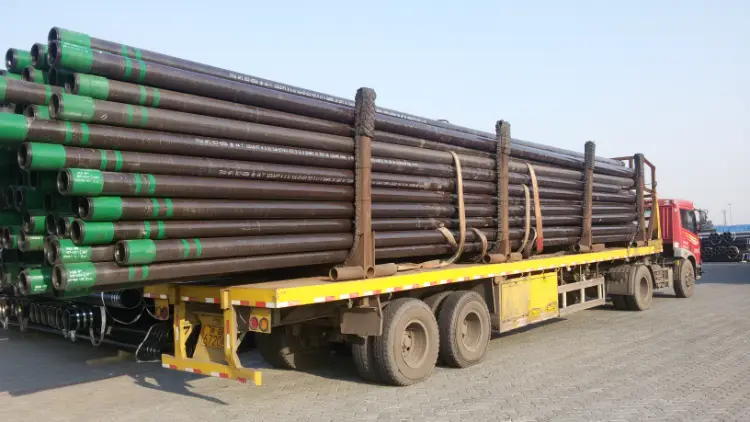
Q390E LSAW Pipe
Q390E LSAW Pipe: High-Strength Low-Alloy Structural Steel with Excellent Low-Temperature Toughness
Detailed material data for Q390E LSAW pipe, a high-strength low-alloy structural steel grade under Chinese standard GB/T 1591, featuring excellent weldability and impact toughness at -40°C. Includes chemical compositions, mechanical properties, thermos-physical data, and international equivalents.
Hot rolling, controlled rolling, normalizing rolling, thermo-mechanical controlled processing (TMCP); welding (SAW, GMAW, SMAW); forming (bending, pressing); machining
- Phone : +8618037372205
- Email : [email protected]
- WhatsApp: Contact via Whtsapp
- WeChat: +8618037372205
Q390E LSAW Pipe Introduction
Q390E is a high-strength low-alloy (HSLA) structural steel grade defined in Chinese standard GB/T 1591-2018. It belongs to the Q390 series with a minimum yield strength of 390 MPa and exhibits excellent low-temperature toughness (quality level E, impact energy ≥34 J at -40°C). The steel is widely used in welded structures such as bridges, buildings, ships, and pressure vessels. When supplied as LSAW (Longitudinally Submerged Arc Welded) pipe, it is manufactured from hot-rolled steel plates or coils, formed into pipe through JCOE or UOE processes, and welded by submerged arc welding. The material offers a good balance of strength, ductility, and weldability, making it suitable for demanding engineering applications in cold regions.
Q390E LSAW Pipe Chemical Composition
The chemical composition of Q390E is controlled to ensure high strength and excellent low-temperature toughness. The steel is typically microalloyed with niobium, vanadium, and titanium to refine grain size. Phosphorus and sulfur are strictly limited to guarantee ductility and weldability. Nitrogen is bound by aluminum or titanium to prevent strain aging.
| Element | Content (wt.%) | Remarks |
|---|---|---|
| Carbon (C) | ≤ 0.20 | Max. |
| Silicon (Si) | ≤ 0.50 | Max. |
| Manganese (Mn) | ≤ 1.70 | Max. |
| Phosphorus (P) | ≤ 0.020 | Max. |
| Sulfur (S) | ≤ 0.010 | Max. |
| Niobium (Nb) | ≤ 0.07 | Optional microalloying element |
| Vanadium (V) | ≤ 0.20 | Optional microalloying element |
| Titanium (Ti) | ≤ 0.20 | Optional microalloying element |
| Chromium (Cr) | ≤ 0.30 | Optional, residual content |
| Nickel (Ni) | ≤ 0.50 | Optional, residual content |
| Copper (Cu) | ≤ 0.30 | Optional, residual content |
| Molybdenum (Mo) | ≤ 0.10 | Optional, residual content |
| Nitrogen (N) | ≤ 0.015 | Max., sufficient Al or Ti to bind N |
| Aluminum (Al) | ≥ 0.015 | Min. total, for deoxidation and grain refinement |
Q390E LSAW Pipe Thermo-Physical and Electrical Properties
These properties provide essential data for thermal expansion, heat conduction, and design in electrical applications. Values are based on typical data for low-alloy structural steels and may vary slightly with composition. Density and elastic constants are used in stress analysis and weight estimation.
| Property | Typical Value | Unit | Test Condition / Reference Temperature |
|---|---|---|---|
| Density (ρ) | 7.85 | g/cm³ | 20 °C |
| Elastic Modulus (E) | 206 | GPa | Tensile test at ambient temperature |
| Shear Modulus (G) | 79 | GPa | Calculated from E and ν |
| Poisson's Ratio (ν) | 0.3 | - | In elastic range |
| Thermal Expansion Coefficient (α) | 12.2 | µm/(m·°C) | 20 – 100 °C |
| Thermal Expansion Coefficient (α) | 12.8 | µm/(m·°C) | 20 – 200 °C |
| Thermal Expansion Coefficient (α) | 13.5 | µm/(m·°C) | 20 – 300 °C |
| Thermal Conductivity (λ) | 46 | W/(m·K) | At 20 °C |
| Specific Heat Capacity (cp) | 470 | J/(kg·K) | At 20 °C |
| Electrical Resistivity (ρe) | 0.25 | µΩ·m | At 20 °C |
Q390E LSAW Pipe Mechanical Properties
The mechanical properties of Q390E ensure reliable performance under static and dynamic loads. Yield and tensile strengths are guaranteed at ambient temperature, and the steel must meet strict elongation and impact requirements. For LSAW pipe bodies, properties are typically tested on base metal from the same heat, with longitudinal orientation.
| Property | Standard Required Value | Unit | Test Condition |
|---|---|---|---|
| Yield Strength (ReH) | ≥ 390 | MPa | Upper yield, thickness t ≤ 16 mm |
| Yield Strength (ReH) | ≥ 370 | MPa | Upper yield, thickness 16 < t ≤ 40 mm |
| Yield Strength (ReH) | ≥ 350 | MPa | Upper yield, thickness 40 < t ≤ 63 mm |
| Yield Strength (ReH) | ≥ 330 | MPa | Upper yield, thickness 63 < t ≤ 80 mm |
| Yield Strength (ReH) | ≥ 310 | MPa | Upper yield, thickness 80 < t ≤ 100 mm |
| Tensile Strength (Rm) | 490 – 650 | MPa | Tensile test, transverse specimen |
| Elongation After Fracture (A) | ≥ 20 | % | Gauge length 5.65√So, t ≤ 16 mm |
| Elongation After Fracture (A) | ≥ 19 | % | t 16–40 mm |
| Elongation After Fracture (A) | ≥ 18 | % | t 40–63 mm |
| Elongation After Fracture (A) | ≥ 17 | % | t 63–80 mm |
| Elongation After Fracture (A) | ≥ 17 | % | t 80–100 mm |
| Bend Test (Mandrel Diameter) | D = 3a (t ≤ 16 mm) | - | 180° bending, a = specimen thickness; no cracking |
| Bend Test (Mandrel Diameter) | D = 4a (t > 16–100 mm) | - | 180° bending |
| Charpy Impact Energy (KV2) | ≥ 34 | J | Longitudinal, -40 °C, V-notch, average of 3 specimens |
Q390E LSAW Pipe Full Equivalent Material Standards and Substitutable Grades
| Country/Region | Standard | Grade | Remarks |
|---|---|---|---|
| China | GB/T 1591-2018 | Q390E | Original grade, low-temperature toughness E (-40°C) |
| Europe | EN 10025-3:2019 | S420NL | Normalized/normalized rolled; impact at -50°C min 27 J, yield 420 MPa; close chemical match |
| Europe | EN 10025-4:2019 | S420ML | Thermo-mechanically rolled; impact -50°C min 27 J, yield 420 MPa; alternative delivery condition |
| USA | ASTM A572/A572M | Grade 60 [415] | Type 2 microalloyed; yield ≥415 MPa (60 ksi); impact test not mandatory, can be specified supplementary |
| Japan | JIS G3106:2015 | SM490C | Yield ≥325 MPa (thickness dependent), tensile 490–610 MPa; impact 0°C typically, but controlled chemistry and grain refinement similar |
Q390E LSAW Pipe Application Introduction
Q390E steel, especially in the form of LSAW pipe, finds extensive use in infrastructure, energy, and heavy industrial sectors. Its combination of high strength and excellent ductility at low temperatures makes it ideal for cold-climate constructions. The LSAW pipe is particularly suited for high-pressure fluid transportation and structural columns.
Product Applications: Long-distance oil and gas transmission pipelines (LSAW), Structural hollow sections and columns for high-rise buildings, Bridge girders and arches, Jack-up rig legs and bracing, Water and slurry piping in mining operations, Piling pipes for marine foundations
Processed into products: Pipe body and fittings (elbows, tees, reducers) for LSAW line pipe, Welded built-up beams and box girders, Flanges and forged connectors for pressure systems, Node joints in space trusses, Cutting rings and adapters for piling, Base plates and transition pieces for offshore wind monopiles
Application industries: Oil & Gas (onshore and offshore pipelines, flowlines), Civil Engineering (bridges, high-rise buildings, stadiums), Shipbuilding and Marine (hulls, decks, offshore platform jackets), Petrochemical (pressure vessels, storage tanks, process piping), Power Generation (wind turbine towers, boiler supports, penstocks), Mining and Heavy Machinery (excavator arms, dump truck frames)
Q390E LSAW Pipe Similar/Comparable Substitute Materials with Slightly Different Properties
| Country/Region | Standard | Grade | Remarks |
|---|---|---|---|
| China | GB/T 1591-2018 | Q345E | Lower yield strength (345 MPa), similar toughness (-40°C), for less demanding strength applications |
| China | GB/T 1591-2018 | Q420E | Higher yield strength (420 MPa), similar toughness (-40°C), suitable for weight reduction |
| Europe | EN 10025-2:2019 | S355J2 | Widely used structural steel; yield 355 MPa, impact -20°C; lower strength but good weldability |
| International | API Spec 5L | X52 (L360) | Typical LSAW pipe grade; yield 360 MPa, tensile 460 MPa min; impact frequently required, less strict chemistry; often produced from microalloyed steels close to Q390 |
| Russia | GOST 19281-2014 | 17G1S (17Г1С) | Low-alloy structural steel; yield ~345 MPa, tensile ~510 MPa; impact at -40°C possible; similar application range |
Notes:
- For LSAW pipe production, the base material Q390E is supplied as hot-rolled plate with documented Charpy impact at -40°C. The welding consumables and heat input must be controlled to avoid degradation of the heat-affected zone (HAZ) toughness. Post-weld heat treatment (PWHT) may be required for certain wall thicknesses to relieve residual stresses.
- The delivery condition for Q390E plate/coil is typically normalized rolling (+N) or thermo-mechanical controlled rolling (TMCP) depending on the mill capability. The LSAW pipe may be ordered with additional tests: DWTT (Drop Weight Tear Test), CTOD (Crack Tip Opening Displacement), and through-thickness tensile (Z35) if required for critical offshore applications.
- When comparing with international grades, always verify the latest edition of the standard and supplementary requirements for toughness, as the "-40°C" impact is a defining feature of Q390E that may not be automatically fulfilled by all equivalent grades.
- Share



