
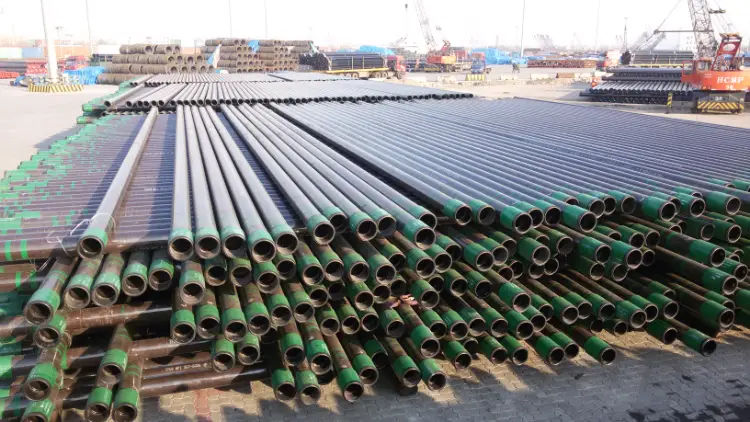
GB/T 1591 Q390D LSAW Pipe Steel
Q390D LSAW Pipe Steel: Chemical Composition, Mechanical & Thermal Properties (GB/T 1591)
Detailed technical data for Q390D steel for LSAW pipe as per GB/T 1591-2018, covering chemical composition, mechanical properties, physical properties, and international equivalents for pipeline and structural applications.
Hot rolling, TMCP, normalizing, welding (LSAW), cold forming, cutting, machining
- Phone : +8618037372205
- Email : [email protected]
- WhatsApp: Contact via Whtsapp
- WeChat: +8618037372205
GB/T 1591 Q390D LSAW Pipe Steel Introduction
Q390D is a low-alloy high-strength structural steel grade conforming to GB/T 1591-2018, commonly used as the base material for longitudinal submerged arc welded (LSAW) pipes. It offers a minimum yield strength of 390 MPa at room temperature, excellent notch toughness down to -20°C (quality D), and good weldability. The steel is designed for heavy-duty welded structures, pressure pipelines, and offshore applications. Typically supplied in hot-rolled plates or coils, it can be delivered in as-rolled, normalized, or thermo-mechanically controlled processed (TMCP) condition. Fine-grain practice with microalloying elements such as Nb, V, and Ti ensures a balanced strength-toughness combination. Carbon equivalent is controlled to guarantee field weldability.
GB/T 1591 Q390D LSAW Pipe Steel Chemical Composition
Typical chemical requirements for Q390D according to GB/T 1591-2018. Microalloying elements (Nb, V, Ti) are added for grain refinement. The actual contents shall conform to the agreement between purchaser and supplier. Carbon equivalent (CEV) is usually controlled to ≤0.45% for good weldability.
| Chemical Element | Specified Value (max or range) | Remarks |
|---|---|---|
| C | ≤ 0.20 | Carbon |
| Si | ≤ 0.50 | Silicon |
| Mn | ≤ 1.70 | Manganese |
| P | ≤ 0.030 | Phosphorus |
| S | ≤ 0.025 | Sulfur |
| Nb | ≤ 0.06 (typical) | Grain-refining element, by agreement |
| V | 0.01 – 0.15 (typical) | Grain-refining element, by agreement |
| Ti | 0.005 – 0.06 (typical) | Grain-refining element, by agreement |
| Al (acid soluble) | ≥ 0.015 | Minimum required for fine-grain practice |
| CEV (typical) | ≤ 0.45 | Carbon equivalent, as agreed |
GB/T 1591 Q390D LSAW Pipe Steel Thermal and Electrical Physical Properties
The following physical properties are typical for carbon-manganese low-alloy structural steels at room temperature, unless another temperature is specified. These values are not mandatory requirements of GB/T 1591 but are provided for design calculations.
| Property | Typical Value | Unit | Test Condition |
|---|---|---|---|
| Density (ρ) | 7.85 | g/cm³ | 20°C |
| Elastic modulus (E) | 206 | GPa | 20°C |
| Shear modulus (G) | 79.3 | GPa | 20°C (calculated from E and ν) |
| Poisson's ratio (ν) | 0.3 | — | 20°C |
| Thermal expansion coefficient (α) | 12.0 | 10⁻⁶/K | 20 – 100°C |
| Thermal expansion coefficient (α) | 12.5 | 10⁻⁶/K | 20 – 200°C |
| Thermal conductivity (λ) | 52 | W/(m·K) | 20°C |
| Specific heat capacity (c) | 460 | J/(kg·K) | 20°C |
| Electrical resistivity (ρ_e) | 0.13 | μΩ·m | 20°C |
GB/T 1591 Q390D LSAW Pipe Steel Mechanical Properties
Mechanical properties for Q390D plates as specified in GB/T 1591-2018. Values refer to the base metal before pipe forming. For LSAW pipes, properties of the weld seam are verified separately per relevant pipe standards. Tensile test specimens are taken transverse to the rolling direction unless otherwise agreed.
| Property | Specified Value | Unit | Test Conditions / Thickness Range |
|---|---|---|---|
| Yield strength (ReH) | ≥ 390 | MPa | t ≤ 16 mm |
| Yield strength (ReH) | ≥ 380 | MPa | 16 < t ≤ 40 mm |
| Yield strength (ReH) | ≥ 370 | MPa | 40 < t ≤ 63 mm |
| Yield strength (ReH) | ≥ 360 | MPa | 63 < t ≤ 80 mm |
| Yield strength (ReH) | ≥ 355 | MPa | 80 < t ≤ 100 mm |
| Yield strength (ReH) | ≥ 345 | MPa | 100 < t ≤ 150 mm |
| Yield strength (ReH) | ≥ 335 | MPa | 150 < t ≤ 200 mm |
| Yield strength (ReH) | ≥ 335 | MPa | 200 < t ≤ 250 mm |
| Tensile strength (Rm) | 490 – 650 | MPa | t ≤ 100 mm |
| Tensile strength (Rm) | 470 – 650 | MPa | 100 < t ≤ 250 mm |
| Elongation (A) | ≥ 20 | % | t ≤ 40 mm, gauge L0=5.65√S0 |
| Elongation (A) | ≥ 19 | % | 40 < t ≤ 63 mm |
| Elongation (A) | ≥ 18 | % | 63 < t ≤ 100 mm |
| Elongation (A) | ≥ 18 | % | 100 < t ≤ 250 mm |
| Impact energy (KV2, longitudinal) | ≥ 34 | J | -20°C, quality D, all thicknesses |
| Bend test (transverse) | d = 2a | t ≤ 16 mm, 180° bend, no cracks | |
| Bend test (transverse) | d = 3a | 16 < t ≤ 100 mm, 180° bend |
GB/T 1591 Q390D LSAW Pipe Steel Exact Equivalent Material Standards and Substitute Grades
| Country / Region | Standard | Grade | Remarks |
|---|---|---|---|
| International (ISO) | ISO 630-2:2011 | E390D | Grade D with -20°C impact, 34J, yield 390 MPa; directly corresponds to Q390D. |
| China | GB/T 1591-2008 (obsolete) | Q390D | Replaced by GB/T 1591-2018 but technically equivalent. |
GB/T 1591 Q390D LSAW Pipe Steel Application Introduction
Q390D LSAW pipes combine high strength, low-temperature toughness, and excellent weldability, making them a preferred choice for long-distance pipelines and heavy-duty structures. The steel's controlled carbon equivalent and fine-grain microstructure ensure good field welding properties without preheating for moderate thicknesses. Common delivery conditions (TMCP or normalized) give a balanced strength-to-weight ratio, allowing design optimization. The grade is also suitable for service in mildly sour environments when supplementary testing is applied. Typical applications span oil and gas transport, hydroelectric pressure conduits, offshore jackets, and large-span bridges.
Product Applications: Longitudinal Submerged Arc Welded (LSAW) pipes, Spiral submerged arc welded pipes, Pipe fittings and flanges, Pressure vessels (when procured to additional norms), Steel bridge girders and truss members, Offshore jacket legs and bracings
Processed into products: LSAW line pipe sections for onshore and offshore pipelines, Penstock pipes for hydropower stations, Spiral casings and draft tube liners, Wind turbine tower sections, Heavy crane booms and chassis parts, Marine riser pipes and structural tubulars
Application industries: Oil and gas transmission and distribution, Water supply and penstock systems, Civil and structural engineering, Shipbuilding and marine structures, Offshore and subsea platforms, Heavy machinery and mining equipment
GB/T 1591 Q390D LSAW Pipe Steel Similar / Substitute Materials with Comparable Performance
| Country / Region | Standard | Grade | Remarks |
|---|---|---|---|
| European Union | EN 10025-3 | S420N / S420NL | Yield 420 MPa (slightly higher); -20°C impact option (NL); suitable alternative with verification. |
| USA | ASTM A572 / A572M | Grade 60 [415] | Yield 415 MPa; impact testing by supplementary requirement; chemical composition differs. |
| Japan | JIS G3106 | SM520B / SM520C | Yield 365 MPa (lower); impact 0°C or -20°C; may require strength upgrade for Q390D. |
Notes:
Note: When Q390D plates are used to produce welded pipes, the final pipe properties are verified according to the applicable pipe standard (e.g., API 5L, GB/T 9711). Supplementary requirements may include through-thickness tensile testing, CTOD toughness, or NACE MR0175 for sour service. The carbon equivalent (CEV) is usually limited to 0.43–0.45% by agreement to ensure cold cracking resistance during welding. The LSAW production process normally utilizes TMCP plates with low carbon and microalloyed design to achieve high toughness in the heat-affected zone.
- Share



