
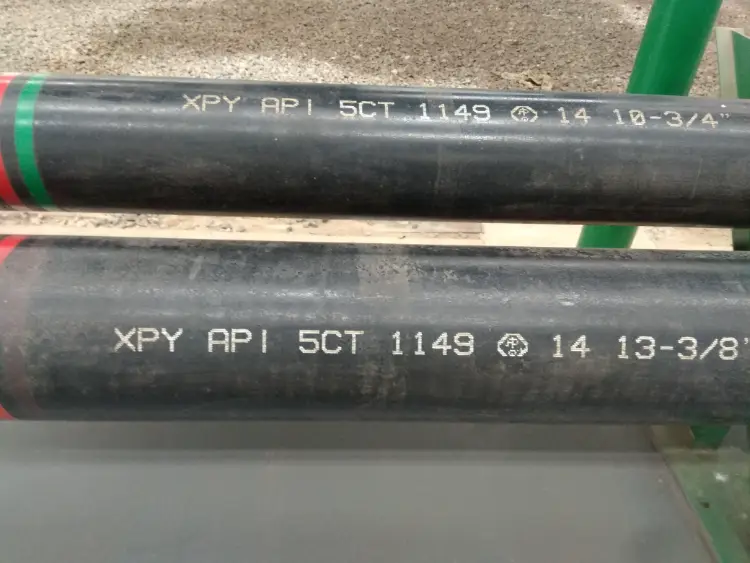
GB/T 1591 Q390C Steel for LSAW Pipe
GB/T 1591 Q390C Steel for LSAW Pipe: Chemical, Mechanical & Physical Properties
Detailed material data sheet for Q390C low-alloy high-strength structural steel under GB/T 1591, commonly used in LSAW (Longitudinal Submerged Arc Welded) pipes.
Hot rolling, thermomechanical rolling, normalizing, cold forming, submerged arc welding (LSAW, SSAW), electric resistance welding (ERW)
- Phone : +8618037372205
- Email : [email protected]
- WhatsApp: Contact via Whtsapp
- WeChat: +8618037372205
GB/T 1591 Q390C Steel for LSAW Pipe Introduction
Q390C is a Chinese standard low-alloy high-strength structural steel conforming to GB/T 1591. It features a minimum yield strength of 390 MPa and is supplied with impact testing at 0°C (quality level C), making it suitable for welded structures in low-temperature environments. The steel exhibits good weldability, formability, and toughness, and is widely used in the manufacture of LSAW pipes for bridges, buildings, offshore platforms, and pressure vessels. The material is typically delivered in hot-rolled, normalized, or thermomechanical rolled condition, with strict control over chemical composition and mechanical properties to ensure reliable performance in demanding structural applications.
GB/T 1591 Q390C Steel for LSAW Pipe Chemical Composition
The chemical composition of Q390C is strictly controlled to achieve the required strength, toughness, and weldability. Microalloying elements such as niobium, vanadium, and titanium are used to refine grain size and enhance precipitation strengthening. Maximum levels of phosphorus and sulfur are kept low to ensure good ductility and notch toughness at 0°C. Carbon equivalent (CEV) is typically controlled to improve weldability.
| Element | Specified Value (wt%) | Remarks |
|---|---|---|
| Carbon (C) | ≤ 0.18 | Heat analysis |
| Silicon (Si) | ≤ 0.50 | Heat analysis |
| Manganese (Mn) | 1.00 – 1.60 | Heat analysis |
| Phosphorus (P) | ≤ 0.030 | Heat analysis |
| Sulfur (S) | ≤ 0.030 | Heat analysis |
| Niobium (Nb) | 0.015 – 0.060 | Heat analysis |
| Vanadium (V) | 0.02 – 0.20 | Heat analysis |
| Titanium (Ti) | 0.02 – 0.20 | Heat analysis |
| Chromium (Cr) | ≤ 0.30 | Optional; may be added as specified |
| Nickel (Ni) | ≤ 0.50 | Optional; may be added as specified |
| Copper (Cu) | ≤ 0.40 | Optional; may be added as specified |
| Molybdenum (Mo) | ≤ 0.10 | Optional; may be added as specified |
| Nitrogen (N) | ≤ 0.015 | For aluminum-killed steel; otherwise ≤ 0.012 |
GB/T 1591 Q390C Steel for LSAW Pipe Physical Properties
The physical properties of Q390C are typical for low-alloy structural steels and are influenced by microstructure and manufacturing process. Values provided are at room temperature unless otherwise noted and may vary slightly with composition.
| Property | Value | Unit | Test Condition |
|---|---|---|---|
| Density (ρ) | 7850 | kg/m³ | At 20°C |
| Modulus of elasticity (E) | 206 | GPa | At 20°C, tension |
| Shear modulus (G) | 79.3 | GPa | Calculated from E and ν |
| Poisson's ratio (ν) | 0.30 | Dimensionless | Typical for steel |
| Thermal expansion coefficient (α) | 11.6 – 12.5 | 10⁻⁶/K | 20 – 100°C |
| Thermal conductivity (λ) | 42 – 46 | W/(m·K) | At 100°C |
| Specific heat capacity (c) | 480 | J/(kg·K) | At 20 – 100°C |
| Electrical resistivity (ρ_e) | ≈ 0.15 – 0.20 | μΩ·m | At 20°C |
GB/T 1591 Q390C Steel for LSAW Pipe Mechanical Properties
Mechanical properties of Q390C are defined for different thickness ranges and test orientations (longitudinal/transverse). The impact energy is specified at 0°C for quality level C (KV2 ≥ 34 J). Values listed below are based on GB/T 1591 for flat products and are often used as the basis for LSAW pipe base metal properties.
| Property | Value | Unit | Test Condition |
|---|---|---|---|
| Upper yield strength (ReH) – thickness ≤ 16 mm | ≥ 390 | MPa | Room temperature, longitudinal specimen |
| Upper yield strength (ReH) – thickness > 16 mm to ≤ 40 mm | ≥ 380 | MPa | Room temperature, longitudinal specimen |
| Upper yield strength (ReH) – thickness > 40 mm to ≤ 63 mm | ≥ 370 | MPa | Room temperature, longitudinal specimen |
| Tensile strength (Rm) – all thicknesses | 470 – 630 | MPa | Room temperature, longitudinal specimen |
| Elongation after fracture (A) – thickness ≤ 16 mm | ≥ 20 | % | Gauge length L0 = 5.65√S0, longitudinal |
| Elongation after fracture (A) – thickness > 16 mm to ≤ 40 mm | ≥ 19 | % | Gauge length L0 = 5.65√S0, longitudinal |
| Elongation after fracture (A) – thickness > 40 mm to ≤ 63 mm | ≥ 18 | % | Gauge length L0 = 5.65√S0, longitudinal |
| Impact energy (KV2) – 0°C | ≥ 34 (average of 3 tests, one individual ≥ 0.7×average) | J | Charpy V-notch, longitudinal specimen |
| Bend test – thickness ≤ 16 mm | d = 2a | - | 180° bend, specimen width ≥ 30 mm, a = thickness |
| Bend test – thickness > 16 mm to ≤ 40 mm | d = 3a | - | 180° bend, specimen width ≥ 30 mm, a = thickness |
GB/T 1591 Q390C Steel for LSAW Pipe International Equivalent Standards and Substitutable Grades
| Country/Region | Standard | Grade | Remarks |
|---|---|---|---|
| China | GB/T 1591 | Q390C | Base grade; 0°C impact, 390 MPa min. YS (≤16 mm) |
| Europe | EN 10025-4 | S420M | Thermomechanical rolled; min. YS 420 MPa (≤16 mm), impact at -20°C optional; strength slightly higher |
| USA | ASTM A572/A572M | Grade 60 [415] | Structural steel; min. YS 415 MPa (≤100 mm); impact testing not mandatory; not exact match for toughness |
| Japan | JIS G3106 | SM490C | Welded structural steel; min. YS 325 MPa (≤16 mm), impact at 0°C; lower strength, similar toughness |
GB/T 1591 Q390C Steel for LSAW Pipe Application Introduction
Q390C steel, particularly in the form of LSAW pipes, is extensively employed in structural and engineering applications that demand high strength, good low-temperature toughness, and reliable weldability. Key application areas include:
Product Applications: Longitudinal submerged arc welded (LSAW) pipes in large diameters (16" to 64" and larger), Structural hollow sections and welded columns, Steel plates for bridge girders and box columns, Caissons and piling pipes, Pressure vessel cylindrical courses
Processed into products: Bridge main girders, arch ribs, and suspension segments, Lattice transmission tower main legs and bracings, Offshore platform tubular joints and chords, Wind turbine tower shells and door frames, Hydraulic cylinder barrels and piston rods (thick-walled pipe), Piling pipe segments with interlocking joints, Flanges and connection plates for high-strength bolted assemblies
Application industries: Civil engineering and construction (high-rise buildings, long-span structures, bridges), Offshore and marine engineering (platform legs, jacket structures, subsea pipelines), Energy sector (wind turbine towers, transmission poles, pressure vessel shells), Pipeline industry (oil & gas transmission lines, water supply mains), Heavy machinery (crane booms, excavator arms, heavy-duty frameworks)
GB/T 1591 Q390C Steel for LSAW Pipe Similar and Alternative Material Recommendations
| Country/Region | Standard | Grade | Remarks |
|---|---|---|---|
| China | GB/T 1591 | Q345C | Lower yield strength (345 MPa); widely available, suitable for less demanding applications |
| China | GB/T 1591 | Q420C | Higher yield strength (420 MPa); closer in strength to S420M, may require adjustment in design |
| Europe | EN 10025-2 | S355J2 | Lower strength (355 MPa), good weldability; often used as a conservative substitute |
| USA | ASTM A709/A709M | Grade 50T [345T] | Bridge steel with similar toughness class; lower strength, suitable for bridges |
| International | ISO 4950-2 | E 390 C | High yield strength flat products; directly seeks 390 MPa YS with 0°C impact; obsolete but still referenced |
Notes:
When designing with Q390C, attention should be paid to the selection of appropriate welding consumables and pre-heating requirements to avoid cold cracking, especially in thick sections. Post-weld heat treatment (PWHT) may be specified for certain pressure vessel applications. For LSAW pipes, the weld seam is typically subjected to non-destructive testing (ultrasonic or radiographic) per applicable product standards. The carbon equivalent (CEV) is commonly limited to 0.45% or lower to ensure good field weldability. For critical structures, supplementary testing such as through-thickness tensile (Z-quality) or HIC/SSC testing may be specified by the purchaser.
- Share



