
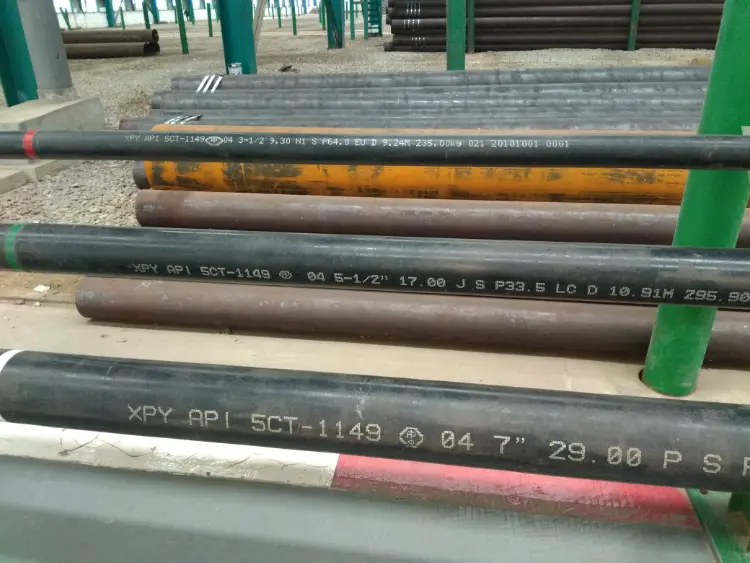
Q390B Steel for LSAW Pipe
GB/T1591 Grade Q390B Low Alloy High Strength Steel - Properties, Chemistry & LSAW Pipe Applications
Complete material datasheet for Q390B steel under GB/T1591, used for LSAW pipes. Includes chemical composition, mechanical & thermal physical properties, international equivalents, and application guidance.
Welding, cutting, cold/heat bending, machining, hot forming
- Phone : +8618037372205
- Email : [email protected]
- WhatsApp: Contact via Whtsapp
- WeChat: +8618037372205
Q390B Steel for LSAW Pipe Introduction
Q390B is a low alloy high strength structural steel grade specified in the Chinese standard GB/T 1591-2008. It offers a minimum yield strength of 390 MPa in thin sections, combined with good weldability, moderate toughness, and excellent cold formability. The steel is microalloyed with elements like vanadium, niobium, and titanium to achieve fine grain structure and enhanced strength. In the form of LSAW (Longitudinal Submerged Arc Welded) pipe, Q390B is widely used for oil and gas transmission, structural columns, and pressure applications. Plates are typically supplied in hot-rolled, controlled-rolled, or normalized condition; pipes are manufactured by forming and submerged arc welding, often followed by expansion.
Q390B Steel for LSAW Pipe Chemical Composition
The chemical composition complies with GB/T 1591-2008 for grade Q390B. Microalloying elements (V, Nb, Ti) are added singly or in combination to obtain fine grain size and desired strength level. Aluminum is added for deoxidation and grain refinement. Residual elements such as Cr, Ni, Cu, and Mo are limited to ensure weldability and toughness.
| Element | Content (%) | Remarks |
|---|---|---|
| Carbon, C | ≤ 0.20 | |
| Silicon, Si | ≤ 0.55 | |
| Manganese, Mn | 1.00 – 1.60 | |
| Phosphorus, P | ≤ 0.035 | |
| Sulfur, S | ≤ 0.035 | |
| Vanadium, V | 0.02 – 0.20 | Microalloying element |
| Niobium, Nb | 0.015 – 0.060 | Microalloying element |
| Titanium, Ti | 0.02 – 0.20 | Microalloying element |
| Chromium, Cr | ≤ 0.30 | Residual element |
| Nickel, Ni | ≤ 0.70 | Residual element |
| Copper, Cu | ≤ 0.30 | Residual element |
| Nitrogen, N | ≤ 0.015 | |
| Molybdenum, Mo | ≤ 0.20 | Residual element |
| Als (acid sol. Al) | ≥ 0.015 | Fine grain practice |
Q390B Steel for LSAW Pipe Thermal and Electrical Physical Properties
The following physical properties are typical for low alloy structural steel similar to Q390B at room temperature unless otherwise stated. These values may vary slightly with actual chemical composition and heat treatment condition. They are not specified in GB/T 1591 and serve as engineering approximations.
| Property | Typical Value | Unit | Test Condition |
|---|---|---|---|
| Density (ρ) | 7.85 | g/cm³ | At 20°C |
| Elastic modulus (E) | 206 | GPa | At 20°C |
| Shear modulus (G) | 79 | GPa | At 20°C |
| Poisson's ratio (ν) | 0.30 | - | At 20°C |
| Coefficient of thermal expansion (α) | 12.0 × 10⁻⁶ | 1/K | 20–100°C |
| Coefficient of thermal expansion (α) | 12.8 × 10⁻⁶ | 1/K | 20–200°C |
| Thermal conductivity (λ) | 45 – 50 | W/(m·K) | At 100°C |
| Specific heat capacity (c) | 460 | J/(kg·K) | At 20°C |
| Electrical resistivity (ρ_e) | 0.18 – 0.20 | Ω·mm²/m | At 20°C |
Q390B Steel for LSAW Pipe Mechanical Properties
The mechanical properties are specified according to GB/T 1591-2008 and depend on the product thickness. LSAW pipe wall thicknesses commonly fall in the range of 6–40 mm. The values below are for transversal test pieces taken from plates before pipe forming. Impact test temperature is 20°C (B class). For pipes, additional requirements such as weld seam toughness and hydrostatic testing may apply as per pipe manufacturing standard (e.g., GB/T 9711, API 5L).
| Property | Standard Value | Unit | Test Condition |
|---|---|---|---|
| Yield strength (ReH) | ≥ 390 | MPa | Thickness ≤ 16 mm |
| Yield strength (ReH) | ≥ 370 | MPa | Thickness 16 mm < t ≤ 40 mm |
| Yield strength (ReH) | ≥ 350 | MPa | Thickness 40 mm < t ≤ 63 mm |
| Yield strength (ReH) | ≥ 330 | MPa | Thickness 63 mm < t ≤ 80 mm |
| Yield strength (ReH) | ≥ 310 | MPa | Thickness 80 mm < t ≤ 100 mm |
| Tensile strength (Rm) | 490 – 650 | MPa | Thickness ≤ 100 mm |
| Elongation after fracture (A) | ≥ 20 | % | Thickness ≤ 16 mm, gauge length 5.65√So |
| Elongation after fracture (A) | ≥ 19 | % | Thickness 16–63 mm |
| Elongation after fracture (A) | ≥ 18 | % | Thickness 63–100 mm |
| Charpy impact energy (KV2) | ≥ 34 | J | At 20°C, longitudinal specimen |
| Bend test (bend angle 180°) | d = 3a | - | Thickness ≤ 16 mm |
| Bend test (bend angle 180°) | d = 4a | - | Thickness > 16–100 mm |
Q390B Steel for LSAW Pipe Full Equivalent Material Standards & Recommended Substitute Grades
No internationally standardized grade identically matches Q390B in both chemical composition and mechanical properties. The following table lists the closest commercial substitutes that can be considered for interchangeability in design, provided adjustments are made for strength levels and acceptance by the relevant project specification.
| Country/Region | Standard | Grade | Remarks |
|---|---|---|---|
| China | GB/T 1591-2008 | Q390B | Base reference |
| EU | EN 10025-3:2019 | S420N | Yield min. 420 MPa (≤16 mm); CVN at -20°C; similar alloy concept, negotiable as substitute |
| USA | ASTM A572/A572M | Grade 60 [415] | Yield min. 415 MPa; no specific impact requirement; check toughness requirement |
| Japan | JIS G3106:2015 | SM490B | Yield min. 325 MPa (≤16 mm); lower strength but widely used; can match with thickness compensation |
Q390B Steel for LSAW Pipe Application Introduction
Q390B grade LSAW pipe offers an optimum balance of high strength, good low-temperature toughness, and excellent weldability. It is especially favored in oil and gas transportation systems, large-span structures, and heavy machinery. The submerged arc welded longitudinal seam ensures high productivity and consistent quality. Key applications and processed components include:
Product Applications: LSAW line pipes (API 5L PSL2 type, or GB/T 9711 equivalent), Structural tubular columns and beams, Spiral welded pipes (if formed into spiral pipe), Piling pipes for ports and bridges, Process piping in petrochemical plants, Rolled and welded pressure vessel cylinders
Processed into products: Pipe fittings: elbows, tees, reducers, Flanges and weld-neck flanges, Manhole and nozzle reinforcements, Support saddles and base rings, Drilling riser pipes, Casing and conductor pipes in geotechnical applications
Application industries: Oil & gas transmission (onshore and offshore pipelines), Structural engineering (buildings, bridges, towers), Offshore and marine construction (platforms, jackets, risers), Pressure vessel and boiler manufacturing (shell courses, nozzles), Piling and foundation works, Mechanical engineering (crane booms, heavy equipment frames)
Q390B Steel for LSAW Pipe Near/Similar Substitute Materials
These materials are not direct equivalents but exhibit comparable mechanical properties or similar application environments. They may be considered where availability or project requirements allow, after engineering evaluation.
| Country/Region | Standard | Grade | Remarks |
|---|---|---|---|
| China | GB/T 1591-2018 | Q355B | New standard; yield 355 MPa, lower strength; part of the Q355 series replacing Q345/Q390 |
| EU | EN 10025-2:2019 | S355J0 | Yield 355 MPa; widely used high strength structural steel; lower strength than Q390B |
| USA | ASTM A572/A572M | Grade 50 [345] | Yield 345 MPa; commonly used for structural pipes, lower strength |
| International | ISO 4950-2 | ISO E355 | Yield 355 MPa; fine-grain steel for structural applications |
Notes:
For LSAW pipe production, supplementary requirements such as through-thickness property (Z-direction), hardness limits, and special impact testing temperatures should be specified in the purchase order. The welding consumables must match the base metal strength level; typical preheat may be required for thicker sections (>25 mm) depending on carbon equivalent. Information contained herein is based on GB/T 1591-2008 and typical engineering data; always verify with the mill test certificate for a specific heat.
- Share



