
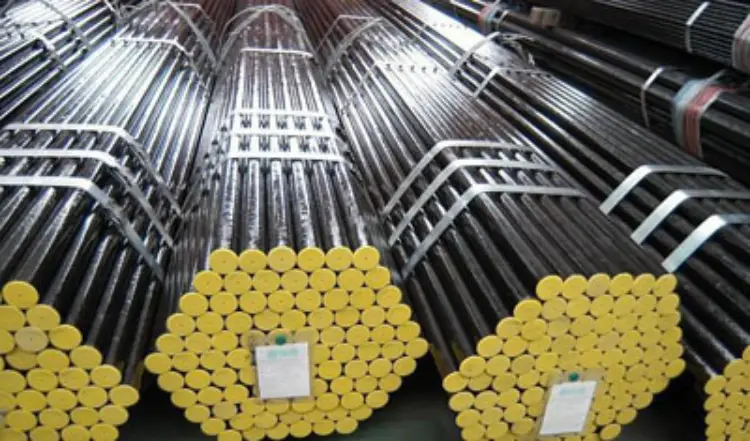
Q390A High-Strength Low-Alloy Steel LSAW Pipe
Q390A High-Strength Low-Alloy Steel LSAW Pipe Data Sheet | GB/T 1591
Comprehensive material data for Q390A low alloy high strength structural steel according to GB/T 1591, commonly used for LSAW pipes, including chemical composition, mechanical and physical properties, equivalent grades, and fabrication guidance.
Hot rolling, normalizing, welding
- Phone : +8618037372205
- Email : [email protected]
- WhatsApp: Contact via Whtsapp
- WeChat: +8618037372205
Q390A High-Strength Low-Alloy Steel LSAW Pipe Introduction
Q390A is a Chinese standard low alloy high strength structural steel defined in GB/T 1591-2018. It features a minimum yield strength of 390 MPa and good weldability, making it suitable for welded structures such as longitudinally submerged arc welded (LSAW) pipes. As a Grade A designation, it does not guarantee specific impact toughness. The steel is typically delivered in hot-rolled or normalized condition and is widely used in oil and gas transmission pipelines, bridge engineering, building structures, and heavy machinery. Its balanced chemical composition with microalloying elements (Nb, V, Ti) ensures fine grain strengthening and excellent mechanical properties across a range of thicknesses.
Q390A High-Strength Low-Alloy Steel LSAW Pipe Chemical Composition
The chemical composition of Q390A is in accordance with GB/T 1591-2018. Values are heat analysis limits. Microalloying elements such as Nb, V, and Ti are added for grain refinement and precipitation strengthening. Phosphorus and sulfur are strictly controlled to ensure weldability and toughness.
| Chemical Element | Standard Value (%) | Remarks |
|---|---|---|
| Carbon (C) | ≤ 0.20 | |
| Silicon (Si) | ≤ 0.50 | |
| Manganese (Mn) | 1.00 - 1.60 | |
| Phosphorus (P) | ≤ 0.035 | |
| Sulfur (S) | ≤ 0.035 | |
| Niobium (Nb) | 0.015 - 0.060 | Optional element |
| Vanadium (V) | 0.02 - 0.20 | Optional element |
| Titanium (Ti) | 0.02 - 0.20 | Optional element |
| Chromium (Cr) | ≤ 0.30 | |
| Nickel (Ni) | ≤ 0.30 | |
| Copper (Cu) | ≤ 0.30 | |
| Molybdenum (Mo) | ≤ 0.10 | |
| Nitrogen (N) | ≤ 0.015 | |
| Acid-soluble Aluminum (Als) | ≥ 0.015 | Optional, for grain refinement |
Q390A High-Strength Low-Alloy Steel LSAW Pipe Thermal and Electrical Physical Properties
The following physical properties are typical values for low alloy structural steels at room temperature unless stated otherwise. They are not specified in GB/T 1591 but are commonly accepted engineering data for Q390A and similar grades.
| Property | Standard Value | Unit | Test Condition |
|---|---|---|---|
| Density (ρ) | 7.85 | g/cm³ | 20 °C |
| Elastic Modulus (E) | 206 | GPa | 20 °C |
| Shear Modulus (G) | 79 | GPa | 20 °C |
| Poisson's Ratio (ν) | 0.30 | 20 °C | |
| Thermal Expansion Coefficient (α) | 12.0 | ×10⁻⁶/K | 20–100 °C |
| Thermal Conductivity (λ) | approx. 50 | W/(m·K) | 20 °C |
| Specific Heat Capacity (cp) | approx. 460 | J/(kg·K) | 20 °C |
| Electrical Resistivity (ρₑ) | 0.15 – 0.25 | Ω·mm²/m | 20 °C |
Q390A High-Strength Low-Alloy Steel LSAW Pipe Mechanical Properties
The mechanical properties are based on GB/T 1591-2018 for Q390A steel. The values depend on the nominal thickness of the product. For LSAW pipes, the wall thickness determines the applicable grade. Q390A does not have specified impact energy requirements (Grade A).
| Property | Required Value | Unit | Test Condition |
|---|---|---|---|
| Yield Strength (ReH) | ≥ 390 | MPa | Thickness ≤ 16 mm |
| Yield Strength (ReH) | ≥ 370 | MPa | Thickness > 16 mm to 40 mm |
| Yield Strength (ReH) | ≥ 350 | MPa | Thickness > 40 mm to 63 mm |
| Yield Strength (ReH) | ≥ 330 | MPa | Thickness > 63 mm to 80 mm |
| Yield Strength (ReH) | ≥ 310 | MPa | Thickness > 80 mm to 100 mm |
| Tensile Strength (Rm) | 490 - 650 | MPa | Thickness ≤ 100 mm |
| Elongation (A) | ≥ 20 | % | Thickness ≤ 40 mm |
| Elongation (A) | ≥ 19 | % | Thickness > 40 mm to 100 mm |
| Bend Test (180°) | d = a | Thickness ≤ 16 mm | |
| Bend Test (180°) | d = 2a | Thickness > 16 mm to 100 mm |
Q390A High-Strength Low-Alloy Steel LSAW Pipe Completely Equivalent Material Standards and Replaceable Grades
| Country/Region | Standard | Grade | Remarks |
|---|---|---|---|
| China | GB/T 1591-2018 | Q390A | Original grade, base specification |
| International | ISO 4950-2 | S355K2G3 | Similar yield 355 MPa, lower strength |
| European Union | EN 10025-2 | S355J0 | Closest available, yield 355 MPa |
| Japan | JIS G3106 | SM490A | Yield strength ~325 MPa, lower |
| USA | ASTM A572/A572M | Grade 60 [415] | Minimum yield 415 MPa, slightly higher |
Q390A High-Strength Low-Alloy Steel LSAW Pipe Application Introduction
Q390A LSAW pipe and plate are widely used in welded structures where moderate strength and good weldability are required. The material can be easily fabricated by cutting, welding, and cold forming. It is commonly employed in industries requiring reliable structural integrity under static and dynamic loads.
Product Applications: Longitudinally Submerged Arc Welded (LSAW) pipes, Welded structural hollow sections, Heavy plates for bridge decks, Fabricated building frames, Machinery base frames
Processed into products: Oil pipeline segments and fittings, Offshore platform structural members, Bridge main girders and arch ribs, High-rise building columns, Crane booms and chassis, Pressure vessel shells
Application industries: Oil and Gas (transmission pipelines), Construction and Civil Engineering, Bridge Engineering, Shipbuilding, Heavy Machinery Manufacturing, Pressure Vessels
Q390A High-Strength Low-Alloy Steel LSAW Pipe Similar/Alternative Material Recommendations
| Country/Region | Standard | Grade | Remarks |
|---|---|---|---|
| China | GB/T 1591-2018 | Q345B | Lower yield strength (345 MPa), good for general structures |
| China | GB/T 1591-2018 | Q420A | Higher yield strength (420 MPa), for more demanding applications |
| European Union | EN 10025-2 | S355J2 | Impact tested at -20°C, slightly lower strength |
| European Union | EN 10025-3 | S420N | Normalized, yield 420 MPa, better toughness |
Notes:
Q390A is a basic grade without impact test requirement; for low temperature or dynamic loading environments, consider upgrading to Q390C, Q390D, or Q390E. Welding consumables should be selected according to the base metal and service condition. Preheating and post-weld heat treatment may be required for thicker sections. Typical welding processes include SAW, SMAW, and GMAW.
- Share



