
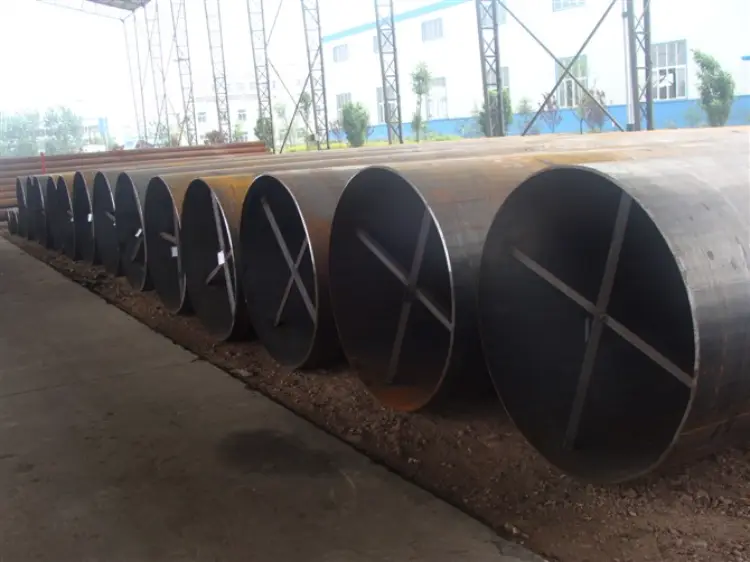
Q345E Structural Steel for LSAW Pipe
Q345E Structural Steel for LSAW Pipe - Chemical, Mechanical & Thermal Properties
Comprehensive material data for Q345E steel according to GB/T 1591-2008, including chemical composition, mechanical properties, thermal and electrical physical properties, used in LSAW pipe manufacturing.
Hot rolling, normalizing, thermo-mechanical controlled processing (TMCP), welding
- Phone : +8618037372205
- Email : [email protected]
- WhatsApp: Contact via Whtsapp
- WeChat: +8618037372205
Q345E Structural Steel for LSAW Pipe Introduction
Q345E is a low-alloy high-strength structural steel classified under Chinese standard GB/T 1591-2008. It is widely used in welded structures requiring excellent notch toughness at low temperatures down to -40°C. The steel is characterized by a minimum yield strength of 345 MPa (for thickness ≤16 mm) and good weldability. Typical applications include heavy-duty LSAW (Longitudinal Submerged Arc Welded) pipes for oil and gas transmission, offshore platforms, bridges, and building structures. The material is supplied in hot-rolled, normalised or thermo-mechanically rolled condition, ensuring fine grain size and consistent mechanical properties. Its balanced chemical composition with micro-alloying elements like Nb, V, Ti enhances strength and toughness without compromising weldability.
Q345E Structural Steel for LSAW Pipe Chemical Composition
Chemical composition per GB/T 1591-2008 for Q345E. The steel is produced as fine grain killed steel with micro-alloying additions. Note: For thickness >100 mm C content may be increased, and acid-soluble aluminium (Als) ≥0.015% is required.
| Element | Specified Value (max) | Remarks |
|---|---|---|
| Carbon (C) | 0.18 | For thickness ≤100 mm |
| Silicon (Si) | 0.50 | If required, may be reduced for improved weldability |
| Manganese (Mn) | 1.70 | Slightly higher Mn helps to refine grain and increase strength |
| Phosphorus (P) | 0.025 | Low P for excellent low-temperature toughness |
| Sulfur (S) | 0.020 | Low S to avoid hot shortness and improve through-thickness properties |
| Niobium (Nb) | 0.07 | Micro-alloying element for grain refinement and precipitation strengthening |
| Vanadium (V) | 0.15 | Combined with Nb or Ti for enhanced strength |
| Titanium (Ti) | 0.20 | Ti forms nitrides/carbides for grain size control |
| Chromium (Cr) | 0.30 | Residual or added for strength, may be controlled to lower values |
| Nickel (Ni) | 0.50 | Optional, improves toughness but limited to 0.50% in Q345E |
| Copper (Cu) | 0.30 | Residual, may be higher if specified |
| Nitrogen (N) | 0.012 | Low nitrogen content to avoid strain ageing |
| Molybdenum (Mo) | 0.10 | Optional, residual element |
| Aluminium (Als) | ≥0.015 | Acid-soluble Al for full deoxidation and grain refinement |
Q345E Structural Steel for LSAW Pipe Thermal and Electrical Physical Properties
Typical physical properties for Q345E steel at ambient temperature unless otherwise noted. These values are indicative and may vary slightly with manufacturing process and microstructure.
| Property | Typical Value | Unit | Test Condition / Remarks |
|---|---|---|---|
| Density (ρ) | 7.85 | g/cm³ | At 20°C |
| Modulus of Elasticity (E) | 206 | GPa | At 20°C, longitudinal |
| Shear Modulus (G) | 79.3 | GPa | Calculated from E and Poisson's ratio |
| Poisson's Ratio (ν) | 0.3 | — | At 20°C |
| Thermal Expansion Coefficient (α) | 11.5 × 10⁻⁶ | K⁻¹ | Between 20°C and 100°C |
| Thermal Expansion Coefficient (α) | 12.4 × 10⁻⁶ | K⁻¹ | Between 20°C and 300°C |
| Thermal Conductivity (λ) | 45 | W/(m·K) | At 20°C |
| Specific Heat Capacity (cp) | 460 | J/(kg·K) | At 20°C |
| Electrical Resistivity (ρe) | 0.22 × 10⁻⁶ | Ω·m | At 20°C |
Q345E Structural Steel for LSAW Pipe Mechanical Properties
Mechanical properties according to GB/T 1591-2008 for Q345E. Yield strength values vary with thickness. Charpy V-notch impact energy is guaranteed at -40°C for longitudinal specimens. Tension test specimens are taken transversely unless otherwise agreed.
| Property | Specified Value | Unit | Test Condition / Remarks |
|---|---|---|---|
| Yield Strength (ReH) | ≥345 | MPa | Thickness ≤16 mm, transverse |
| Yield Strength (ReH) | ≥335 | MPa | Thickness >16 mm ≤40 mm |
| Yield Strength (ReH) | ≥325 | MPa | Thickness >40 mm ≤63 mm |
| Yield Strength (ReH) | ≥315 | MPa | Thickness >63 mm ≤80 mm |
| Yield Strength (ReH) | ≥305 | MPa | Thickness >80 mm ≤100 mm |
| Yield Strength (ReH) | ≥285 | MPa | Thickness >100 mm ≤150 mm |
| Yield Strength (ReH) | ≥275 | MPa | Thickness >150 mm ≤200 mm (plate) |
| Tensile Strength (Rm) | 470–630 | MPa | All thicknesses, transverse |
| Elongation (A) | ≥21 | % | Gauge length Lo=5.65√So; thickness ≤40 mm |
| Elongation (A) | ≥20 | % | Thickness >40 mm ≤63 mm |
| Elongation (A) | ≥19 | % | Thickness >63 mm ≤100 mm |
| Elongation (A) | ≥18 | % | Thickness >100 mm ≤150 mm |
| Elongation (A) | ≥17 | % | Thickness >150 mm ≤200 mm |
| Charpy Impact (KV2) | ≥34 | J | Longitudinal, -40°C, average of 3 tests; one individual min 27 J |
| Bend Test (180°) | d=2a | — | Bend diameter; for thickness ≤16 mm |
| Bend Test (180°) | d=3a | — | For thickness >16 mm; a = specimen thickness |
Q345E Structural Steel for LSAW Pipe Direct Equivalent Material Standards & Substitute Grades
| Country/Region | Standard | Grade | Remarks |
|---|---|---|---|
| China | GB/T 1591-2018 | Q355NE | Modern replacement for Q345E; minimum yield 355 MPa, -40°C impact |
| European Union | EN 10025-3 | S355NL | Normalised low alloy structural steel with -50°C impact energy |
| International | ISO 630-3 | S355E | Equivalent to E quality (-40°C). IS0 630-3 S355ML is also similar |
| Japan | JIS G3106 | SM490B | Not fully equivalent but with supplementary requirement for -40°C toughness |
| United States | ASTM A572/A572M | Grade 50 [345] Type 1 | Requires additional low-temperature Charpy specification; not standard |
Q345E Structural Steel for LSAW Pipe Application Introduction
Q345E steel is especially suited for welded structures requiring high strength and excellent resistance to brittle fracture at low temperatures. The guaranteed impact energy at -40°C makes it a preferred choice for arctic environments and critical piping. LSAW pipes produced from Q345E plates are extensively used in oil and gas transmission, where reliable toughness and weld integrity are essential.
Product Applications: LSAW (Longitudinal Submerged Arc Welded) steel pipes, Spiral welded pipes, Welded structural sections (H-beams, box columns), Plates for ship hull and offshore platforms, Penstocks and water conveyance pipes, Bridge girders and steel trusses
Processed into products: Pipe body and longitudinal weld seam of LSAW line pipes, Flanges, elbows, tees, and reducers for pipeline fittings, Base plates and stiffeners of wind turbine towers, Main bearing supports in construction cranes and excavators, Pressure vessel shells and heads, Structural nodes in long-span bridges
Application industries: Oil & gas (onshore/offshore pipeline systems), Petrochemical and chemical processing, Marine and offshore engineering, Civil and bridge construction, Wind energy (tower fabrication), Pressure vessel and boiler manufacturing, Heavy machinery and transport equipment
Q345E Structural Steel for LSAW Pipe Similar/Alternative Materials with Comparable Performance
| Country/Region | Standard | Grade | Remarks |
|---|---|---|---|
| China | GB/T 1591-2018 | Q345E (heritage designation) | The old Q345E may still be available under new standard as Q355NE with adjusted chemistry |
| European Union | EN 10025-2 | S355J2+N | Yield 355 MPa but only guaranteed impact at -20°C; suitable for less severe conditions |
| European Union | EN 10025-4 | S355ML | Thermo-mechanically rolled, impact at -50°C; good alternative for plates |
| United States | ASTM A516/A516M | Grade 65 | Pressure vessel quality plate with good low-temp properties; min YS 240 MPa, different strength profile |
| United States | API SPEC 5L | X52 (L360) | Line pipe steel with similar strength level; often produced in TMCP with good notch toughness |
Notes:
Standard update note: The old GB/T 1591-2008 standard has been replaced by GB/T 1591-2018, in which Q345 grades are superseded by Q355 grades (e.g., Q355NE). When ordering to the new standard, the chemical composition and mechanical properties may slightly differ, but the overall performance is equivalent or improved. For LSAW pipe manufacturing, the plate is often supplied with a minimum CEV (Carbon Equivalent Value) limitation, typically CEV ≤0.43% for good weldability. Supplementary testing may include through-thickness tensile (Z-direction) properties if specified for resistance to lamellar tearing.
- Share



