
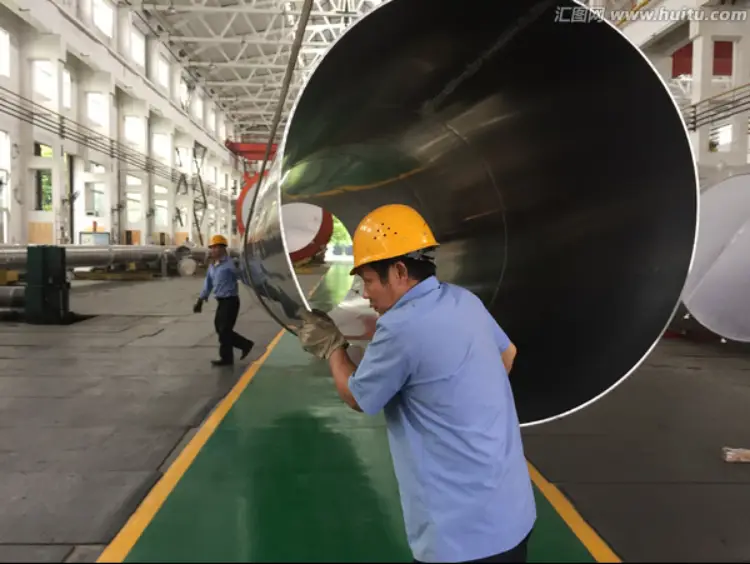
GB/T 1591 Q345D LSAW Pipe
GB/T 1591 Q345D LSAW Pipe: Premium Low-Alloy High-Strength Steel for Welded Pipes
Detailed material data for Q345D low-alloy high-strength structural steel conforming to GB/T 1591, specifically used for LSAW pipes. Includes chemical composition, mechanical and physical properties, international equivalents, and application guidelines for welded tubular structures.
Hot rolling, controlled rolling, normalising, and welding for pipe fabrication
- Phone : +8618037372205
- Email : [email protected]
- WhatsApp: Contact via Whtsapp
- WeChat: +8618037372205
GB/T 1591 Q345D LSAW Pipe Introduction
Q345D is a low-alloy high-strength structural steel grade defined in GB/T 1591-2018. It delivers a minimum yield strength of 345 MPa (for thicknesses ≤16 mm) and excellent low-temperature impact toughness (≥34 J at -20°C). The material is widely used in welded structures and is particularly suited for producing LSAW (Longitudinally Submerged Arc Welded) pipes. These pipes combine high strength, good weldability, and reliable toughness, making them ideal for demanding applications such as oil and gas transmission, construction, and marine engineering. Q345D offers a balanced chemical composition with controlled microalloying elements, ensuring homogeneous mechanical properties after normalising or controlled rolling. This datasheet provides complete technical specifications, international equivalents, and guidance for material selection.
GB/T 1591 Q345D LSAW Pipe Chemical Composition
Heat analysis according to GB/T 1591-2018. The steel is characterised by low carbon content for weldability and microalloying additions (Nb, V, Ti) for grain refinement and precipitation strengthening. Phosphorus and sulphur are strictly controlled to ensure cleanliness and impact resistance.
| Element | Standard Value (max unless range) | Remarks |
|---|---|---|
| C | ≤0.18 | Improves strength; low level aids weldability |
| Si | ≤0.50 | Deoxidiser and solid-solution strengthener |
| Mn | ≤1.70 | Deoxidiser, compensates for lower C content |
| P | ≤0.030 | Impurity element; low content for toughness |
| S | ≤0.025 | Impurity element; low content for cleanliness |
| Nb | ≤0.07 | Grain refiner and precipitation strengthener |
| V | ≤0.15 | Fine precipitation strengthening |
| Ti | ≤0.20 | Grain refinement and nitrogen fixing |
| Cr | ≤0.30 | Addition from scrap; no mandatory requirement |
| Ni | ≤0.50 | Residual element; may improve toughness |
| Cu | ≤0.30 | Residual element; can increase atmospheric corrosion resistance |
| Mo | ≤0.10 | Residual element; not intentionally added |
| Als | ≥0.015 | Acid-soluble aluminium for deoxidation |
| N | ≤0.012 | Combined with Al and V to form nitrides |
GB/T 1591 Q345D LSAW Pipe Thermal and Electrical Physical Properties
Typical physical data for low-alloy structural steel at room temperature unless otherwise noted. These values apply to Q345D and similar carbon-manganese steels. They are suitable for design calculations involving heat transfer, thermal expansion, and electrical resistance. The data are derived from published references for comparable steel grades.
| Property | Standard Value | Unit | Test Condition |
|---|---|---|---|
| Density (ρ) | 7.85 | g/cm³ | At 20°C |
| Elastic Modulus (E) | 210 | GPa | At 20°C, static |
| Shear Modulus (G) | ~81 | GPa | Calculated from E and ν |
| Poisson's Ratio (ν) | 0.3 | - | In elastic range |
| Thermal Expansion Coefficient (α) | 11.7×10⁻⁶ | K-1 | 20°C to 100°C |
| Thermal Expansion Coefficient (α) | 12.5×10⁻⁶ | K-1 | 20°C to 200°C |
| Thermal Conductivity (λ) | ~45 | W/(m·K) | At 20°C |
| Specific Heat Capacity (c) | ~470 | J/(kg·K) | At 20°C |
| Electrical Resistivity (ρe) | ~0.23×10⁻⁶ | Ω·m | At 20°C |
GB/T 1591 Q345D LSAW Pipe Mechanical Properties
Tensile and impact properties as per GB/T 1591-2018 for Q345D. Values depend on product thickness. The steel exhibits a minimum yield strength of 345 MPa in thin sections and excellent low-temperature Charpy V-notch toughness at -20°C. Bending test requirements ensure acceptable formability. Data apply to the base material; LSAW pipe properties are verified by weld qualification and hydrostatic testing.
| Property | Standard Requirement | Unit | Test Condition |
|---|---|---|---|
| Yield Strength (ReH) | ≥345 | MPa | Thickness ≤16 mm |
| Yield Strength (ReH) | ≥335 | MPa | Thickness >16–40 mm |
| Yield Strength (ReH) | ≥325 | MPa | Thickness >40–63 mm |
| Yield Strength (ReH) | ≥315 | MPa | Thickness >63–80 mm |
| Yield Strength (ReH) | ≥305 | MPa | Thickness >80–100 mm |
| Yield Strength (ReH) | ≥285 | MPa | Thickness >100–150 mm |
| Yield Strength (ReH) | ≥275 | MPa | Thickness >150–200 mm |
| Yield Strength (ReH) | ≥265 | MPa | Thickness >200–250 mm |
| Tensile Strength (Rm) | 470–630 | MPa | All thicknesses |
| Elongation after Fracture (A) | ≥21 | % | Thickness ≤40 mm, gauge L0=5.65√S0 |
| Elongation after Fracture (A) | ≥20 | % | Thickness >40–63 mm |
| Elongation after Fracture (A) | ≥19 | % | Thickness >63–100 mm |
| Elongation after Fracture (A) | ≥18 | % | Thickness >100–150 mm |
| Elongation after Fracture (A) | ≥17 | % | Thickness >150–250 mm |
| Impact Energy (KV2) | ≥34 | J | Longitudinal, -20°C, V-notch |
| Bend Test (180°) | d=2a | - | Thickness ≤16 mm |
| Bend Test (180°) | d=3a | - | Thickness >16–100 mm |
GB/T 1591 Q345D LSAW Pipe Completely Equivalent Material Standards and Replaceable Grades
| Country/Region | Standard | Grade | Remarks |
|---|---|---|---|
| China | GB/T 1591-2018 | Q345D | Original designation |
| European Union | EN 10025-2:2019 | S355J2 (+N) | Equivalent for minimum yield 355 MPa, impact at -20°C; check thickness ranges |
| USA | ASTM A572/A572M-21 | Grade 50 [345] | Closest match; Type 2 or 5 may be needed for low temp. toughness |
| International | ISO 4950-2:1995 | E355D | High yield strength structural steel, same impact temperature |
| Japan | JIS G3106:2015 | SM490A | Comparable strength, charpy requirements differ; verify with supplier |
| India | IS 2062:2011 | E345 D | Grade with similar tensile and impact properties |
GB/T 1591 Q345D LSAW Pipe Application Introduction
Q345D LSAW pipes are used in large-diameter, high-pressure applications where a combination of strength, weldability, and resistance to brittle fracture is required. Typical wall thicknesses range from 6 mm to 80 mm, and diameters from 406 mm to 1626 mm. The pipes can be manufactured according to API 5L (PSL2), GB/T 9711, or other project specifications when using Q345D as the base material. The low carbon equivalent (CEV typically ≤0.45%) enables reliable welding without preheating under moderate ambient conditions.
Product Applications: Long-distance oil and natural gas pipelines, Structural columns and trusses in buildings, Offshore platform legs and braces, Piling pipes for deep foundations, Welded fluid transportation pipes for chemical and mining industries
Processed into products: Pipeline sections and fittings (elbows, tees, reducers), Welded girders and box columns, High-pressure boiler drums and separators (subject to code approval), Wind turbine towers, Marine risers and conductor casings
Application industries: Oil and gas transmission (onshore and offshore pipelines), Structural engineering (bridge supports, stadium frames, high-rise buildings), Water supply and sewage treatment (large-diameter fluid transmission), Shipbuilding and marine structures (jacket platforms, piling), Power plants (cooling water circuits, penstocks)
GB/T 1591 Q345D LSAW Pipe Similar / Alternative Material Recommendations
| Country/Region | Standard | Grade | Remarks |
|---|---|---|---|
| China | GB/T 1591-2018 | Q345B | Same strength, impact only at +20°C; less tough |
| China | GB/T 1591-2018 | Q345C | Same strength, impact at 0°C |
| China | GB/T 1591-2018 | Q345E | Same strength, impact at -40°C; superior toughness |
| China | GB/T 1591-2018 | Q355D | New revision with 355 MPa minimum yield, similar impact |
| China | GB/T 19879-2015 | Q345GJD | Structural steel for building, with stricter through-thickness properties |
| European Union | EN 10025-3:2019 | S355N/NL | Normalised fine grain steel, good low-temperature toughness |
Notes:
- For LSAW pipe production, Q345D plates are typically formed by JCOE or UOE processes and welded with submerged arc technique. The finished pipe must meet additional dimensional and non-destructive testing requirements per application standards (e.g., API 5L, DNV-OS-F101).
- When substituting with international grades, verify that the mechanical properties match for the intended thickness range and that the impact test temperature is adequate for the project environment.
- The steel is classified as a fine-grain quality in accordance with GB/T 1591-2018, which implies a minimum ratio of aluminium to nitrogen and grain size requirements.
- In through-thickness (Z-direction) loaded structures, consider specifying Q345D-Z15/Z25/Z35 according to GB/T 5313 to avoid lamellar tearing.
- Share



