
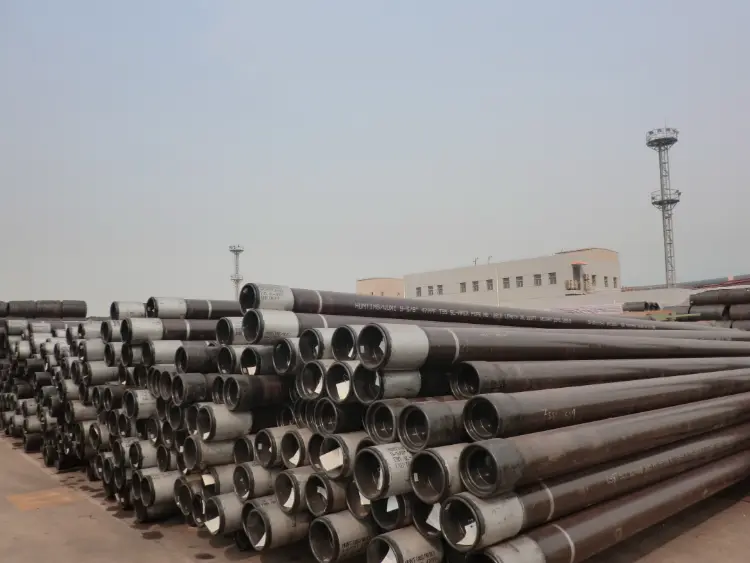
Q420A Low Alloy Structural Steel for LSAW Pipe
Q420A Low Alloy Structural Steel for LSAW Pipe - GB/T 1591
Explore Q420A steel under GB/T 1591 for LSAW pipes, covering chemical composition, mechanical and thermal properties, and equivalent grades.
Hot rolling, controlled rolling, normalizing, welding, cutting, forming
- Phone : +8618037372205
- Email : [email protected]
- WhatsApp: Contact via Whtsapp
- WeChat: +8618037372205
Q420A Low Alloy Structural Steel for LSAW Pipe Introduction
Q420A is a low alloy high strength structural steel in accordance with Chinese standard GB/T 1591. It is designed for welded structures and heavy-duty applications requiring a minimum yield strength of 420 MPa. This grade belongs to quality class A, which does not require impact testing, making it suitable for general structural purposes. The steel is typically supplied in hot-rolled, controlled rolled, or normalized condition, and is widely used in the manufacture of longitudinally submerged arc welded (LSAW) pipes for oil and gas transportation, structural frameworks, bridges, and machinery. Q420A exhibits excellent weldability, good ductility, and reasonable toughness at ambient temperatures, though it is not intended for low-temperature service. The chemical composition is microalloyed with elements such as niobium, vanadium, and titanium to refine grain size and enhance strength. This material can be processed by cutting, cold forming, and welding. Delivery condition for LSAW pipe is often thermomechanical rolled (TMCP) or normalized to meet stringent dimensional and mechanical requirements.
Q420A Low Alloy Structural Steel for LSAW Pipe Chemical Composition
Chemical composition of Q420A according to GB/T 1591-2018. The steel is microalloyed with Nb, V, Ti to ensure grain refinement and precipitation strengthening. Residual elements are controlled to ensure weldability and mechanical properties.
- For thickness ≤100 mm, ladle analysis applies.
- At least one of the fine grain elements (Nb, V, Ti) shall be present. Alternatively, Al content ≥0.015% can be used.
| Element | Standard Value (≤, %) | Remarks |
|---|---|---|
| C (Carbon) | 0.20 | Max |
| Si (Silicon) | 0.55 | Max |
| Mn (Manganese) | 1.70 | Max |
| P (Phosphorus) | 0.030 | Max |
| S (Sulfur) | 0.030 | Max |
| Nb (Niobium) | 0.07 | Max; optional microalloy |
| V (Vanadium) | 0.15 | Max; optional microalloy |
| Ti (Titanium) | 0.20 | Max; optional microalloy |
| Cr (Chromium) | 0.30 | Max; residual |
| Ni (Nickel) | 0.80 | Max; residual |
| Cu (Copper) | 0.55 | Max; residual |
| Mo (Molybdenum) | 0.20 | Max; residual |
| N (Nitrogen) | 0.015 | Max |
| Als (Acid-soluble Al) | ≥0.015 | If used for grain refinement, or total Al ≥0.020 |
Q420A Low Alloy Structural Steel for LSAW Pipe Thermal and Electrical Physical Properties
Typical physical properties for low alloy structural steel like Q420A. These values are indicative for room temperature unless otherwise stated and can slightly vary with composition and heat treatment.
- Density assumed for steel with approximately 0.2% carbon.
- Thermal properties are average values over specified temperature ranges.
| Property | Typical Value | Unit | Test Condition / Notes |
|---|---|---|---|
| Density (ρ) | 7.85 | g/cm³ | 20°C |
| Modulus of elasticity (E) | 200 - 210 | GPa | 20°C, typical 206 GPa |
| Shear modulus (G) | 79.3 - 81 | GPa | Calculated from E and ν |
| Poisson's ratio (ν) | 0.30 | - | Elastic range |
| Thermal expansion coefficient (α) | 11.0 - 12.5 | 10⁻⁶/K | 20-100°C |
| Thermal expansion coefficient (α) | 12.0 - 13.5 | 10⁻⁶/K | 20-200°C |
| Thermal conductivity (λ) | 45 - 50 | W/(m·K) | 20°C |
| Specific heat capacity (cp) | 470 | J/(kg·K) | 20°C |
| Electrical resistivity (ρ_e) | 0.20 - 0.25 | μΩ·m | 20°C |
Q420A Low Alloy Structural Steel for LSAW Pipe Mechanical Properties
Mechanical properties for Q420A as per GB/T 1591-2018 for thickness ranges. The values apply to test specimens taken in the transverse direction for plate/pipe. Impact test is not required for grade A, hence not specified.
- Tensile testing at room temperature.
- Bend test: mandrel diameter based on specimen thickness after 180° bending.
- % Elongation measured on gauge length L0 = 5.65√S0.
| Property | Required Value | Unit | Test Condition / Thickness (mm) |
|---|---|---|---|
| Yield Strength (ReH) | ≥420 | MPa | t ≤ 16 |
| Yield Strength (ReH) | ≥400 | MPa | 16 < t ≤ 35 |
| Yield Strength (ReH) | ≥380 | MPa | 35 < t ≤ 50 |
| Yield Strength (ReH) | ≥360 | MPa | 50 < t ≤ 100 |
| Tensile Strength (Rm) | 520 - 680 | MPa | t ≤ 100 |
| Elongation after fracture (A) | ≥19 | % | t ≤ 16 |
| Elongation after fracture (A) | ≥18 | % | 16 < t ≤ 40 |
| Elongation after fracture (A) | ≥18 | % | 40 < t ≤ 63 |
| Elongation after fracture (A) | ≥18 | % | 63 < t ≤ 100 |
| Bend test (d - mandrel dia.) | d=2a (no cracks) | - | t ≤ 16, 180° bending |
| Bend test (d - mandrel dia.) | d=3a (no cracks) | - | 16 < t ≤ 100, 180° bending |
| Impact energy (KV) | Not required | J | Grade A (ambient) |
Q420A Low Alloy Structural Steel for LSAW Pipe Equivalent Material Standards and Replaceable Grades
| Country/Region | Standard | Grade | Remarks |
|---|---|---|---|
| China | GB/T 1591 | Q420A | Original specification |
| International | ISO 4950-2 | E420 | High yield strength flat products; similar strength but composition may differ |
| Europe | EN 10025-4 | S420M | Thermomechanical rolled; closest European match for Q420A (impact class may be mandatory) |
| USA | ASTM A572/A572M | Grade 60 [415] | Yield strength 415 MPa; slightly lower than 420 MPa; not exact equivalent |
| Japan | JIS G3106 | SM490YB | Yield strength 365 MPa for thicker sections; not directly equivalent but can be considered for substitution with design review |
Q420A Low Alloy Structural Steel for LSAW Pipe Application Introduction
Q420A LSAW pipe is widely used in structural and transmission applications due to its balanced strength and weldability. The steel can be formed into pipes and structural profiles, suitable for welded constructions.
- Industries: Petrochemical, construction, shipbuilding, machinery, bridge engineering.
- Products: Longitudinally submerged arc welded pipes, spiral pipes, steel structures, pressure vessels.
- Components: Pipeline segments, flanges, supports, truss members, crane booms, building frames.
Product Applications: LSAW (Longitudinal Submerged Arc Welded) pipes, Water and slurry pipelines, Structural hollow sections, Steel sheet piles, Pressure vessels
Processed into products: Pipe joints and fittings, Structural columns and beams, Crane main chords, Penstocks, Wind turbine towers
Application industries: Oil and gas transmission, Structural engineering and construction, Bridge building, Offshore and marine structures, Heavy machinery
Q420A Low Alloy Structural Steel for LSAW Pipe Similar or Approximate Substitute Materials
| Country/Region | Standard | Grade | Remarks |
|---|---|---|---|
| Europe | EN 10025-3 | S420N | Normalized fine grain steel; similar strength but normalized condition |
| USA | ASTM A572 | Grade 65 [450] | Higher strength; may require adjustment in design |
| China | GB/T 1591 | Q420B/C/D/E | Same strength level with different impact requirements, suitable for lower temperatures |
| Russia | GOST 19281 | 15HSND | Similar structural steel but requires comparison of chemical composition |
Notes:
- For LSAW pipe production, the base metal is typically hot-rolled coil or plate that meets Q420A requirements, then formed and welded with appropriate consumables.
- Since Q420A does not require impact testing, it is not recommended for low-temperature service (below 0°C). For such applications, consider Q420C or higher grades.
- Welding procedures should follow WPS and preheating may be required based on thickness and equivalent carbon content.
- All data are based on GB/T 1591-2018 and typical reference physical properties. Actual pipe properties may vary depending on the manufacturing process and plate thickness.
- Share



