
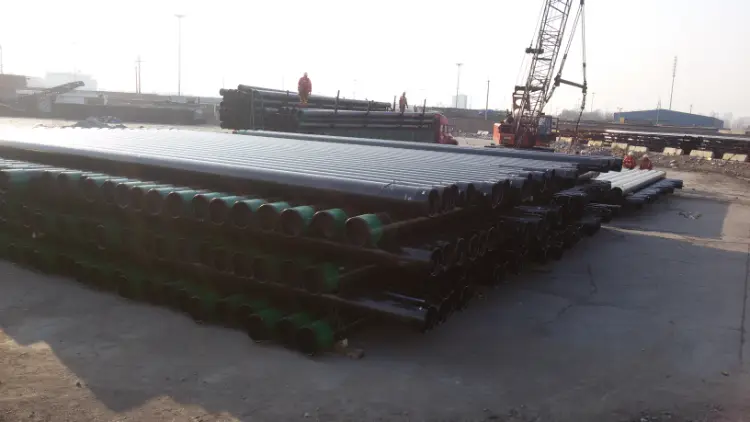
Q390C SSAW Pipe Steel
Q390C SSAW Pipe Steel | GB/T 1591 High-Strength Low-Alloy Structural Steel for Spiral Submerged Arc Welded Pipes
Comprehensive material data for Q390C low-alloy structural steel as per GB/T 1591, used in the production of SSAW (spiral submerged arc welded) pipes. Includes chemical composition, mechanical properties, physical properties, and international equivalents.
Suitable for cold forming, hot forming, welding (SAW, ERW, GMAW), cutting, bending, and machining
- Phone : +8618037372205
- Email : [email protected]
- WhatsApp: Contact via Whtsapp
- WeChat: +8618037372205
Q390C SSAW Pipe Steel Introduction
Q390C is a high-strength low-alloy structural steel grade specified in GB/T 1591-2018 (High Strength Low Alloy Structural Steels). It belongs to the Q390 series with a minimum yield strength of 390 MPa for thickness ≤16 mm and quality level C, which guarantees impact energy of at least 34 J at 0 °C. The steel is characterized by good weldability, favorable cold-forming properties, and adequate toughness for structural applications. When manufactured into SSAW (spiral submerged arc welded) pipes, Q390C provides a reliable combination of strength and ductility, making it suitable for high-pressure fluid transmission, large-diameter pipelines, piling, and structural supports. The controlled carbon equivalent facilitates welding without excessive preheating, and the fine-grain practice (typically via aluminum or other grain refiners) ensures homogeneous mechanical properties throughout the coil and pipe body.
Q390C SSAW Pipe Steel Chemical Composition – Q390C per GB/T 1591-2018
The chemical composition shown below is the ladle analysis for Q390C according to GB/T 1591-2018. Elements like Nb, V, Ti, and Al are added for grain refinement and precipitation strengthening. The carbon equivalent (CEV) is normally controlled to ensure good weldability, typically ≤0.45% for thicknesses ≤40 mm. Phosphorus and sulfur are strictly limited to enhance toughness and resistance to cracking.
| Chemical Element | Specified Value (max, %) | Remarks |
|---|---|---|
| C | ≤ 0.20 | |
| Si | ≤ 0.50 | |
| Mn | ≤ 1.70 | |
| P | ≤ 0.030 | |
| S | ≤ 0.030 | |
| Nb | ≤ 0.07 | may be added singly or in combination |
| V | ≤ 0.15 | may be added singly or in combination |
| Ti | ≤ 0.20 | may be added singly or in combination |
| Cr | ≤ 0.30 | |
| Ni | ≤ 0.50 | |
| Cu | ≤ 0.30 | |
| Mo | ≤ 0.10 | |
| N | ≤ 0.015 | |
| Als (acid-soluble aluminum) | ≥ 0.015 | or total aluminum ≥0.020%; if other grain-refining elements are used, Als may be lower |
Q390C SSAW Pipe Steel Physical and Thermal Properties – Q390C
Physical properties are provided for general engineering reference and are not mandatory per GB/T 1591-2018. The values are representative of low-carbon low-alloy structural steel at room temperature unless otherwise noted. Thermal conductivity decreases slightly with temperature, and thermal expansion increases. These properties are essential for heat transfer analysis in pipelines and for assessing thermal stresses during welding.
| Property | Typical Value | Unit | Test Condition / Remarks |
|---|---|---|---|
| Density (ρ) | 7.85 | g/cm³ | room temperature |
| Modulus of Elasticity (E) | 206 | GPa | room temperature, tension |
| Shear Modulus (G) | 79 | GPa | room temperature, calculated from E and ν |
| Poisson's Ratio (ν) | 0.3 | – | room temperature, elastic range |
| Thermal Expansion Coefficient (α) | 12.0 × 10⁻⁶ | 1/K | 20 – 100 °C |
| Thermal Expansion Coefficient (α) | 12.8 × 10⁻⁶ | 1/K | 20 – 200 °C |
| Thermal Expansion Coefficient (α) | 13.5 × 10⁻⁶ | 1/K | 20 – 400 °C |
| Thermal Conductivity (λ) | 45 | W/(m·K) | 20 °C |
| Specific Heat Capacity (cₚ) | 460 | J/(kg·K) | 20 – 100 °C |
| Electrical Resistivity (ρₑ) | 0.23 | μΩ·m | 20 °C |
Q390C SSAW Pipe Steel Mechanical Properties – Q390C
Mechanical properties are valid for flat products (plate/strip) in delivery condition and tested according to GB/T 228.1 and GB/T 229. The yield strength decreases with increasing thickness, and impact energy is guaranteed at 0 °C for longitudinal Charpy-V specimens (KV₂). The elongation values ensure adequate ductility for cold forming and pipe expansion. When the steel is used to produce SSAW pipes, properties of the base metal must comply with these values, while the welded joint shall meet additional requirements of the pipe standard (e.g., API 5L or GB/T 9711).
| Property | Specified Value | Unit | Test Condition |
|---|---|---|---|
| Yield Strength (ReH) | ≥ 390 | MPa | thickness ≤ 16 mm |
| Yield Strength (ReH) | ≥ 370 | MPa | thickness > 16 mm ≤ 40 mm |
| Yield Strength (ReH) | ≥ 350 | MPa | thickness > 40 mm ≤ 63 mm |
| Yield Strength (ReH) | ≥ 330 | MPa | thickness > 63 mm ≤ 80 mm |
| Yield Strength (ReH) | ≥ 310 | MPa | thickness > 80 mm ≤ 100 mm |
| Tensile Strength (Rm) | 490 – 650 | MPa | all thicknesses |
| Elongation (A) | ≥ 20 | % | gauge length 5.65√S₀, thickness ≤ 40 mm |
| Elongation (A) | ≥ 19 | % | thickness > 40 mm ≤ 63 mm |
| Elongation (A) | ≥ 18 | % | thickness > 63 mm ≤ 100 mm |
| Impact Energy (KV₂, 0°C) | ≥ 34 | J | longitudinal, standard Charpy-V specimen |
| Bend Test (180°) | d = 2a (t ≤ 16 mm) | – | d = bend diameter, a = specimen thickness |
| Bend Test (180°) | d = 3a (t > 16 mm ≤ 100 mm) | – |
Q390C SSAW Pipe Steel Directly Equivalent Standards and Alternative Grades
| Country/Region | Standard | Grade | Remarks |
|---|---|---|---|
| China | GB/T 1591-2018 | Q390C | Base grade for this SSAW pipe material |
| International / ISO | ISO 630-3:2021 | S420N (not identical) | S420N has minimum yield 420 MPa vs. 390 MPa; toughness at -20°C |
| Europe | EN 10025-3:2019 | S420N | Close in strength but higher min. yield; normalized delivery; impact at -20°C |
| USA | ASTM A572/A572M | Grade 60 [415] | Min. yield 415 MPa; comparable strength level; no mandatory low-temperature impact |
| USA | ASTM A572/A572M | Grade 60 Type 2 | When toughness (e.g., 0°C impact) is required, supplementary requirement S5 may be added |
| Japan | JIS G3135 | SPFC 590Y | High-strength cold-rolled steel; yield ~390 MPa; for structural uses with toughness |
Q390C SSAW Pipe Steel Application Introduction
Q390C in the form ofhot-rolled coils or platesis the primary raw material for manufacturing SSAW (spiral submerged arc welded) pipes. The steel's excellent formability, weldability, and sufficient low-temperature toughness make it ideal for large-diameter (up to 3000 mm) and thick-wall pipes (up to 25.4 mm). These pipes are widely used in the energy, water, and construction sectors. The spiral welding process allows flexible diameter and length combinations while maintaining high productivity. Post-weld heat treatment is generally not required for thicknesses suitable for cold expansion and hydrostatic testing.
Product Applications: Long-distance oil and gas pipelines, High-pressure water mains, Spiral welded structural piles and casings, Large-diameter ventilation and exhaust ducts, Penstocks for hydroelectric power stations, Storage tank shells and roof structures, Heavy-duty sign poles and lighting columns, Conveyor roller tubes
Processed into products: Pipe body (SSAW pipe segments 6–18 m long), Pipe fittings (elbows, tees, reducers) made from Q390C plate, Flanges and connectors, Pile shoes and closure plates, Stiffening rings and saddle supports, Manhole and handhole covers, Transition pieces in process piping
Application industries: Oil and gas transmission (on-shore and off-shore pipelines), Petrochemical and refining industry, Water supply and sewage treatment, Bridge construction and foundation engineering (piling), Power plant cooling water systems, Structural engineering (columns, trusses, towers), Dredging and marine applications, Mechanical and pressure vessel fabrication
Q390C SSAW Pipe Steel Similar or Approximate Substitutes
| Country/Region | Standard | Grade | Remarks |
|---|---|---|---|
| China | GB/T 1591-2018 | Q420C | Higher strength (420 MPa), similar chemistry and impact condition; can replace Q390C with design adjustments |
| China | GB/T 699-2015 | Q390C (old GB/T 1591-2008) | Previous edition; identical chemical and mechanical requirements |
| International | ISO 630-2:2021 | S415MC | Thermo-mechanical rolled with min. yield 415 MPa; good weldability |
| Europe | EN 10149-2:2013 | S390MC | High-strength low-alloy for cold forming; min. yield 390 MPa, impact at -20°C (when specified) |
| Russia | GOST 19281-2014 | 14G2F (14Г2Ф) | Similar Mn-V-N system, yield ~390 MPa, grade with improved toughness |
| India | IS 2062:2011 | E390C | Direct correspondence to former E390C; now replaced by grades like E390 with impact requirements |
Notes:
Note 1: When Q390C is used for SSAW pipes according to GB/T 9711-2017 (PSL1) or API Spec 5L, the pipe manufacturer shall verify that the chemical composition and mechanical properties of the pipe body meet the pipe standard after forming and welding. The pipe may be supplied in as-welded condition or, if specified, with a stress-relieving heat treatment.
Note 2: For welded structures, it is recommended to select welding consumables that produce matching tensile strength and guarantee adequate impact toughness at the design temperature. Preheat (typically ≥50°C for thickness >25 mm) may be applied depending on welding procedure and plate carbon equivalent.
Note 3: This information is based on GB/T 1591-2018. For critical applications, the buyer should agree on specific test conditions and supplementary requirements (e.g., through-thickness tensile, ultrasonic testing) at the time of enquiry and order.
- Share



