
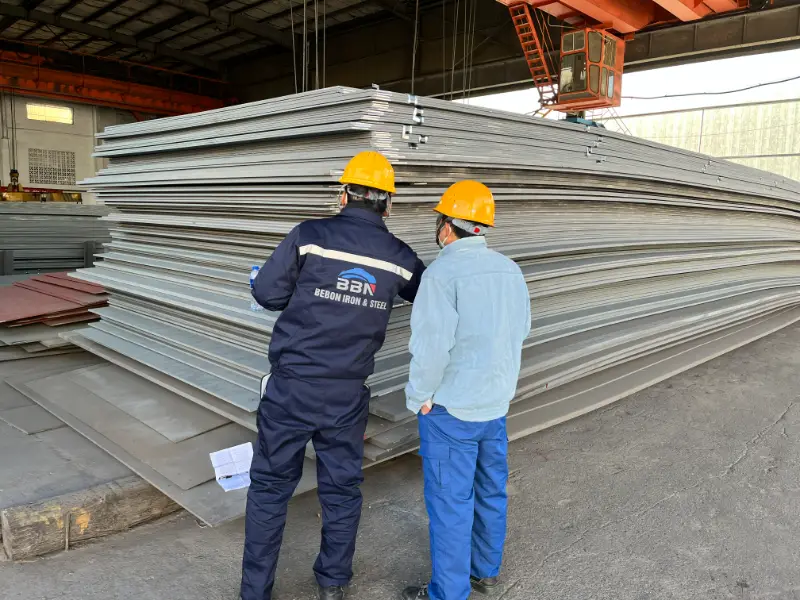
Q390D Structural Steel
Q390D Low-Alloy High-Strength Structural Steel for SSAW Pipe Applications
Q390D is a Chinese standard low-alloy high-strength structural steel with minimum yield strength of 390 MPa, excellent weldability and cold-formability, specified for spiral submerged arc welded (SSAW) pipes and general structural engineering at -20°C impact conditions.
Hot rolling, normalizing rolling, thermomechanical rolling, normalizing, welding, cold forming, machining
- Phone : +8618037372205
- Email : [email protected]
- WhatsApp: Contact via Whtsapp
- WeChat: +8618037372205
Q390D Structural Steel Introduction
Q390D is a low-alloy high-strength structural steel grade defined in GB/T 1591-2018 (High strength low alloy structural steels). It offers a minimum yield strength of 390 MPa and is designed for welded structures requiring good low-temperature toughness (impact tested at -20°C). The steel is typically supplied in the normalized, normalized rolled or thermomechanically rolled condition, providing a fine-grained microstructure with balanced strength, ductility and weldability. Key features include:
- High strength-to-weight ratio for weight reduction in structural design.
- Excellent weldability with low carbon equivalent values.
- Reliable impact toughness down to -20°C.
- Good formability for cold bending and press braking.
Q390D Structural Steel Chemical Composition
The chemical composition of Q390D is controlled to achieve the required mechanical properties and weldability. The limits shown are according to GB/T 1591-2018 for thicknesses ≤ 250 mm. The steel may contain additions of grain-refining elements such as niobium, vanadium and titanium. The carbon equivalent (CEV) is usually limited to ensure good weldability.
| Element | Standard Value (max, unless range given) | Remarks |
|---|---|---|
| C | ≤ 0.20 | Depending on thickness, lower C improves toughness and weldability |
| Si | ≤ 0.50 | Deoxidizer and strength contributor |
| Mn | ≤ 1.70 | Main strengthening element; higher Mn for thick sections |
| P | ≤ 0.030 | Low phosphorus for improved toughness (especially for D-grade) |
| S | ≤ 0.025 | Low sulfur for formability and weld quality |
| Nb | ≤ 0.07 | Grain refiner, micro-alloying for strength |
| V | ≤ 0.20 | Optional micro-alloying, improves yield strength |
| Ti | ≤ 0.20 | Grain refiner and deoxidizer; often 0.01–0.04% for toughness |
| Cr | ≤ 0.30 | Residual element; not intentionally added |
| Ni | ≤ 0.80 | Residual; higher values may be allowed for thicker sections or by agreement |
| Cu | ≤ 0.30 | Residual; can be higher in weathering variants (but Q390D is not weathering grade) |
| N | ≤ 0.015 | Limited to prevent strain aging; combines with Al, V, Ti |
| Mo | ≤ 0.20 | Residual; may be added for increased hardenability in heavy plates |
| Als (total Al) | ≥ 0.015 | Grain refining by aluminum nitride formation |
| CEV | ≤ 0.45–0.47 (typical) | Carbon equivalent value depends on thickness; ranges specified in GB/T 1591 for different delivery conditions |
Q390D Structural Steel Thermal and Electrical Physical Properties
The following physical properties are typical for low-alloy structural steels of similar chemistry and are not specified in GB/T 1591. They serve as engineering reference values at ambient temperature unless otherwise noted. Properties may vary slightly with the actual heat treatment and chemical composition.
| Property | Typical Value | Unit | Test Conditions / Remarks |
|---|---|---|---|
| Density (ρ) | 7.85 | g/cm³ | Room temperature |
| Modulus of elasticity (E) | 206 | GPa | Ambient temperature, tension |
| Shear modulus (G) | 79 | GPa | Calculated from E and ν |
| Poisson's ratio (ν) | 0.30 | – | Within elastic range |
| Thermal expansion coefficient (α) | 12.0 | 10⁻⁶/K | 20–100°C |
| Thermal expansion coefficient (α) | 12.5 | 10⁻⁶/K | 20–200°C |
| Thermal expansion coefficient (α) | 13.0 | 10⁻⁶/K | 20–300°C |
| Thermal conductivity (λ) | 53 | W/(m·K) | At 100°C |
| Thermal conductivity (λ) | 50 | W/(m·K) | At 200°C |
| Thermal conductivity (λ) | 44 | W/(m·K) | At 400°C |
| Specific heat capacity (cp) | 486 | J/(kg·K) | At 20°C |
| Specific heat capacity (cp) | 540 | J/(kg·K) | At 100°C |
| Electrical resistivity (ρₑ) | 0.22 | 10⁻⁶ Ω·m | 20°C, typical for low-alloy steel |
Q390D Structural Steel Mechanical Properties
Mechanical properties are mandatory requirements from GB/T 1591-2018 for flat and long products in the normalized or thermomechanically rolled condition. Tensile testing is performed at ambient temperature. Impact testing at -20°C uses longitudinal V-notch Charpy specimens of 10×10 mm. For thicknesses less than 10 mm, sub-size specimens are used with proportionally reduced energy requirements.
| Property | Standard Requirement (min – max / or min) | Unit | Test Conditions / Remarks |
|---|---|---|---|
| Yield strength (ReH) | ≥ 390 | MPa | Thickness ≤ 16 mm |
| Yield strength (ReH) | ≥ 370 | MPa | Thickness >16–40 mm |
| Yield strength (ReH) | ≥ 350 | MPa | Thickness >40–63 mm |
| Yield strength (ReH) | ≥ 330 | MPa | Thickness >63–80 mm |
| Yield strength (ReH) | ≥ 310 | MPa | Thickness >80–100 mm |
| Yield strength (ReH) | ≥ 290 | MPa | Thickness >100–150 mm |
| Yield strength (ReH) | ≥ 280 | MPa | Thickness >150–200 mm |
| Yield strength (ReH) | ≥ 270 | MPa | Thickness >200–250 mm (upon agreement) |
| Tensile strength (Rm) | 470 – 630 | MPa | All thicknesses |
| Elongation after fracture (A) | ≥ 20 | % | Thickness ≤ 16 mm, gauge length Lo=5.65√So |
| Elongation after fracture (A) | ≥ 19 | % | Thickness >16–40 mm |
| Elongation after fracture (A) | ≥ 19 | % | Thickness >40–63 mm |
| Elongation after fracture (A) | ≥ 18 | % | Thickness >63–80 mm |
| Elongation after fracture (A) | ≥ 18 | % | Thickness >80–100 mm |
| Elongation after fracture (A) | ≥ 18 | % | Thickness >100–150 mm |
| Elongation after fracture (A) | ≥ 17 | % | Thickness >150–200 mm |
| Elongation after fracture (A) | ≥ 17 | % | Thickness >200–250 mm |
| Impact energy (KV₂) | ≥ 47 | J | At -20°C, longitudinal, 10×10 mm specimen; for sub-size specimens the minimum value is proportional to the cross-section |
| Bend test (180°) | d = 2a | – | Thickness ≤ 16 mm (no cracks) |
| Bend test (180°) | d = 3a | – | Thickness >16–100 mm |
Q390D Structural Steel Completely Equivalent Material Standards and Substitute Grades
| Country/Region | Standard | Grade | Remarks |
|---|---|---|---|
| Europe | EN 10025-4 | S420M / S420ML | Thermomechanically rolled, yield 420 MPa min, tensile 500–660 MPa, impact at -20°C (S420M) or -50°C (S420ML). S420ML is the closest equivalent for toughness and strength, but slightly higher yield and tensile range. |
| International | ISO 4950-2 | E390DD | High yield strength flat steel products, yield 390 MPa min, tensile 490–640 MPa, -20°C impact (DD). Very similar chemical and mechanical requirements to Q390D. |
| USA | ASTM A572/A572M | Grade 60 [415] | Minimum yield 415 MPa (60 ksi); no specified impact temperature. Q390D has better low-temperature toughness; not fully interchangeable but often used for similar structural applications. |
| Japan | JIS G 3106 | SM490B / SM490C | Yield 325–365 MPa depending on thickness, tensile 490–610 MPa. Strength is slightly lower than Q390D. SM490C offers 0°C impact, not -20°C – Q390D is tougher. |
| Germany (ex DIN) | DIN EN 10025-3 | S420N | Normalized, yield 420 MPa. Higher strength but same toughness class as Q390D; often used as a substitute where extra margin is acceptable. |
Q390D Structural Steel Application Introduction
Q390D steel is widely used in welded structures that demand high strength, good toughness at sub-zero temperatures, and reliable weldability. Because of its balanced properties, it is particularly suitable for fabricating spiral submerged arc welded (SSAW) pipes for oil and gas transmission, structural tubular sections, and heavy engineering components. The steel is typically supplied as plates or coils, which are then formed and welded into pipes. Its -20°C impact guarantee ensures safe operation in cold climates and during low-temperature service.
- Key application drivers: high strength-to-weight ratio, excellent notch toughness, and suitability for automated welding.
- Fabrication: Q390D can be hot or cold formed. Welding is performed with low-hydrogen processes; preheat may be required for thick sections depending on the carbon equivalent.
- Surface protection: The material is not inherently corrosion-resistant and relies on coatings (FBE, 3LPE) or cathodic protection in buried pipelines.
Product Applications: Spiral submerged arc welded (SSAW) pipe for long-distance pipelines, Longitudinal seam welded (LSAW) pipe for high-pressure transmission, Structural hollow sections (square, rectangular, circular) for columns and trusses, Welded beams (H-beams, box girders) for bridge construction, Pressure vessels and storage tanks for low-temperature service, Jack-up rig legs, crane booms and heavy-duty structural components
Processed into products: Pipe spools and bends for pipeline systems, Flanges and forged fittings (welded onto Q390D pipe), Branch connections (tees, wyes) for piping networks, Stiffeners and diaphragms in box girders, Node castings or welded joints in tubular trusses, End closures and manways for pressure vessels, Transition pieces between different diameter pipes or pressure classes
Application industries: Oil & gas (line pipe, gathering systems, gas distribution), Civil engineering (bridges, stadiums, high-rise buildings), Shipbuilding (hull structures, deck plates), Offshore & marine (platform structures, risers), Pressure vessel & storage tank manufacturing, Mining & heavy machinery (booms, arms, frames), Wind energy (tower sections, transition pieces)
Q390D Structural Steel Analogous / Similar Substitute Material Recommendations
| Country/Region | Standard | Grade | Remarks |
|---|---|---|---|
| China | GB/T 1591 | Q355D | Lower strength (yield 355 MPa), same -20°C impact class. Can be used if design allows strength reduction; better cost-effectiveness for many structural applications. |
| China | GB/T 1591 | Q420D | Higher strength (yield 420 MPa), same toughness. Possible upgrade if higher strength is needed, but requires adjustment of welding procedures. |
| Europe | EN 10025-3 | S355N / S355NL | Normalized, yield 355 MPa, impact at -20°C (S355N) or -50°C (S355NL). Suitable for lower strength requirements but equivalent toughness. |
| Europe | EN 10025-4 | S355M / S355ML | Thermomechanically rolled, similar strength range to S355N, -20°C impact (S355M). Can replace Q390D if design allows thickness-dependent strength reduction. |
| USA | ASTM A572/A572M | Grade 50 [345] | Yield 345 MPa, no impact requirement. For structural shapes not requiring low-temperature toughness; Q390D is superior in both strength and toughness. |
| USA | ASTM A572/A572M | Grade 65 [450] | Yield 450 MPa, higher than Q390D. Can be considered for overmatch when joint strength is critical, but requires careful welding to avoid excessive hardness. |
Notes:
Q390D is a fully killed fine-grain steel. The delivery condition strongly affects the mechanical properties: normalized (+N) or normalized rolled typically provides the best combination of strength and toughness. For SSAW pipe production, TMCP (thermomechanically controlled processed) plates are often preferred for thicknesses up to 25 mm due to better formability and lower cost. When ordering, the pipe manufacturer normally specifies the plate standard and grade as GB/T 1591 Q390D, with additional requirements such as carbon equivalent, through-thickness properties (Z-quality if needed), and ultrasonic testing. The steel is not intended for applications above 400°C where creep becomes significant. For sour service (H₂S), special hydrogen-induced cracking (HIC) resistant chemistries may be specified; standard Q390D is not guaranteed for sour conditions. Always refer to the latest GB/T 1591-2018 for precise limits and supplementary requirements.
- Share



