
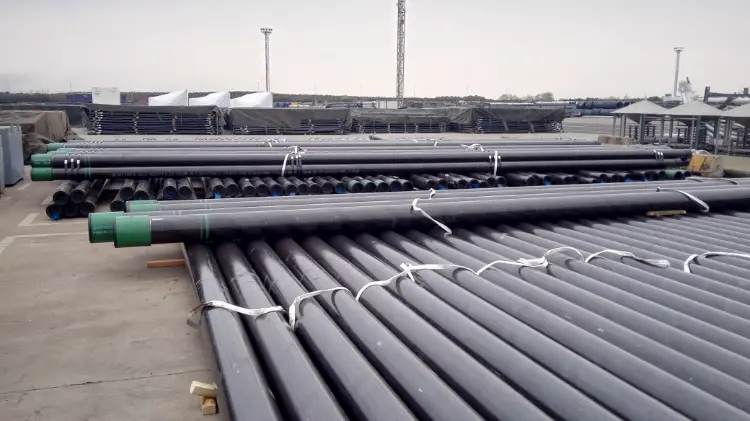
Q390B High-Strength Low-Alloy Structural Steel for SSAW Pipes
Q390B High-Strength Low-Alloy Structural Steel for SSAW Pipes - GB/T 1591 Grade
Comprehensive material data for Q390B steel according to GB/T 1591, used in spiral submerged arc welded (SSAW) pipes, covering chemical composition, mechanical and physical properties, international equivalents, and application guidelines.
Weldable, formable; typically used in welded structures, can be processed by cutting, bending, and joining via SMAW, SAW, GMAW processes
- Phone : +8618037372205
- Email : [email protected]
- WhatsApp: Contact via Whtsapp
- WeChat: +8618037372205
Q390B High-Strength Low-Alloy Structural Steel for SSAW Pipes Introduction
Q390B is a Chinese standard low-alloy high-strength structural steel defined in GB/T 1591, with a minimum yield strength of 390 MPa. It offers excellent weldability, good toughness, and high strength-to-weight ratio, making it suitable for welded structures such as SSAW pipes used in construction, bridges, and pressure vessels. The steel is normally supplied in the hot-rolled or normalized condition and can be delivered as plates, strips, or formed into spiral pipes. Q390B exhibits reliable performance at ambient and low temperatures, with strict control over carbon equivalent to ensure weldability without preheating in many cases.
Q390B High-Strength Low-Alloy Structural Steel for SSAW Pipes Chemical Composition
The chemical composition of Q390B is controlled to ensure a balance of strength, toughness, and weldability. Carbon equivalent (CEV) is typically below 0.40% to guarantee good field weldability. The following limits are as per GB/T 1591-2018 for thickness ≤ 100 mm. Elements like Nb, V, Ti may be added individually or in combination to refine grain structure.
| Element | Standard Value (max, unless range) | Remarks |
|---|---|---|
| Carbon (C) | ≤ 0.20% | Controls strength and weldability |
| Silicon (Si) | ≤ 0.50% | Deoxidizer; enhances strength |
| Manganese (Mn) | 1.00 - 1.60% | Primary strengthening element |
| Phosphorus (P) | ≤ 0.030% | Max limit for toughness |
| Sulfur (S) | ≤ 0.030% | Max limit to prevent hot cracking |
| Niobium (Nb) | 0.015 - 0.060% | Grain refiner; optional microalloy |
| Vanadium (V) | 0.02 - 0.15% | Grain refiner; optional |
| Titanium (Ti) | 0.02 - 0.20% | Grain refiner; optional |
| Chromium (Cr) | ≤ 0.30% | Residual element; may improve hardenability |
| Nickel (Ni) | ≤ 0.50% | Residual element; improves toughness |
| Copper (Cu) | ≤ 0.30% | Residual element; may provide slight corrosion resistance |
| Nitrogen (N) | ≤ 0.015% | Can form nitrides with microalloy elements |
| Carbon Equivalent (CEV) | ≤ 0.44% | Based on CEV = C + Mn/6 + (Cr+Mo+V)/5 + (Ni+Cu)/15 |
Q390B High-Strength Low-Alloy Structural Steel for SSAW Pipes Thermal and Electrical Physical Properties
Physical properties are typical for low-alloy structural steel at room temperature unless noted. These values are derived from standard data for similar HSLA steels and are not mandatory per GB/T 1591, but are essential for design and engineering calculations.
| Property | Typical Value | Unit | Condition / Temperature |
|---|---|---|---|
| Density (ρ) | 7.85 | g/cm³ | 20°C |
| Elastic Modulus (E) | 210 | GPa | 20°C |
| Shear Modulus (G) | 81 | GPa | 20°C (calculated from E and ν) |
| Poisson's Ratio (ν) | 0.3 | - | 20°C |
| Thermal Expansion Coefficient (α) | 11.5 × 10⁻⁶ | 1/K | 20°C to 100°C |
| Thermal Expansion Coefficient (α) | 12.0 × 10⁻⁶ | 1/K | 20°C to 200°C |
| Thermal Expansion Coefficient (α) | 13.0 × 10⁻⁶ | 1/K | 20°C to 400°C |
| Thermal Conductivity (λ) | 45 | W/(m·K) | 20°C |
| Thermal Conductivity (λ) | 41 | W/(m·K) | 100°C |
| Thermal Conductivity (λ) | 37 | W/(m·K) | 200°C |
| Specific Heat Capacity (cp) | 460 | J/(kg·K) | 20°C to 100°C |
| Specific Heat Capacity (cp) | 500 | J/(kg·K) | 20°C to 200°C |
| Electrical Resistivity (ρe) | 0.23 × 10⁻⁶ | Ω·m | 20°C |
Q390B High-Strength Low-Alloy Structural Steel for SSAW Pipes Mechanical Properties
Mechanical properties for Q390B as specified in GB/T 1591-2018 for products with thickness ≤ 100 mm. For SSAW pipes made from hot-rolled strip, the base material properties apply before pipe forming. The values below correspond to the delivery condition (as-rolled or normalized). Tensile testing is transverse to rolling direction.
| Property | Standard Required Value | Unit | Test Condition |
|---|---|---|---|
| Yield Strength (ReH) | ≥ 390 | MPa | Thickness ≤ 16 mm |
| Yield Strength (ReH) | ≥ 370 | MPa | Thickness > 16 mm and ≤ 40 mm |
| Yield Strength (ReH) | ≥ 350 | MPa | Thickness > 40 mm and ≤ 63 mm |
| Yield Strength (ReH) | ≥ 330 | MPa | Thickness > 63 mm and ≤ 100 mm |
| Tensile Strength (Rm) | 490 - 650 | MPa | All thicknesses |
| Elongation after Fracture (A) | ≥ 20 | % | Gauge length 5.65√So, thickness ≤ 16 mm |
| Elongation after Fracture (A) | ≥ 19 | % | Gauge length 5.65√So, thickness > 16 mm and ≤ 40 mm |
| Elongation after Fracture (A) | ≥ 18 | % | Gauge length 5.65√So, thickness > 40 mm and ≤ 63 mm |
| Elongation after Fracture (A) | ≥ 17 | % | Gauge length 5.65√So, thickness > 63 mm and ≤ 100 mm |
| Charpy Impact Energy (KV2) | ≥ 34 (longitudinal) | J | Test temperature 20°C (B requirement) |
| Charpy Impact Energy (KV2) | ≥ 34 (longitudinal) | J | Test temperature 0°C (B quality; optional per agreement) |
| Bend Test (mandrel diameter) | D = 2a (for thickness ≤ 16 mm) | - | 180° cold bend, a = specimen thickness |
| Bend Test (mandrel diameter) | D = 3a (for thickness > 16 mm and ≤ 100 mm) | - | 180° cold bend |
Q390B High-Strength Low-Alloy Structural Steel for SSAW Pipes Exactly Equivalent Material Standards and Replaceable Grades
| Country/Region | Standard | Grade | Remarks |
|---|---|---|---|
| China | GB/T 1591 | Q390B | Original specification; high-strength low-alloy structural steel |
| International | ISO 4951-3 | E390DD | Closest ISO equivalent; DD indicates hot-finished delivery condition |
| European Union | EN 10025-3 | S390N/S390NL | Normalized/normalized rolled fine-grain steel; S390N has similar strength but stricter toughness (N=normalized) |
| United States | ASTM A572/A572M | Grade 65 | Type 2 or similar; yield strength 450 MPa (65 ksi) – slightly higher, but often considered equivalent in practice |
| Japan | JIS G3106 | SM490A/B | SM490B with impact requirement at 0°C, similar strength range |
| India | IS 2062 E410 | E410 GR. C | Microalloyed structural steel with comparable minimum yield of 400-410 MPa, but composition differs |
Q390B High-Strength Low-Alloy Structural Steel for SSAW Pipes Application Introduction
Q390B is engineered for demanding structural applications where high strength, good weldability, and notch toughness are required. Its balanced chemistry makes it ideal for manufacturing spiral submerged arc welded (SSAW) pipes, which are used extensively in civil engineering, marine, and energy sectors. The steel exhibits reliable performance in ambient and moderately low temperatures and can be formed into complex shapes without loss of properties. Common fabrication processes include cold bending, hot induction bending, and welding with standard low-hydrogen consumables.
Product Applications: SSAW (Spiral Submerged Arc Welded) steel pipes for long-distance pipelines, LSAW (Longitudinal Submerged Arc Welded) pipes, Welded structural hollow sections (circular, square, rectangular), Plate girders and built-up beams for bridges, Crane booms and heavy machinery frames, Piles and sheet piles for marine foundations, Tubular towers for wind turbines, Penstocks and hydropower conduits
Processed into products: Pipe body and joints in oil, gas, and water pipelines, Flanges, reducers, and bends for piping systems, Bridge deck plates and stiffeners, Offshore platform legs and bracing members, Mono-pile foundations for offshore wind turbines, Columns and trusses in high-rise buildings, Boiler drums and pressure vessel shells (up to certain codes), Architectural tubular structures and stadium frames
Application industries: Oil and Gas Transmission Pipelines, Water Supply and Sewage Systems, Construction and Building Structures, Bridge Engineering, Offshore and Marine Structures, Wind Turbine Towers and Foundations, Industrial Storage Tanks and Pressure Vessels, Piling and Foundation Engineering
Q390B High-Strength Low-Alloy Structural Steel for SSAW Pipes Similar or Alternative Materials
| Country/Region | Standard | Grade | Remarks |
|---|---|---|---|
| China | GB/T 1591 | Q420B | Higher yield strength (min 420 MPa), otherwise similar chemistry; may be substituted if higher strength needed |
| China | GB/T 1591 | Q355B | Lower yield strength (min 355 MPa); former Q345B; widely used, economical alternative where 390 MPa not required |
| European Union | EN 10025-4 | S420M/ML | Thermomechanically rolled fine-grain steel with minimum yield 420 MPa; higher toughness classes available |
| United States | ASTM A572/A572M | Grade 60 | Yield strength 415 MPa (60 ksi), similar carbon equivalent and weldability |
| Japan | JIS G3124 | SPH440 | High-strength steel for welded structures, but yield point around 325-435 MPa depending on thickness |
| South Korea | KS D 3515 | SM490B | Same as JIS SM490B, commonly used for welded structural pipes |
Notes:
Weldability: Q390B has carbon equivalent typically ≤ 0.44%, ensuring good field weldability. Preheating is generally not required for thicknesses up to 30 mm; for thicker sections, a preheat of 50-100°C is recommended. Heat treatment: Normalizing may be applied to refine grain and improve toughness; the steel is not intended for quenching and tempering. SSAW pipe specifics: The spiral welding process may introduce slight changes in mechanical properties; hydrotesting and NDE are mandatory per pipe standards such as SY/T 5037 or API Spec 5L for pipe delivery. Supplementary testing: Additional impact tests at -20°C or -40°C can be agreed upon at the time of order. Certification: Mill test certificates shall comply with EN 10204 Type 3.1 or equivalent.
- Share



