
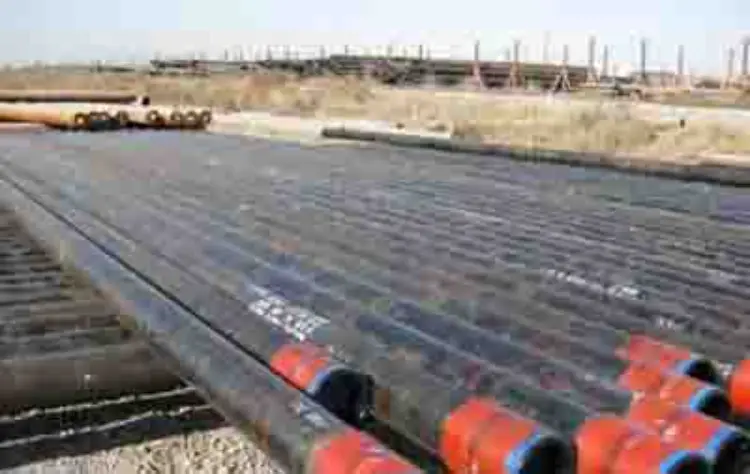
Q390A Steel (GB/T 1591) for SSAW Pipes
Q390A Steel (GB/T 1591) for SSAW Pipes - Properties, Equivalents & Application Data
Detailed material analysis of Q390A low alloy high strength steel according to GB/T 1591, widely used in spiral submerged arc welded (SSAW) pipes, covering chemical composition, mechanical and physical properties, international equivalent grades, and application guidance.
Hot rolling, cold forming, welding (SAW, SSAW), cutting, machining, bending
- Phone : +8618037372205
- Email : [email protected]
- WhatsApp: Contact via Whtsapp
- WeChat: +8618037372205
Q390A Steel for SSAW Pipes Introduction
Q390A is a low alloy high strength structural steel grade defined in Chinese standard GB/T 1591, with a minimum yield strength of 390 MPa. It belongs to the Q390 series (quality grade A) and is designed for welded structures subject to heavy loads. The steel offers good weldability, moderate cold bending performance, and sufficient toughness for general structural applications. As a hot-rolled product, Q390A is typically supplied in the form of plates or strips and is a preferred material for manufacturing SSAW pipes (spiral submerged arc welded pipes) used in oil and gas transmission, piling, and structural frameworks. The quality grade A does not guarantee impact energy at low temperatures, making it suitable for ambient temperature service. Its balanced composition with microalloying elements (Nb, V, Ti) ensures the required mechanical strength without excessive carbon content.
Q390A Steel for SSAW Pipes Chemical Composition
The chemical composition conforms to GB/T 1591-2018 for Q390A. Microalloying elements such as niobium, vanadium, and titanium may be added singly or in combination to achieve the required mechanical properties. Aluminum is usually present as a grain refiner. Phosphorus and sulfur limits are for grade A; lower levels improve cleanliness. The values below are for thickness ≤ 100 mm.
| Element | Standard Value (wt%) | Remarks |
|---|---|---|
| Carbon (C) | ≤ 0.20 | Heat analysis |
| Silicon (Si) | ≤ 0.55 | Heat analysis |
| Manganese (Mn) | ≤ 1.70 | Heat analysis |
| Phosphorus (P) | ≤ 0.035 | Grade A limit |
| Sulfur (S) | ≤ 0.035 | Grade A limit |
| Chromium (Cr) | ≤ 0.30 | Heat analysis |
| Nickel (Ni) | ≤ 0.50 | Heat analysis |
| Copper (Cu) | ≤ 0.30 | Heat analysis |
| Molybdenum (Mo) | ≤ 0.10 | Heat analysis |
| Niobium (Nb) | ≤ 0.07 | Heat analysis |
| Vanadium (V) | ≤ 0.15 | Heat analysis |
| Titanium (Ti) | ≤ 0.20 | Heat analysis |
| Aluminum (Al) | ≥ 0.015 | If used for grain refinement |
| Nitrogen (N) | ≤ 0.015 | Heat analysis |
| Nb+V+Ti | ≤ 0.22 | Combined microalloying limit |
Q390A Steel for SSAW Pipes Thermal and Electrical Physical Properties
The following values are typical for low alloy structural steel of this strength level and are not part of the GB/T 1591 certification. They are provided for engineering design purposes. Data apply at room temperature unless otherwise noted.
| Property | Typical Value | Unit | Conditions/Remarks |
|---|---|---|---|
| Density (ρ) | 7850 | kg/m³ | 20°C |
| Elastic Modulus (E) | 200 | GPa | 20°C |
| Shear Modulus (G) | 80 | GPa | 20°C, calculated from E and ν |
| Poisson's Ratio (ν) | 0.30 | — | 20°C |
| Thermal Expansion Coefficient (α) | 12.0 | 10⁻⁶/K | 20-100°C |
| Thermal Expansion Coefficient (α) | 12.8 | 10⁻⁶/K | 20-200°C |
| Thermal Expansion Coefficient (α) | 13.5 | 10⁻⁶/K | 20-400°C |
| Thermal Conductivity (λ) | 52 | W/(m·K) | 20°C |
| Thermal Conductivity (λ) | 47 | W/(m·K) | 200°C |
| Specific Heat Capacity (c) | 460 | J/(kg·K) | 20°C |
| Electrical Resistivity (ρ_e) | 0.17 | 10⁻⁶ Ω·m | 20°C |
Q390A Steel for SSAW Pipes Mechanical Properties
Tensile properties for Q390A are specified in GB/T 1591-2018 for the as-delivered condition (hot-rolled or normalized). Yield and tensile strengths are thickness dependent. Elongation is measured on a gauge length of 5.65√S₀. The bending test uses a mandrel diameter related to the specimen thickness. Impact testing is not required for grade A; therefore, impact energy values are not specified. For SSAW pipe applications, the base material properties must meet these minimums before welding.
| Property | Required Value | Unit | Test Condition |
|---|---|---|---|
| Yield Strength (ReH) | ≥ 390 | MPa | Thickness ≤ 16 mm |
| Yield Strength (ReH) | ≥ 370 | MPa | Thickness 16-35 mm |
| Yield Strength (ReH) | ≥ 350 | MPa | Thickness 35-50 mm |
| Yield Strength (ReH) | ≥ 330 | MPa | Thickness 50-100 mm |
| Tensile Strength (Rm) | 490 – 650 | MPa | All thicknesses |
| Elongation (A) | ≥ 20 | % | Thickness ≤ 40 mm |
| Elongation (A) | ≥ 19 | % | Thickness > 40 mm |
| Bend Test (180°) | d = 3a | — | Thickness ≤ 16 mm |
| Bend Test (180°) | d = 4a | — | Thickness 16-100 mm |
Q390A Steel for SSAW Pipes International Equivalent Standards and Substitute Grades
Q390A does not have a direct, chemically identical counterpart in international standards. The following grades are frequently used as functional substitutes based on similar mechanical properties and applications.
| Country/Region | Standard | Grade | Remarks |
|---|---|---|---|
| China | GB/T 1591 | Q390A | Original grade; base material for SSAW pipes |
| USA | ASTM A572/A572M | Grade 60 [415] | Yield strength 415 MPa (60 ksi), slightly higher; suitable for structural shapes |
| Europe | EN 10025-3 | S420N | Yield 420 MPa; normalized fine-grain structural steel; higher toughness options available |
| Europe | EN 10025-2 | S355J0/J2 | Lower yield (355 MPa); acceptable if design allows reduced strength |
| Japan | JIS G3106 | SM520B/C | Yield 365-390 MPa; for welded structures; chemistry differs but often interchangeable |
| International | ISO 4950-2 | E390 | Yield 390 MPa; high strength flat products; chemical composition may vary |
Q390A Steel for SSAW Pipes Application Introduction
Q390A is widely used for manufacturing spiral welded pipes due to its excellent strength-to-weight ratio and good weldability. It is also employed in structural steelwork, heavy machinery, and transportation systems. The material can be formed into various shapes and is suitable for both static and dynamic loads in non-cryogenic environments.
Product Applications: Spiral submerged arc welded (SSAW) pipes, Longitudinal welded pipes, Welded structural hollow sections, Plates for welded girders and columns, Pipe piles and foundation elements, Pressure vessel shells (requiring additional certification)
Processed into products: Oil and gas pipe sections and fittings, Bridge beams and truss elements, Building columns and load-bearing frames, Piling connectors and shoes, Hydroelectric penstock liners, Offshore platform legs and bracing
Application industries: Oil & Gas (transmission pipelines, flowlines), Civil Engineering & Construction (piling, bridges, high-rise buildings), Water & Wastewater (large-diameter supply and drainage pipes), Offshore & Marine (structural supports, jack-up rig legs), Mining & Materials Handling (slurry pipes, chutes), Power Generation (penstocks, cooling water pipes)
Q390A Steel for SSAW Pipes Similar/Alternative Materials with Close Characteristics
These materials are not exact matches but are often considered for substitution in structural and piping applications where the mechanical requirements overlap. Differences in carbon equivalent, weldability, and impact properties should be evaluated.
| Country/Region | Standard | Grade | Remarks |
|---|---|---|---|
| Europe | EN 10025-3 | S420N | Higher strength; better toughness at low temperature; higher cost |
| USA | ASTM A572 | Grade 55 [380] | Slightly lower yield (380 MPa); may be acceptable for some designs |
| USA | API 5L | X60 (L415) | Line pipe grade; suitable for SSAW pipes; similar strength but different manufacturing standard |
| Germany (former) | DIN 17100 | St52-3 | Obsolete but historically equivalent; yield ~355 MPa, lower |
| Russia | GOST 19281 | 17G1S | Yield ~370 MPa; common for pipelines; often used in SSAW pipes |
Notes:
Q390A quality A implies no specified impact energy for low temperature, making it unsuitable for service below 0°C where impact toughness is required. For low-temperature applications, grades Q390C, D, or E should be considered. SSAW pipes made from Q390A are typically used for above-ground or buried pipelines at normal ambient temperatures. Welding consumables should match the strength level and a proper preheat may be necessary depending on thickness and carbon equivalent. Post-weld heat treatment is not usually required for standard pipe fabrication.
- Share



