
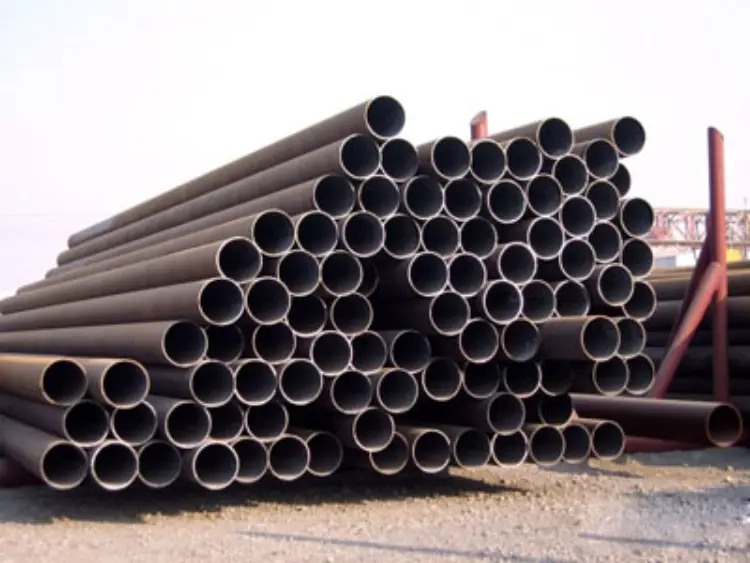
Q345E Steel SSAW Pipe
Q345E Steel SSAW Pipe: Low-Temp Toughness & Weldable Structural Solution
In-depth analysis of Q345E grade for spiral submerged arc welded pipes, covering chemical composition, mechanical properties at low temperatures, and equivalent international standards.
Hot rolling, cold forming, welding (SAW, ERW), machining, cutting
- Phone : +8618037372205
- Email : [email protected]
- WhatsApp: Contact via Whtsapp
- WeChat: +8618037372205
Q345E Steel SSAW Pipe Introduction
Q345E is a Chinese standard low-alloy high-strength structural steel grade, widely utilized for manufacturing Spiral Submerged Arc Welded (SSAW) pipes under the GB/T 1591 standard. It is characterized by a minimum yield strength of 345 MPa and is specifically designed with enhanced impact toughness at low temperatures, achieving a minimum impact energy of 34J at -40°C. This makes it exceptionally suitable for demanding structural applications in cold climates, such as oil and gas transmission pipelines, offshore structures, and large-scale building frameworks where reliable low-temperature performance and good weldability are critical prerequisites.
Q345E Steel SSAW Pipe Chemical Composition
The chemical composition of Q345E steel is carefully controlled to balance strength, low-temperature toughness, and weldability. Compared to standard Q345 grades, it features lower impurity levels of phosphorus (P) and sulfur (S) to ensure superior impact properties. Grain-refining elements such as niobium (Nb), vanadium (V), and titanium (Ti) are added individually or in combination to achieve high strength while maintaining excellent formability.
| Element | Standard Value (%) | Remarks |
|---|---|---|
| Carbon (C) | ≤ 0.18 | Max permissible content |
| Silicon (Si) | ≤ 0.50 | Max permissible content |
| Manganese (Mn) | ≤ 1.70 | Max permissible content |
| Phosphorus (P) | ≤ 0.025 | Critical for low-temperature toughness |
| Sulfur (S) | ≤ 0.020 | Critical for low-temperature toughness |
| Niobium (Nb) | ≤ 0.07 | Grain refining element |
| Vanadium (V) | ≤ 0.15 | Grain refining element |
| Titanium (Ti) | ≤ 0.20 | Grain refining element |
| Chromium (Cr) | ≤ 0.30 | Residual element |
| Nickel (Ni) | ≤ 0.50 | Residual element |
| Copper (Cu) | ≤ 0.30 | Residual element |
| Nitrogen (N) | ≤ 0.012 | Max permissible content |
| Molybdenum (Mo) | ≤ 0.10 | Residual element |
Q345E Steel SSAW Pipe Thermal and Electrical Physical Properties
These physical properties are typical for low-alloy steel grades like Q345E at ambient temperature and are essential for engineering calculations involving thermal expansion, heat transfer, or structural weight. Actual values may vary slightly based on specific mill heat treatment and chemical composition, but these provide a reliable basis for design.
| Property | Standard Value | Unit | Test Condition |
|---|---|---|---|
| Density (ρ) | 7.85 | g/cm³ | At 20°C |
| Elastic Modulus (E) | 206 | GPa | At 20°C |
| Shear Modulus (G) | 79.4 | GPa | At 20°C |
| Poisson's Ratio (ν) | 0.30 | - | At 20°C |
| Thermal Expansion Coefficient (α) | 12.2 | 10⁻⁶/K | Range 20-100°C |
| Thermal Expansion Coefficient (α) | 13.5 | 10⁻⁶/K | Range 20-200°C |
| Thermal Expansion Coefficient (α) | 14.2 | 10⁻⁶/K | Range 20-400°C |
| Thermal Conductivity (λ) | 47 | W/(m·K) | At 20°C |
| Specific Heat Capacity (c_lambda) | 480 | J/(kg·K) | At 20°C |
| Electrical Resistivity (ρ_e) | 0.22 | Ω·mm²/m | At 20°C |
Q345E Steel SSAW Pipe Mechanical Properties of Base Material
The mechanical properties for Q345E are specified for the base metal before welding. Property values are dependent on the wall thickness of the plate or coil used to form the SSAW pipe. This grade is distinguished from Q345A/B/C/D by its mandatory notch impact toughness testing at -40°C, ensuring resilience in extreme cold environments.
| Property | Standard Value | Unit | Test Condition |
|---|---|---|---|
| Yield Strength (ReH) | ≥ 345 | MPa | Thickness ≤ 16 mm |
| Yield Strength (ReH) | ≥ 335 | MPa | Thickness 16-40 mm |
| Yield Strength (ReH) | ≥ 325 | MPa | Thickness 40-63 mm |
| Tensile Strength (Rm) | 470 - 630 | MPa | Thickness ≤ 100 mm |
| Elongation after fracture (A) | ≥ 21 | % | Longitudinal, 5.65√S₀ |
| Charpy Impact Energy (KV) | ≥ 34 | J | Longitudinal, at -40°C |
| Bend Test (Diameter a) | 2a (thk ≤ 16mm), 3a (thk > 16-100mm) | ° | 180-degree bend |
Q345E Steel SSAW Pipe Completely Equivalent Material Standards and Replaceable Grades
| Country/Region | Standard | Grade | Remarks |
|---|---|---|---|
| China | GB/T 1591 | Q345E | Original standard and grade. |
| European Union | EN 10025-3 | S355NL | Normalized steel with specified minimum impact at -50°C, which exceeds Q345E requirements. |
| International | ISO 4950 | E355DD | High yield strength flat products with delivery condition and impact properties similar to Q345E. |
| Japan | JIS G 3106 | SM490B | Comparable strength but typically tested at 0°C. Special low-temperature quality agreements are needed for equivalence. |
Q345E Steel SSAW Pipe Application Introduction
Q345E SSAW pipe is an optimal choice for critical structural applications requiring a unique combination of high strength, superior low-temperature toughness, and cost-effective production for large-diameter pipelines. Its spiral-welded manufacturing process allows for a wide range of diameters and thick walls from coiled steel plate, providing great flexibility for large infrastructure projects. The material's guaranteed impact energy at -40°C makes it indispensable for use in severe cold regions.
Product Applications: Long-distance crude oil pipelines, Natural gas distribution networks, Water mains and penstocks, Structural piling and foundation pipes, Bridge arches and truss chords, Jacket legs for offshore platforms, Monopile foundations for wind turbines
Processed into products: Cold-formed pipe sections and elbows, Flanges and pipe fittings, Tubing for buried sections, High-pressure gas cylinders (base material), Steel bends for subsea pipelines, Suction anchors for floating structures
Application industries: Oil & Gas Transmission, Petrochemical Refineries, Water Supply & Sewage Systems, Civil & Structural Engineering, Offshore & Marine Engineering, Wind Power Generation, Mining & Slurry Transport
Q345E Steel SSAW Pipe Similar/Comparable Substitute Material Recommendations
| Country/Region | Standard | Grade | Remarks |
|---|---|---|---|
| United States | ASTM A572/A572M | Grade 50 [345] | Similar minimum yield strength. However, standard Charpy test temperature is higher (21°C). Supplementary requirement S5 is needed for low-temperature impact testing to approach Q345E performance. |
| European Union | EN 10025-2 | S355J2 | Strength is identical to Q345E. Crucially, its impact test is guaranteed down to -20°C, making it less suitable than Q345E for -40°C applications. |
| Russia/CIS | GOST 27772-88 | C345 | Used for building structures with a similar yield strength class, but low-temperature toughness specifications must be verified separately. |
| India | IS 2062 | E350 C | New generation high-strength structural steel. Low-temperature impact options require explicit agreement for -40°C performance. |
Notes:
For SSAW pipes manufactured from Q345E coils, the pipe's longitudinal weld seam properties must meet or exceed the base material specification. Post-weld heat treatment (PWHT) is not typically mandatory but may be applied to relieve residual stresses for specific service conditions. Users should specify the standard for supplementary non-destructive testing (NDT), such as ultrasonic testing (UT) for the weld seam and full body, in addition to hydrostatic testing mandated by pipe delivery standards like API 5L or GB/T 9711, to ensure structural integrity. The significant difference between Q345E and Q345D is the 20°C lower impact test temperature, a critical factor for material substitution decisions.
- Share



