
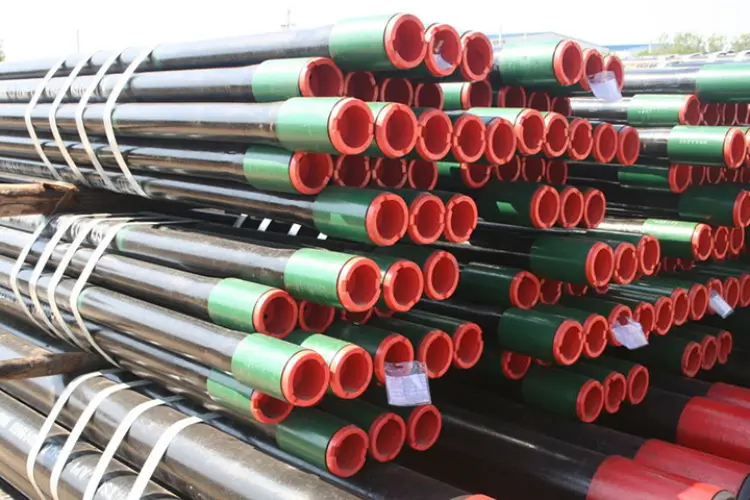
Q345D Steel SSAW Pipe
Q345D Steel SSAW Pipe: Low-Alloy High-Strength Structural Steel for Critical Welded Applications
Comprehensive material data for Q345D spiral submerged arc welded pipe per GB/T 1591, including chemical composition, mechanical properties, thermal-physical properties, international equivalents, and application guidance.
Hot rolling, controlled rolling, normalizing; welding by SSAW process; suitable for cold forming, machining, and galvanizing
- Phone : +8618037372205
- Email : [email protected]
- WhatsApp: Contact via Whtsapp
- WeChat: +8618037372205
Q345D Steel SSAW Pipe Introduction
Q345D is a low-alloy high-strength structural steel grade specified in GB/T 1591-2008, widely used for welded pipes and structural components. It features minimum yield strength of 345 MPa for thickness ≤16 mm, excellent weldability, and guaranteed impact toughness at -20°C (34 J min). In spiral submerged arc welded (SSAW) pipe form, it combines cost-effective manufacturing with reliable performance for long-distance transportation. The steel has fine grain strengthening through microalloying (Nb, V, Ti), ensuring good ductility and cold-bending capacity. It is commonly delivered in hot-rolled or normalized condition, and the SSAW process allows production of large-diameter pipes (up to 2500 mm).
- High strength-to-weight ratio
- Excellent low-temperature toughness
- Good weldability with low carbon equivalent
- Conformity to Chinese construction and pipeline standards
Q345D Steel SSAW Pipe Chemical Composition
The chemical composition of Q345D as per GB/T 1591-2008. The steel is microalloyed with Nb, V, Ti for grain refinement and precipitation strengthening. Low sulfur and phosphorus contents ensure good toughness. The carbon equivalent (CEV) is typically ≤0.45% to guarantee weldability. For SSAW pipes, the pipe standard may impose tighter limits on S, P, and CEV.
- Maximum limits unless a range is given
- Aluminum: total Al ≥0.015% or acid-soluble Als ≥0.015%
- Nitrogen limited to avoid strain aging
| Chemical Element | Standard Value (≤, unless specified) | Remarks |
|---|---|---|
| Carbon (C) | ≤0.18 | Max. |
| Silicon (Si) | ≤0.50 | Max. |
| Manganese (Mn) | ≤1.70 | Max. |
| Phosphorus (P) | ≤0.030 | Max. |
| Sulfur (S) | ≤0.025 | Max. |
| Chromium (Cr) | ≤0.30 | Max. |
| Nickel (Ni) | ≤0.50 | Max. |
| Copper (Cu) | ≤0.30 | Max. |
| Molybdenum (Mo) | ≤0.10 | Max. |
| Niobium (Nb) | ≤0.07 | Max. |
| Vanadium (V) | ≤0.15 | Max. |
| Titanium (Ti) | ≤0.20 | Max. |
| Aluminum (Als) | ≥0.015 | Acid-soluble; total Al also acceptable |
| Nitrogen (N) | ≤0.012 | Max.; if Al is present, N shall be bound |
Q345D Steel SSAW Pipe Thermal and Electrical Physical Properties
These are typical room-temperature properties for low-alloy structural steel similar to Q345D. They are not specified in GB/T 1591 but are widely accepted engineering data. The values may vary with temperature and processing.
- Thermal expansion coefficient valid from 20°C to 100°C
- Thermal conductivity and specific heat typical for carbon-manganese steels
| Property | Typical Value | Unit | Test Condition |
|---|---|---|---|
| Density (ρ) | 7.85 | g/cm³ | Room temperature |
| Elastic Modulus (E) | 205 | GPa | Room temperature (dynamic method) |
| Shear Modulus (G) | 80 | GPa | Room temperature (calculated from E and ν) |
| Poisson's Ratio (ν) | 0.29 | — | Room temperature |
| Thermal Expansion Coefficient (α) | 12.0 | 10⁻⁶/K | 20°C to 100°C |
| Thermal Conductivity (λ) | 45 | W/(m·K) | Room temperature |
| Specific Heat Capacity (c_p) | 470 | J/(kg·K) | Room temperature |
| Electrical Resistivity (ρ_e) | 0.23 | 10⁻⁶ Ω·m | Room temperature |
Q345D Steel SSAW Pipe Mechanical Properties
Mechanical properties for Q345D according to GB/T 1591-2008. Values depend on thickness. For SSAW pipes, the base metal properties are generally taken from the plate/coil used; the pipe standard (e.g., SY/T 5037) may specify weld zone properties separately. Impact test temperature of -20°C is mandatory for D-grade.
- Yield strength decreases with increasing thickness
- Elongation measured on gauge length 5.65√S₀
| Property | Standard Requirement Value | Unit | Test Condition / Thickness Range |
|---|---|---|---|
| Yield Strength (ReH) | ≥345 | MPa | t ≤ 16 mm |
| Yield Strength (ReH) | ≥335 | MPa | 16 mm < t ≤ 40 mm |
| Yield Strength (ReH) | ≥325 | MPa | 40 mm < t ≤ 63 mm |
| Yield Strength (ReH) | ≥315 | MPa | 63 mm < t ≤ 80 mm |
| Yield Strength (ReH) | ≥305 | MPa | 80 mm < t ≤ 100 mm |
| Yield Strength (ReH) | ≥285 | MPa | 100 mm < t ≤ 150 mm |
| Yield Strength (ReH) | ≥275 | MPa | 150 mm < t ≤ 200 mm |
| Tensile Strength (Rm) | 470–630 | MPa | t ≤ 40 mm |
| Tensile Strength (Rm) | 470–630 | MPa | 40 mm < t ≤ 100 mm |
| Tensile Strength (Rm) | 450–600 | MPa | 100 mm < t ≤ 200 mm |
| Elongation (A) | ≥21 | % | t ≤ 40 mm, longitudinal |
| Elongation (A) | ≥20 | % | 40 mm < t ≤ 63 mm, longitudinal |
| Elongation (A) | ≥19 | % | 63 mm < t ≤ 100 mm, longitudinal |
| Elongation (A) | ≥18 | % | 100 mm < t ≤ 150 mm, longitudinal |
| Elongation (A) | ≥17 | % | 150 mm < t ≤ 200 mm, longitudinal |
| Impact Energy (KV2) | ≥34 | J | Test temperature -20°C, longitudinal, 10×10 mm specimen |
| Bend Test (D = mandrel diameter, a = thickness) | D = 2a | — | 180° bend, t ≤ 16 mm |
| Bend Test | D = 3a | — | 180° bend, t > 16 mm to 100 mm |
Q345D Steel SSAW Pipe Completely Equivalent Material Standards and Substitutable Grades
International equivalents that meet similar chemical and mechanical requirements with -20°C impact toughness. For SSAW pipes, the pipe manufacturing standard (e.g., API 5L X52 or ISO 3183 L360) may also correspond in strength but with different toughness and chemistry requirements.
| Country/Region | Standard | Grade | Remarks |
|---|---|---|---|
| China | GB/T 1591-2018 | Q355D | Direct replacement; min. yield 355 MPa for t≤16 mm, -20°C impact |
| European Union | EN 10025-2:2004 | S355J2 (+N) | Equivalent strength and toughness; normalized delivery optional; C, Si, Mn similar |
| International | ISO 4950-2:1995 / ISO 4951-2:2001 | S355NL | Normalized condition; -50°C option but -20°C toughness guaranteed |
| Japan | JIS G3106:2015 | SM490B (modified) | Requires -20°C Charpy supplement and modified chemistry; SM490C standard has 0°C impact |
| United States | ASTM A572/A572M-21 | Grade 50 [345] Type 2 with CVN -20°C supplement | Must specify -20°C impact requirement; chemistry needs comparison |
| Australia/New Zealand | AS/NZS 3678:2016 | Grade 350L0 | Minimum yield 350 MPa, impact at 0°C; additional -20°C agreement required for full parity |
Q345D Steel SSAW Pipe Application Introduction
Q345D SSAW pipes combine high strength, excellent low-temperature toughness, and cost-efficient spiral forming. They are predominantly used in medium- to large-diameter pipelines and structural tubulars. Delivery condition: often hot-rolled coil formed, welded, and subjected to hydrotesting. Welding: low carbon equivalent allows standard welding procedures; preheat may be needed for thick walls and low ambient temperature. Surface protection: commonly applied with 3LPE/3LPP or coal-tar enamel for buried lines.
Product Applications: Long-distance oil and gas pipelines (up to API 5L X52 equivalent), Large-diameter structural columns and bracing, Penstock pipes for hydropower plants, Sewage and drainage mains, Pipeline casings and culverts, Foundation piles (open-end and closed-end), Offshore risers and conductors (subject to specification adjustments)
Processed into products: Spiral pipe body (straight, single- or double-seam SSAW), Pipe fittings: elbows, reducers, tees (manufactured from Q345D plates), Flanges and pipe end connectors, Support brackets and saddles, Anchor blocks and thrust restraints, Tubular sections for truss structures, Wind turbine tower segments
Application industries: Oil & Gas Transmission, Petrochemical and Chemical Processing, Water & Wastewater Conveyance, Bridge and Building Construction, Port and Harbor Engineering (piles), Wind Energy (tower tubes), Mining and Slurry Transportation
Q345D Steel SSAW Pipe Similar / Close Alternative Materials
Materials with comparable strength levels but differences in toughness guarantee, delivery condition, or weldability. They may serve as substitutes with additional process adjustments or qualification.
| Country/Region | Standard | Grade | Remarks |
|---|---|---|---|
| China | GB/T 9711-2017 / ISO 3183:2019 | L360 / X52 | Pipe grade for oil/gas; yield 360 MPa; chemistry different, but strength overlaps; -20°C CVN optional per SR 15 |
| Russia/CIS | GOST 19281-2014 | 09G2S (09Г2С) equivalent to -30°C version | Yield ~345 MPa; often used for pipelines; Mn 1.3-1.7, Si 0.5-0.8; -40°C impact possible |
| India | IS 2062:2011 | E350 Grade BR/B0/C | E350C with -20°C impact; yield 350 MPa; microalloyed variant |
| Brazil | ABNT NBR 7007:2021 | MR 250 (mod.) with high Mn | Yield 250 MPa base; requires microalloyed variant to reach 345 MPa; toughness not standard |
| South Africa | SANS 50025-2:2011 | S355J2+N | Equivalent to EN standard; directly usable |
Notes:
The data presented is based on GB/T 1591-2008. For SSAW pipes, the applicable pipe product standards (e.g., SY/T 5037, GB/T 9711, or project-specific specifications) may impose additional requirements on weld seam properties, hydrostatic test pressure, NDT acceptance criteria, and dimensional tolerances. Users should verify the intended application against the latest steel and pipe standards. Q345D has been superseded by Q355D in GB/T 1591-2018; however, many pipeline projects still reference Q345D due to legacy design codes. For pressure-containing parts, design allowable stress must be derived from the material's minimum specified properties and applicable design code (e.g., ASME B31.3, GB 50316).
- Share



