
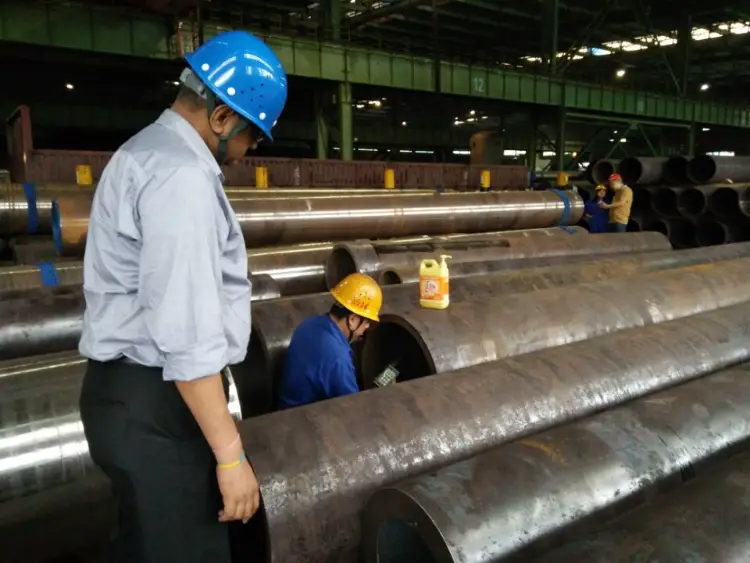
Q390A Low Alloy High Strength Steel for LSAW Pipes
Q390A Low Alloy High Strength Steel for LSAW Pipes - GB/T 1591 Grade Data
Comprehensive material properties of Q390A low alloy high strength structural steel per GB/T 1591, commonly used for LSAW pipes, with chemical, mechanical, thermal and electrical data.
Hot rolling, controlled rolling, normalizing, welding (for pipe fabrication)
- Phone : +8618037372205
- Email : [email protected]
- WhatsApp: Contact via Whtsapp
- WeChat: +8618037372205
Q390A Low Alloy High Strength Steel for LSAW Pipes Introduction
Q390A is a Chinese low alloy high strength structural steel grade defined in GB/T 1591, offering a minimum yield strength of 390 MPa in the as-delivered condition. It is characterized by good weldability, toughness, and resistance to brittle fracture, making it suitable for welded structures such as longitudinal submerged arc welded (LSAW) pipes. The 'Q' designation denotes yield point, '390' the minimum yield strength in MPa, and 'A' indicates the quality level without mandatory impact testing at ambient temperature. This grade is widely applied in construction, bridges, pressure vessels, and pipeline systems. Microalloying elements like Nb, V, and Ti are often added to refine grain structure and improve strength. The material is typically supplied in hot-rolled, normalized, or thermomechanically processed condition.
Q390A Low Alloy High Strength Steel for LSAW Pipes Chemical Composition
Standard analysis limits according to GB/T 1591-2008 for Q390A. Optional microalloying additions of Nb, V, Ti (individually or combined) are permissible to achieve required mechanical properties. Residual elements are controlled to maintain weldability and toughness.
| Element | Content (%) | Remarks |
|---|---|---|
| C | ≤0.20 | Max carbon equivalent control for weldability |
| Si | ≤0.55 | Deoxidizing element, helps strength |
| Mn | ≤1.70 | Primary solid solution strengthener |
| P | ≤0.035 | Impurity, controlled for toughness |
| S | ≤0.035 | Impurity, controlled to avoid hot shortness |
| Nb | 0.015–0.060 | Grain refiner, precipitation strengthening |
| V | 0.02–0.20 | Precipitation strengthening |
| Ti | 0.02–0.20 | Grain refiner, improves toughness |
| Cr | ≤0.30 | Residual, may slightly increase hardenability |
| Ni | ≤0.50 | Residual, improves toughness |
| Cu | ≤0.30 | Residual, may cause hot shortness if not controlled |
| Mo | ≤0.10 | Residual, enhances strength and tempering resistance |
| N | ≤0.015 | Limiting free nitrogen for aging resistance |
| Als | ≥0.015 | Required for fully killed steel (minimum soluble aluminum) |
Q390A Low Alloy High Strength Steel for LSAW Pipes Physical Properties
Representative thermal and electrical properties for Q390A low alloy steel at room temperature unless otherwise stated. These values are useful for design calculations involving heat transfer and structural modeling.
| Property | Typical Value | Unit | Conditions |
|---|---|---|---|
| Density (ρ) | 7.85 | g/cm³ | 20 °C |
| Elastic Modulus (E) | 206 | GPa | 20 °C |
| Shear Modulus (G) | 79.3 | GPa | 20 °C |
| Poisson's Ratio (ν) | 0.30 | — | 20 °C |
| Thermal Expansion Coefficient (α) | 12.0 × 10⁻⁶ | 1/K | 20 – 100 °C |
| Thermal Conductivity (λ) | 53 | W/(m·K) | 20 °C |
| Specific Heat Capacity (c) | 460 | J/(kg·K) | 20 °C |
| Electrical Resistivity (ρₑ) | 0.15 | μΩ·m | 20 °C |
Q390A Low Alloy High Strength Steel for LSAW Pipes Mechanical Properties
Tensile and bend properties as per GB/T 1591-2008 for Q390A at ambient temperature. The yield strength varies with product thickness. Impact energy is not mandatory for quality level A, but can be agreed upon between purchaser and manufacturer.
| Property | Required Value | Unit | Test Condition / Thickness |
|---|---|---|---|
| Yield Strength (ReH) – min | 390 | MPa | Thickness ≤ 16 mm |
| Yield Strength (ReH) – min | 370 | MPa | 16 mm < thickness ≤ 35 mm |
| Yield Strength (ReH) – min | 350 | MPa | 35 mm < thickness ≤ 50 mm |
| Yield Strength (ReH) – min | 330 | MPa | 50 mm < thickness ≤ 100 mm |
| Tensile Strength (Rm) | 490 – 650 | MPa | All thicknesses |
| Elongation (A) – min | 20 | % | Thickness ≤ 16 mm, gauge L₀ = 5.65√S₀ |
| Elongation (A) – min | 19 | % | 16 mm < thickness ≤ 100 mm |
| Bend Test (180°) – bend factor | d = 2a | – | Thickness ≤ 16 mm (a = specimen thickness) |
| Bend Test (180°) – bend factor | d = 3a | – | 16 mm < thickness ≤ 100 mm |
| Impact Energy (KV₂) – optional | ≥ 34 | J | Room temperature, when agreed upon |
Q390A Low Alloy High Strength Steel for LSAW Pipes Completely Equivalent Standards and Grades
| Country/Region | Standard | Grade | Remarks |
|---|---|---|---|
| China | GB/T 1591 | Q390A | Original designation |
| — | — | — | No foreign standard offers an identical match. See similar materials for closest replacements. |
Q390A Low Alloy High Strength Steel for LSAW Pipes Application Introduction
Q390A is extensively used in welded steel structures where high strength and good weldability are essential. The LSAW pipe application leverages the steel's balanced properties for large-diameter pipelines under medium to high pressure. Below are typical industries, products, and specific components.
Product Applications: Longitudinal Submerged Arc Welded (LSAW) pipes, Welded H-beams and columns, Plate girders for bridges, Storage tanks and silos, Offshore platform jackets and decks, Crane booms and structural frames, Penstocks and hydroelectric pressure pipes
Processed into products: Pipe sections and segments for oil/gas trunklines, Flanges and fittings for LSAW pipes, Bearing plates and stiffeners in bridge construction, Gusset plates and connection nodes in steel frames, Shell plates for pressure vessels, Welded-in nozzles and reinforcements, Base plates and anchor brackets for machinery
Application industries: Oil and gas transmission, Construction and civil engineering, Bridge building, Offshore and marine engineering, Pressure vessel manufacturing, Heavy machinery, Water and sewage pipelines
Q390A Low Alloy High Strength Steel for LSAW Pipes Similar / Alternative Materials
| Country/Region | Standard | Grade | Remarks |
|---|---|---|---|
| European Union | EN 10025-2 | S355J0 | Yield ≥355 MPa, tensile 470–630 MPa, higher impact requirement; often interchangeable for static loading but verify strength. |
| United States | ASTM A572 / A572M | Grade 60 [415] | Yield ≥415 MPa, tensile ≥520 MPa; slightly stronger, can replace Q390A in many structural applications. |
| Japan | JIS G3106 | SM490A / SM490YA | Yield ≥325 / ≥365 MPa, tensile 490–610 MPa; SM490YA is closer in yield but still below 390 MPa; suitable for welded structures. |
| International | ISO 4950-2 | S355NL | Normalized or normalized rolled, yield ≥355 MPa, very high toughness, frequently used in demanding environments. |
Notes:
When fabricating LSAW pipes from Q390A plates, preheating (typically 100–150 °C) may be required depending on thickness and carbon equivalent to avoid cold cracking. Post-weld heat treatment (PWHT) can be applied to relieve residual stresses. The choice of consumables should match the base metal strength, e.g., electrodes with E50XX or E55XX classification. For thicknesses above 40 mm, ultrasonic testing is recommended to ensure internal soundness. Where enhanced low-temperature toughness is needed, Q390D or Q390E grades with mandatory impact testing should be considered. Always refer to the latest version of GB/T 1591 and project specifications for exact delivery conditions and supplementary requirements.
- Share



