
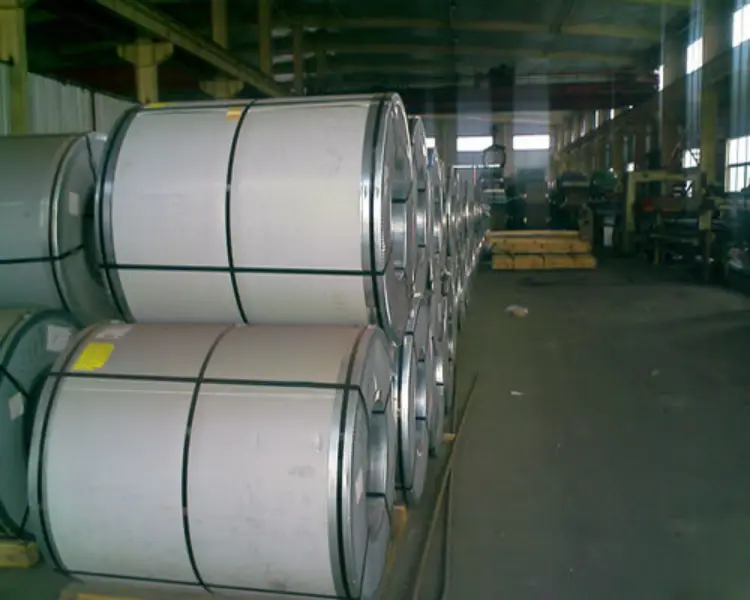
ABS Grade EQ47 Shipbuilding Steel Coil
ABS Grade EQ47 Shipbuilding Steel Coil: High-Strength, Low-Temperature Toughness for Marine Structures
Explore ABS Grade EQ47 shipbuilding steel coil, a high-strength material with 420 MPa min yield strength, excellent low-temperature weldability, and through-thickness properties. Certified under ABS Rules, it is designed for critical offshore and marine structural applications.
Hot Rolling, Normalizing (N), Thermo-Mechanical Controlled Processing (TMCP), Welding, Flame Cutting, Cold Bending, Shearing
- Phone : +8618037372205
- Email : [email protected]
- WhatsApp: Contact via Whtsapp
- WeChat: +8618037372205
ABS Grade EQ47 Shipbuilding Steel Coil Introduction
ABS Grade EQ47 is a high-strength, low-alloy shipbuilding steel coil classified under the American Bureau of Shipping (ABS) Rules for Materials and Welding. It is designed for critical structural components in marine and offshore environments that require exceptional tensile properties and notch toughness at low temperatures. The "E" designation confirms it has undergone normalizing heat treatment, ensuring a refined grain structure and uniform mechanical properties, while the "Q47" denotes a minimum yield strength of 420 MPa. This grade exhibits excellent weldability, which is essential for the fabrication of large ship sections, and superior resistance to brittle fracture, making it suitable for operations in cold-climate or ice-class vessels. Its stringent chemistry control, including fine-grain practice and low carbon equivalent values, enhances its suitability for high-heat-input welding processes. ABS EQ47 steel coils are primarily used in the construction of hull structures, decks, and other critical load-bearing members where weight savings and safety are paramount.
ABS Grade EQ47 Shipbuilding Steel Coil Chemical Composition
The chemical composition of ABS Grade EQ47 steel is meticulously balanced to achieve high strength and superior low-temperature toughness. Carbon content is limited to ensure excellent weldability and minimize cold cracking susceptibility. Additions of manganese, niobium, vanadium, and titanium provide precipitation and grain refinement strengthening. The carbon equivalent is controlled to a low level, typically below 0.40%, which is critical for preventing heat-affected zone (HAZ) hardening during welding. Note: The values below represent the ladle analysis requirements per ABS Rules. The total aluminum content is specified to ensure fully killed, fine-grain steel.
| Element | Standard Value (max %) | Remarks |
|---|---|---|
| Carbon (C) | 0.18 | Ladle Analysis |
| Manganese (Mn) | 0.90 - 1.60 | High Mn for strength and toughness |
| Silicon (Si) | 0.10 - 0.50 | Deoxidizer |
| Phosphorus (P) | 0.025 | Maximum limit for cold ductility |
| Sulfur (S) | 0.025 | Maximum limit for through-thickness properties |
| Aluminum (Al, Acid Soluble) | 0.015 min | For fine grain practice, if used |
| Niobium (Nb) | 0.02 - 0.05 | Optional grain refiner |
| Vanadium (V) | 0.05 - 0.10 | Optional precipitation strengthener |
| Titanium (Ti) | 0.02 | Optional grain refiner, max |
| Nitrogen (N) | 0.012 | Maximum, unless sufficient Al is present |
| Copper (Cu) | 0.35 | Residual element limit |
| Chromium (Cr) | 0.20 | Residual element limit |
| Nickel (Ni) | 0.40 | Residual element limit |
| Molybdenum (Mo) | 0.08 | Residual element limit |
| Carbon Equivalent (CEQ) | 0.40 (typical) | CEQ = C + Mn/6 + (Cr+Mo+V)/5 + (Ni+Cu)/15 |
ABS Grade EQ47 Shipbuilding Steel Coil Thermal and Electrical Physical Properties
The physical properties of ABS EQ47 are typical of low-alloy high-strength structural steels and are essential for engineering calculations related to thermal stress, heat transfer, and structural weight. Density is used for weight estimation, while modulus of elasticity and shear modulus are critical for stiffness and buckling analysis. Thermal conductivity is important for predicting cooling rates in welding, and the coefficient of thermal expansion is necessary for designing systems that undergo significant temperature changes. These values are provided for reference at standard room temperature (20°C) unless otherwise noted.
| Property | Typical Reference Value | Unit | Test Condition / Remarks |
|---|---|---|---|
| Density (ρ) | 7850 | kg/m³ | At room temperature |
| Modulus of Elasticity (E) | 205 | GPa | Typical for steel |
| Shear Modulus (G) | 80 | GPa | Typical for steel |
| Poisson's Ratio (ν) | 0.30 | Dimensionless | In the elastic range |
| Coefficient of Thermal Expansion (α) | 11.7 | 10⁻⁶/K | For range 20°C to 100°C |
| Coefficient of Thermal Expansion (α) | 12.7 | 10⁻⁶/K | For range 20°C to 300°C |
| Thermal Conductivity (λ) | 51.9 | W/(m·K) | At 20°C |
| Thermal Conductivity (λ) | 46.0 | W/(m·K) | At 300°C |
| Specific Heat Capacity (c) | 460 | J/(kg·K) | For range 20°C to 100°C |
| Electrical Resistivity (ρ_e) | 0.23 | Ω·mm²/m | At room temperature, indicative |
ABS Grade EQ47 Shipbuilding Steel Coil Mechanical Properties
The mechanical properties of ABS Grade EQ47 reveal its high-strength attribute with a minimum yield strength of 420 MPa. A high tensile-to-yield ratio and good elongation before fracture indicate a good capacity for plastic deformation before failure, which is vital for structural safety. The impact test requirements are a hallmark of the "E" quality designation, demanding a minimum absorbed energy of 34 J at -40°C (-40°F) for transverse specimens, ensuring resistance to brittle fracture in the most severe marine conditions. Properties can vary based on product thickness and final delivery condition. Values below are for the normalized condition.
| Property | Standard Requirement Value | Unit | Test Condition / Remarks |
|---|---|---|---|
| Yield Strength (ReH) | 420 min | MPa | Specified for t ≤ 100mm; Minimum value may reduce for t > 100mm |
| Tensile Strength (Rm) | 530 - 680 | MPa | For thicknesses (t) ≤ 100mm |
| Elongation (A) | 18 min | % | Gauge length L0=5.65√S0, longitudinal |
| Elongation (A) | 16 min | % | Gauge length L0=5.65√S0, transverse |
| Charpy V-Notch Impact Energy (KV) | 34 min | J | At -40°C, transverse. For t ≤ 50mm, min specimen width 10x7.5mm. Minimum individual value is 70% of average. |
| Charpy V-Notch Impact Energy (KV) | 24 min | J | At -40°C, transverse. For subsize specimen 7.5mm width. Minimum individual value is 70% of average. |
| Charpy V-Notch Impact Energy (KV) | 17 min | J | At -40°C, transverse. For subsize specimen 5.0mm width. Minimum individual value is 70% of average. |
ABS Grade EQ47 Shipbuilding Steel Coil Identical Materials: Equivalent Standards & Replaceable Grades
| Country/Region | Standard | Grade | Remarks |
|---|---|---|---|
| International | ABS | EQ47 | Base specification. |
| Norway/Germany | DNV | E47 | Direct equivalent from Det Norske Veritas. Identical chemical and mechanical requirements. |
| France | BV | E47 | Direct equivalent from Bureau Veritas. |
| United Kingdom | LR | EH47 | Direct equivalent from Lloyd's Register. Identical grade designation. |
| Japan | NK | KE47 | Direct equivalent from Nippon Kaiji Kyokai (ClassNK). |
| China | CCS | E47 | Direct equivalent from China Classification Society. |
| Italy | RINA | E47 | Direct equivalent from the Italian classification society. |
ABS Grade EQ47 Shipbuilding Steel Coil Application Introduction
ABS Grade EQ47 is a strategic material for demanding marine and offshore engineering projects. Its high strength and guaranteed toughness at -40°C make it the material of choice for weight reduction without compromising structural integrity in cold-climate environments. The normalizing heat treatment provides a uniform, reliable microstructure that ensures consistent performance in high-stress cyclic loading conditions. It is easily fabricated using standard shipyard practices and is suitable for all major welding methods, provided appropriate low-hydrogen procedures are followed.
- Key Advantage: Superior low-temperature impact resistance and predictable weldability.
- Fabrication: Can be cut, cold-formed, and welded to fabricate complex structural modules.
Product Applications: Ice-class vessels (container ships, LNG carriers, bulk carriers), Self-elevating platform legs (jack-up rigs), Semi-submersible platform columns, Living quarters modules for offshore platforms, Arctic offshore supply vessels
Processed into products: Shell plating and bottom strakes, Deck stringer plates and sheer strakes, Continuous longitudinal hatch coamings, Bilge keels and stern frames, Main structural web frames and stiffeners, Tubular K-joints and transition cones in offshore wind jackets
Application industries: Shipbuilding (commercial and naval), Offshore Oil and Gas (topside and jacket structures), Renewable Energy (offshore wind turbine foundations), Bridge Construction, Heavy Civil Engineering
ABS Grade EQ47 Shipbuilding Steel Coil Similar/Comparable Substitute Materials
| Country/Region | Standard | Grade | Description & Analysis |
|---|---|---|---|
| Europe | EN 10225 | S460G2+Q | A weldable structural steel for fixed offshore structures. Minimum yield strength is 460 MPa, higher than EQ47. It offers similar excellent toughness at -40°C and is a very close functional substitute for heavy offshore applications. |
| USA | API RP 2A | API 2Y-60 | Steel for offshore platforms. With a yield strength of 414 MPa (60 ksi), it is a direct functional parallel in terms of strength. Properties are tailored for tubular joints and welded nodes in offshore structures. |
| Europe | EN 10025-4 | S420ML | A thermomechanical rolled weldable fine-grain structural steel for construction. It shares the same 420 MPa min yield strength and a similar low-temperature toughness (M-class to -20°C, which is less demanding than EQ47's -40°C rating). |
| Japan | JIS G 3106 | SM520C | A commonly used high-strength rolled steel for welded structures. Its tensile strength ranges from 520 to 640 MPa. While similar in strength, its guaranteed impact temperature of 0°C is significantly higher than EQ47, making it less suitable for critical cryogenic applications. |
Notes:
Welding Considerations: Although EQ47 has low carbon equivalent, strict adherence to preheat and interpass temperature control is recommended, particularly for thick sections, to prevent hydrogen-induced cold cracking. A preheat temperature of 100-150°C is often applied depending on the thickness and combined hydrogen potential of the welding consumable. Supplementary Requirements: ABS may specify additional tests such as through-thickness tensile testing (Z-quality, e.g., Z25 or Z35) and full CTOD fracture toughness testing for fatigue-critical offshore applications. Always consult the specific project specifications and the latest ABS Rules for complete compliance.
- Share



