
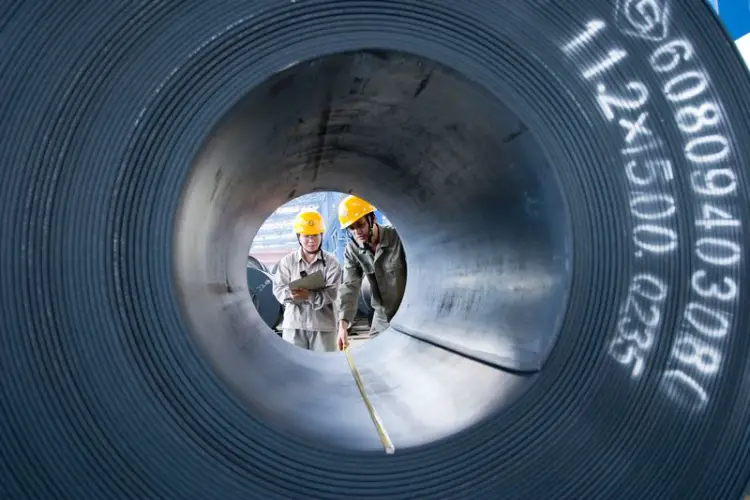
Q390B LSAW Pipe Steel Grade
Q390B LSAW Pipe Steel Grade: Properties and Equivalent Standards per GB/T 1591
Detailed material data sheet for Q390B steel used in longitudinal submerged arc welded (LSAW) pipes according to Chinese standard GB/T 1591-2018, including chemical composition, mechanical and physical properties, and international equivalents.
Hot rolling, cold forming, welding, cutting, normalizing
- Phone : +8618037372205
- Email : [email protected]
- WhatsApp: Contact via Whtsapp
- WeChat: +8618037372205
Q390B LSAW Pipe Steel Grade Introduction
Q390B is a high-strength low-alloy structural steel grade under the Chinese standard GB/T 1591-2018, with a minimum yield strength of 390 MPa. It is commonly supplied in the form of hot-rolled plates and strips used for the fabrication of longitudinal submerged arc welded (LSAW) pipes. The steel offers a good combination of weldability, toughness, and formability, making it suitable for welded structures in bridges, buildings, offshore platforms, and oil & gas transportation pipelines. The 'B' designation indicates that impact testing is carried out at 20°C, with a minimum Charpy V-notch absorbed energy of 34 J (longitudinal direction). Microalloying elements such as niobium, vanadium, titanium, and aluminum are added to achieve fine grain refinement, which contributes to enhanced strength and ductility. The material is typically delivered in the as-rolled or normalized condition, depending on thickness and application requirements, and is fully killed with sufficient aluminum content to ensure grain refinement.
Q390B LSAW Pipe Steel Grade Chemical Composition
The chemical composition of Q390B steel according to GB/T 1591-2018 is detailed below. All values are maximum unless a range or minimum is specified. The steel is fully killed and grain-refined by the addition of aluminum and at least one of the elements niobium, vanadium, or titanium. The total content of Nb+V+Ti shall not exceed 0.22%, and the sum of these three grain-refining elements must include at least one to achieve the fine-grained structure required for the mechanical properties.
| Element | Content (%) | Remarks |
|---|---|---|
| C | ≤0.20 | Heat analysis |
| Si | ≤0.50 | |
| Mn | ≤1.70 | |
| P | ≤0.035 | |
| S | ≤0.035 | |
| Cr | ≤0.30 | |
| Ni | ≤0.30 | |
| Cu | ≤0.30 | |
| Mo | ≤0.10 | |
| Nb | ≤0.07 | Grain refining element |
| V | ≤0.20 | Grain refining element |
| Ti | ≤0.20 | Grain refining element |
| Als | ≥0.015 | Total or acid-soluble aluminum |
| N | ≤0.012 |
Q390B LSAW Pipe Steel Grade Thermal and Electrical Physical Properties
The following physical properties are typical for Q390B low-alloy structural steel at room temperature and are provided for design guidance. These values are not standard requirements but are well-recognised for this class of material. Where temperature-dependent values are given, the test condition is indicated.
| Property | Typical Value | Unit | Test Condition |
|---|---|---|---|
| Density (ρ) | 7.85 | g/cm³ | Room temperature |
| Modulus of Elasticity (E) | 206 | GPa | Room temperature |
| Shear Modulus (G) | 79 | GPa | Room temperature |
| Poisson's Ratio (ν) | 0.3 | — | Room temperature |
| Thermal Expansion Coefficient (α) | 12.0 × 10⁻⁶ | /K | 20–100 °C |
| Thermal Conductivity (λ) | 45 | W/(m·K) | at 20 °C |
| Specific Heat Capacity (c) | 460 | J/(kg·K) | at 20 °C |
| Electrical Resistivity (ρ_e) | 0.23 | µΩ·m | at 20 °C |
Q390B LSAW Pipe Steel Grade Mechanical Properties
The mechanical properties of Q390B steel are dependent on the product thickness. The values listed in the table are the minimum requirements for the longitudinal direction except where noted. The bend test is applicable when specified by the purchaser. The Charpy impact test is mandatory for the B quality level and is performed at 20°C using longitudinal V-notch specimens.
| Property | Value | Unit | Condition / Thickness |
|---|---|---|---|
| Yield Strength (ReH) | ≥390 | MPa | t ≤ 16 mm |
| Yield Strength (ReH) | ≥370 | MPa | 16 < t ≤ 40 mm |
| Yield Strength (ReH) | ≥350 | MPa | 40 < t ≤ 63 mm |
| Yield Strength (ReH) | ≥330 | MPa | 63 < t ≤ 80 mm |
| Yield Strength (ReH) | ≥330 | MPa | 80 < t ≤ 100 mm |
| Yield Strength (ReH) | ≥310 | MPa | 100 < t ≤ 150 mm |
| Tensile Strength (Rm) | 490 – 650 | MPa | All thicknesses |
| Elongation (A) | ≥20 | % | t ≤ 16 mm, Lo = 5.65√So |
| Elongation (A) | ≥19 | % | 16 < t ≤ 40 mm |
| Elongation (A) | ≥19 | % | 40 < t ≤ 63 mm |
| Elongation (A) | ≥18 | % | 63 < t ≤ 80 mm |
| Elongation (A) | ≥18 | % | 80 < t ≤ 100 mm |
| Elongation (A) | ≥17 | % | 100 < t ≤ 150 mm |
| Charpy Impact Energy (KV2, longitudinal, 20°C) | ≥34 | J | V-notch, standard specimen |
| Bend Test (180°), d = bend diameter, a = specimen thickness | d = 2a | — | t ≤ 16 mm |
| Bend Test (180°), d = bend diameter, a = specimen thickness | d = 3a | — | 16 < t ≤ 100 mm |
Q390B LSAW Pipe Steel Grade Fully Equivalent International Standards and Replacement Grades
| Country/Region | Standard | Grade | Remarks |
|---|---|---|---|
| — | — | — | No internationally identical equivalent grade exists for Q390B. The closest substitutes are listed under similar materials. |
Q390B LSAW Pipe Steel Grade Application Introduction
Q390B LSAW pipes and plates are extensively utilised in heavy engineering where high strength, good weldability, and moderate toughness are required. The steel is especially suited for structures exposed to ambient temperatures and can be welded with standard low-hydrogen processes. Typical application sectors and product forms are outlined below.
Product Applications: Longitudinally submerged arc welded (LSAW) pipe for oil and gas, Spiral welded pipe for water and gas transmission, Welded structural hollow sections (square, rectangular, circular), Hot-rolled plate cut to size for fabrication, Bridge girders and box sections, Pressure vessel shells (when impact requirements are met)
Processed into products: LSAW pipe spools and fittings (elbows, tees, reducers), Flanges and connectors for piping systems, Pipe piles for foundations and marine structures, Structural support beams and columns, Welded truss members, Offshore platform legs and bracing
Application industries: Oil and gas transmission (long-distance pipelines), Structural engineering (high-rise buildings, stadiums), Offshore engineering (platform substructures, jackets), Bridge construction (girder and arch components), Heavy machinery (crane booms, earthmoving equipment), Shipbuilding (hull structural elements, deckhouses)
Q390B LSAW Pipe Steel Grade Similar or Alternative Material Grades with Comparable Strength
| Country/Region | Standard | Grade | Remarks |
|---|---|---|---|
| Europe | EN 10025-3 | S420N / S420M | Minimum yield strength 420 MPa; normalized (N) or thermomechanically rolled (M). Slightly higher strength than Q390B; good toughness. |
| USA | ASTM A572/A572M | Grade 60 | Minimum yield 60 ksi (415 MPa). Commonly used in structural applications; chemistry may differ. |
| Japan | JIS G3106 | SM520B / SM520C | Minimum yield 365 MPa for SM520B (t>16–40 mm), somewhat lower; SM520B with Charpy at 0 °C and SM520C at –20 °C. Not exact match. |
| International | ISO 4951-3 | E390 | High-strength fine-grained steel with nominal yield 390 MPa; may be comparable depending on sub-grade and delivery condition. |
Notes:
For LSAW pipe made from Q390B steel plate, the pipe body properties are typically verified according to the pipe product standard (e.g., GB/T 3091, GB/T 9711, or API 5L PSL2). The base metal must conform to the chemical and mechanical requirements of GB/T 1591 Q390B, while the weld seam properties may have separate requirements. Post-weld heat treatment (PWHT) is generally not required unless specified for stress relief. Consult the appropriate pipe manufacturing specification for dimensional tolerances, hydrostatic testing, and additional non-destructive examination. The Charpy impact test at 20°C is mandatory for B quality; for lower temperatures grades Q390C (0°C), Q390D (–20°C), or Q390E (–40°C) should be considered.
- Share



