
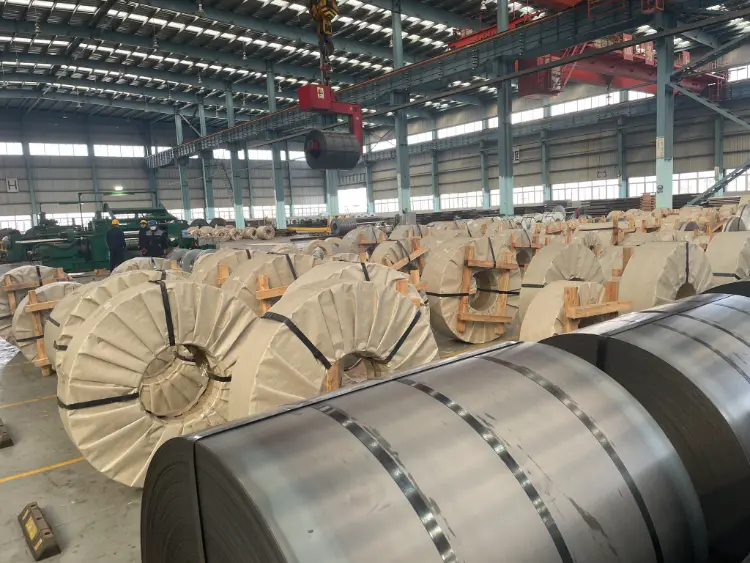
ABS Grade DQ47 Shipbuilding Steel Coil
ABS Grade DQ47 Shipbuilding Steel Coil: High-Strength Quenched & Tempered Structural Plate
In-depth material data of ABS DQ47 shipbuilding steel coil including chemical composition, mechanical and thermal properties, equivalent grades, and applications.
Quenching and tempering (Q&T), suitable for welding, cutting, forming (cold or hot bending with care)
- Phone : +8618037372205
- Email : [email protected]
- WhatsApp: Contact via Whtsapp
- WeChat: +8618037372205
ABS Grade DQ47 Shipbuilding Steel Coil Introduction
ABS Grade DQ47 is a high-strength quenched and tempered structural steel specifically designed for shipbuilding and offshore engineering. As a member of the ABS (American Bureau of Shipping) higher-strength hull structural steel family, DQ47 delivers a minimum yield strength of 460 MPa and excellent low-temperature toughness (longitudinal impact absorbed energy ≥ 41 J at -20 °C, D-grade). The steel is produced under tight control of carbon equivalent (typically ≤ 0.43% for ≤ 50 mm thickness) to ensure good weldability alongside high strength. Typical applications include critical hull members such as deck plating, sheer strakes, and strength deck structures exposed to high stress and low temperatures. The material is supplied in the quenched and tempered condition (Q), offering a refined microstructure and superior mechanical properties compared to conventional normalized or thermo-mechanically controlled processed steels.
ABS Grade DQ47 Shipbuilding Steel Coil Chemical Composition
The chemical composition of ABS Grade DQ47 steel shall comply with the limits specified by ABS Rules. Grain-refining elements (Nb, V, Ti) may be added singly or in combination. The carbon equivalent (CEV) is generally controlled to ≤0.40% for thickness ≤50 mm to ensure adequate weldability, but specific CEV limits may be defined in the contract.
- Aluminum is required as a grain refiner and for deoxidation (Al≥0.015% for acid-soluble Al).
- Maximum P and S contents ensure cleanliness and toughness.
| Element | Specified Value (max, unless range) | Remarks |
|---|---|---|
| C (Carbon) | 0.20 | Maximum |
| Mn (Manganese) | 0.90 – 1.60 | Range |
| Si (Silicon) | 0.10 – 0.55 | Range (typical min 0.10) |
| P (Phosphorus) | 0.025 | Maximum |
| S (Sulfur) | 0.025 | Maximum |
| Al (Aluminum, acid soluble) | ≥ 0.015 | Minimum for grain refinement |
| Nb (Niobium) | 0.02 – 0.05 | Optional, singly or combined |
| V (Vanadium) | 0.05 – 0.10 | Optional, singly or combined |
| Ti (Titanium) | 0.007 – 0.05 | Optional, singly or combined |
| Cu (Copper) | 0.35 | Maximum, if specified |
| Cr (Chromium) | 0.20 | Maximum, residual |
| Ni (Nickel) | 0.40 | Maximum, residual |
| Mo (Molybdenum) | 0.08 | Maximum, residual |
| N (Nitrogen) | 0.009 | Maximum if sufficient amount of Al or other N-binding elements present |
| CEV (Carbon Equivalent) | ≤ 0.40 (typical for ≤50 mm) | CEV = C + Mn/6 + (Cr+Mo+V)/5 + (Ni+Cu)/15 |
ABS Grade DQ47 Shipbuilding Steel Coil Thermal & Electrical Physical Properties
These properties are representative of low-carbon, high-strength quenched and tempered steel grades and are suitable for engineering calculations. Actual values may vary slightly depending on composition and heat treatment. Properties are measured at room temperature unless otherwise specified.
- The thermal expansion coefficient is given for the range 20–100 °C; for higher temperatures it increases.
- Electrical resistivity is for direct current (DC) at 20 °C.
| Property | Typical Value | Unit | Test Condition |
|---|---|---|---|
| Density (ρ) | 7850 | kg/m³ | At 20 °C |
| Elastic Modulus (E) | 210 | GPa | At 20 °C, static |
| Shear Modulus (G) | 81 | GPa | Calculated from E and ν |
| Poisson's Ratio (ν) | 0.3 | – | In elastic range |
| Thermal Expansion Coefficient (α) | 12.0 × 10⁻⁶ | K⁻¹ | 20–100 °C range |
| Thermal Conductivity (λ) | 45 – 52 | W/(m·K) | At 20 °C |
| Specific Heat Capacity (cp) | 460 – 500 | J/(kg·K) | At 20 °C |
| Electrical Resistivity (ρ_e) | 0.15 – 0.25 | µΩ·m | At 20 °C, DC |
ABS Grade DQ47 Shipbuilding Steel Coil Mechanical Properties
The mechanical properties of ABS DQ47 steel are verified on test samples taken from the finished product. Properties are generally valid for thicknesses ≤ 50 mm. For thicknesses above 50 mm, the specification may be subject to agreement. Impact testing is conducted on Charpy V-notch specimens at -20 °C for transverse orientation. Longitudinal values are higher.
- The bending test is performed with a former diameter specified as a multiple of the specimen thickness.
- Elongation is measured on a gauge length of 5.65√S₀ (A5) for proportional test pieces.
| Property | Value | Unit | Test Condition / Remarks |
|---|---|---|---|
| Yield Strength (ReH) | ≥ 460 | MPa | Thickness ≤ 50 mm, transverse |
| Yield Strength (ReH) | ≥ 440 | MPa | Thickness > 50 mm, ≤ 100 mm (by agreement), transverse |
| Tensile Strength (Rm) | 570 – 720 | MPa | Thickness ≤ 100 mm, transverse |
| Elongation (A5) | ≥ 17 | % | Gauge length 5.65√S₀, transverse |
| Charpy Impact Energy (KV₂) | ≥ 41 (mean of 3) | J | At -20 °C, transverse; single value ≥ 70% of specified mean |
| Charpy Impact Energy (KV₂) | ≥ 55 (mean of 3) | J | At -20 °C, longitudinal (typical), for reference |
| Bend Test (180°) | No cracks | – | Former diameter: 3 × thickness (transverse); for thickness ≤ 50 mm |
ABS Grade DQ47 Shipbuilding Steel Coil Fully Equivalent Material Standards & Replaceable Grades
| Country / Region | Standard / Classification Society | Grade Designation | Remarks |
|---|---|---|---|
| International | DNV (Det Norske Veritas) | D47 | Direct equivalent; quenched & tempered, -20 °C impact |
| International | Lloyd's Register (LR) | DH47 | Equivalent; DH indicates -20 °C toughness |
| International | Bureau Veritas (BV) | D47 | Same strength and toughness level |
| International | China Classification Society (CCS) | DH47 | Equivalent grade, widely used in Chinese shipyards |
| International | Nippon Kaiji Kyokai (NK) | D47 | Identical designation, quenched & tempered |
| International | Korean Register (KR) | D47 | Identical requirements to ABS DQ47 |
| International | RINA (Registro Italiano Navale) | D47 | Equivalent high-strength grade |
ABS Grade DQ47 Shipbuilding Steel Coil Application Introduction
ABS DQ47 steel coil/plate is specifically engineered for marine and offshore structural applications where high strength and reliable toughness at low temperatures are required. Its quenched and tempered condition guarantees uniform mechanical properties across the thickness, making it a preferred material for critical, highly stressed ship components. The material can be processed by cutting, forming, and welding using standard shipyard practices. Pre-heating and post-weld heat treatment may be required for thicker sections.
- Typical applications are in hull girder strength members, deck strips, and longitudinal stiffeners.
- Also used in ice-strengthened vessels and Arctic offshore structures.
Product Applications: Hull plates and shell plating, Strength decks and sheer strakes, Longitudinal stiffeners and stringers, Upper deck plating of container ships and bulk carriers, Ice belts and reinforcement structures
Processed into products: Thermal-cut and welded beams and frames, Stiffened panels for ship blocks, Lifting lugs and padeyes on offshore structures, Crane pedestal foundations on vessels, Machined rudder horns and brackets
Application industries: Shipbuilding (merchant ships, naval vessels, icebreakers), Offshore oil & gas (jack-up rigs, semisubmersibles, FPSOs), Marine engineering (port cranes, floating docks), Renewable energy (offshore wind turbine foundations, substructures)
ABS Grade DQ47 Shipbuilding Steel Coil Similar / Alternative Materials Recommendation
| Country / Region | Standard / Classification Society | Grade Designation | Remarks |
|---|---|---|---|
| International | ABS | EQ47 | Same strength (460 MPa min YS) but with -40 °C impact toughness; suitable for lower service temperatures |
| International | ABS | FQ47 | Same strength with -60 °C impact toughness for cryogenic applications |
| International | ABS | AH47 / DH47 / EH47 | Higher strength 47-ksi series with different delivery conditions (N, TMCP) may be used as substitute where Q&T is not mandatory, subject to design approval |
| International | DNV / LR / BV | E47 / F47 | Low-temperature equivalents for -40 °C and -60 °C respectively |
| International | EN 10025-6 | S460Q / S460QL / S460QL1 | European quenched & tempered structural steel with similar strength; verify toughness class (L = -50 °C) for equivalent low-temperature performance |
| Japan | JIS G 3128 | SHY 685 (or older designation SQV2A/B) | Higher strength but similar production route; not directly equivalent, use only after careful evaluation |
Notes:
- DQ47 steel is typically certified by ABS surveyors and stamped with the ABS mark and heat number.
- Supplementary requirements such as through-thickness property testing (Z-quality), ultrasonic testing per ASTM A578/A578M, or simulated post-weld heat treatment (PWHT) testing can be specified at the time of order.
- For improved corrosion resistance, painting or coating systems are applied in service; the steel itself is not inherently corrosion resistant.
- When substituting an equivalent grade from another classification society, always verify that the specific grade's chemical and mechanical limits meet the designer's requirements and that the material is approved by the relevant society.
- Share



