
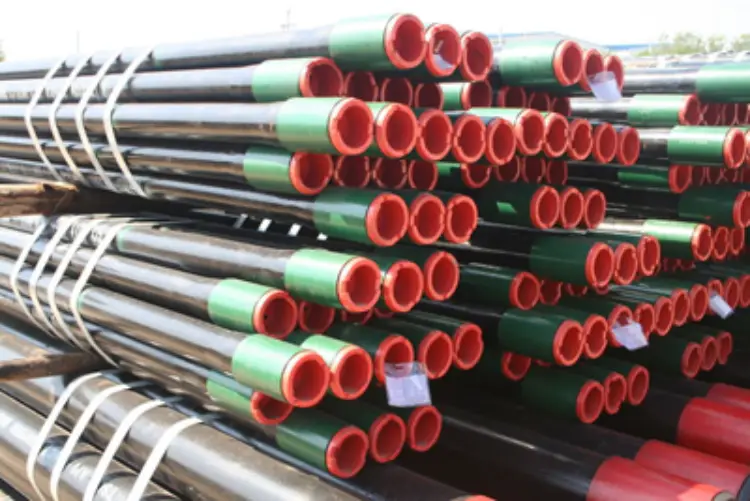
Q345C Steel Grade for LSAW Pipe
Q345C Steel Grade for LSAW Pipe - GB/T 1591 Low Alloy Structural Steel
Comprehensive material data for Q345C steel used in LSAW pipes: chemical composition, mechanical properties, thermal & electrical performance in accordance with GB/T 1591. Includes international equivalents and application guidance.
Hot rolling, controlled rolling, normalizing; pipe forming by UOE, JCOE, or roll bending and submerged arc welding
- Phone : +8618037372205
- Email : [email protected]
- WhatsApp: Contact via Whtsapp
- WeChat: +8618037372205
Q345C Steel Grade for LSAW Pipe Introduction
Q345C is a Chinese standard low-alloy high-strength structural steel grade defined by GB/T 1591, primarily used for welded pipes such as LSAW (Longitudinal Submerged Arc Welded) pipes. It belongs to the yield strength 345 MPa class with enhanced notch toughness at 0 °C (C quality). Typical delivery condition for LSAW pipe is hot-rolled or normalized steel plate/coil, then formed and welded. The material exhibits good weldability, moderate corrosion resistance, and reliable low-temperature toughness, making it suitable for structural, pressure, and linepipe applications in oil & gas, construction, and marine sectors. Its balanced C-Mn-Si composition with microalloying elements (Nb, V, Ti) ensures fine grain structure and improved mechanical strength. Under the 2018 revision (Q355), Q345 remains widely referenced and available for legacy projects.
Q345C Steel Grade for LSAW Pipe Chemical Composition
The chemical composition of Q345C conforms to GB/T 1591-2008. Carbon equivalent (CEV) is typically controlled to ensure good weldability. Microalloying elements such as Nb, V, Ti refine the grain size, and elements like Als (total aluminum) are added for deoxidation. Limits for P and S are stricter than in lower-quality grades to improve toughness and weldability.
| Element | Content (%) | Remarks |
|---|---|---|
| C | ≤0.20 | |
| Si | ≤0.50 | |
| Mn | ≤1.70 | |
| P | ≤0.030 | |
| S | ≤0.030 | |
| Nb | ≤0.07 | May be partly replaced by V |
| V | ≤0.15 | |
| Ti | ≤0.20 | |
| Cr | ≤0.30 | |
| Ni | ≤0.50 | |
| Cu | ≤0.30 | |
| N | ≤0.012 | If Al is present (Als ≥0.015) |
| Mo | ≤0.10 | |
| Als | ≥0.015 | Total aluminum, for fine grain practice |
Q345C Steel Grade for LSAW Pipe Thermal and Electrical Physical Properties
Physical properties are representative for low‑alloy C-Mn steels at ambient temperature unless otherwise noted. These values are not specifically regulated by GB/T 1591 but are based on published data for Q345 grade family. Actual properties may vary slightly with heat treatment and thickness.
| Property | Typical Value | Unit | Test Condition |
|---|---|---|---|
| Density (ρ) | 7.85 | g/cm³ | 20 °C |
| Modulus of elasticity (E) | 206 | GPa | 20 °C |
| Shear modulus (G) | ~80 | GPa | 20 °C |
| Poisson's ratio (ν) | 0.3 | — | 20 °C |
| Thermal expansion coefficient (α) | 11.5 | ×10⁻⁶/K | 20–100 °C |
| Thermal expansion coefficient (α) | 12.1 | ×10⁻⁶/K | 20–200 °C |
| Thermal conductivity (λ) | 50.6 | W/(m·K) | 20 °C |
| Thermal conductivity (λ) | 47.0 | W/(m·K) | 200 °C |
| Specific heat capacity (c) | 460 | J/(kg·K) | 20 °C |
| Electrical resistivity (ρₑ) | 0.18 | μΩ·m | 20 °C |
Q345C Steel Grade for LSAW Pipe Mechanical Properties
Mechanical properties are based on GB/T 1591-2008 for plates/strips used in LSAW pipe manufacturing. Values depend on thickness. Impact energy requirement for Q345C is KV2 ≥ 34 J at 0 °C (longitudinal). For LSAW pipe, the base metal and welded joint properties must meet the standard, with bend test diameters as shown.
| Property | Value | Unit | Test Condition |
|---|---|---|---|
| Yield strength (ReH) | ≥345 | MPa | Thickness ≤ 16 mm |
| Yield strength (ReH) | ≥325 | MPa | Thickness >16–35 mm |
| Yield strength (ReH) | ≥315 | MPa | Thickness >35–50 mm |
| Yield strength (ReH) | ≥295 | MPa | Thickness >50–100 mm |
| Tensile strength (Rm) | 470 – 630 | MPa | All thicknesses |
| Elongation after fracture (A) | ≥21 | % | Thickness ≤ 40 mm, gauge 5.65√S₀ |
| Elongation after fracture (A) | ≥20 | % | Thickness >40–63 mm |
| Elongation after fracture (A) | ≥19 | % | Thickness >63–100 mm |
| Impact energy (KV2) | ≥34 | J | 0 °C, longitudinal |
| Bend test (d = bend diameter, a = thickness) | d = 3a | — | Thickness ≤ 16 mm, 180° bend |
| Bend test | d = 4a | — | Thickness >16–100 mm, 180° bend |
Q345C Steel Grade for LSAW Pipe Fully Equivalent Material Standards and Substitute Grades
| Country / Region | Standard | Grade | Remarks |
|---|---|---|---|
| China | GB/T 1591-2008 | Q345C | Original standard for LSAW pipe base material |
| European Union | EN 10025-2:2019 | S355J0 | Analogous yield class (355 MPa), 0 °C impact, comparable chemistry |
| International | ISO 630-2 | S355C | Similar strength and toughness classification |
| USA | ASTM A572/A572M | Grade 50 [345] | Yield 345 MPa, but no mandatory impact test; often accepted with supplementary requirement |
| Japan | JIS G 3106 | SM490A | Yield 325–365 MPa, but impact temperature not standardised; close match for thickness ≤ 16 mm |
Q345C Steel Grade for LSAW Pipe Application Introduction
Q345C LSAW pipes deliver a reliable combination of strength, weldability, and 0 °C notch toughness. They are extensively employed in long-distance oil & gas transmission pipelines, structural frameworks, and offshore/marine construction. The LSAW process permits large diameters and thick walls, making this material ideal for high-pressure and heavy-load environments. Typical delivery conditions include hot-rolled plate with normalizing rolling; post-weld heat treatment can be applied to relieve residual stresses. With proper welding consumables and procedures, the steel maintains its properties in the heat-affected zone, ensuring code compliance across a broad variety of standards.
Product Applications: LSAW steel pipes for hydrocarbon transport (oil, gas, water), Structural hollow sections for bridges and high-rise buildings, Piling pipes and foundation tubes, Penstock pipes for hydropower plants, Line pipes and flowlines, Caissons and conductor pipes in offshore platforms
Processed into products: Pipe spools and straight-run pipe segments, Long-radius elbows and bends, Tees, reducers, and lateral outlets, Weldneck flanges and blind flanges, Pipe supports, saddles, and anchors, Stiffened piles and jacket leg components, Transition pieces and pup pieces
Application industries: Oil and gas (onshore and offshore pipelines), Civil construction and infrastructure, Marine engineering and shipbuilding, Bridge building, Pressure vessels and storage tanks, Mechanical and heavy equipment manufacturing
Q345C Steel Grade for LSAW Pipe Similar / Alternative Materials for Q345C LSAW Pipe
| Country / Region | Standard | Grade | Remarks |
|---|---|---|---|
| China | GB/T 1591-2018 | Q355C | New grade replacing Q345C, slightly higher yield (355 MPa), identical impact class |
| China | GB/T 1591-2008 | Q345D | Same yield but guaranteed toughness at -20 °C, superior for lower temperature use |
| European Union | EN 10025-2 | S355J2 | Impact tested at -20 °C, better toughness than S355J0; often used when notch ductility is critical |
| USA | ASTM A572/A572M | Grade 50 with Charpy test | When ordered with supplementary Charpy requirement at 0 °C, it matches Q345C |
| API Spec 5L (PSL1/PSL2) | API 5L | X52 (L360) | Line pipe specification; X52 shows comparable strength but may require adjustment for toughness specification |
Notes:
Note for LSAW pipe production: The mechanical properties stated are based on the parent plate/strip prior to pipe forming. The welding process may affect the HAZ toughness; therefore, welding procedure qualification and, if necessary, post-weld heat treatment should be considered. For sour service or highly corrosive environments, specific HIC/SSC tests may be required beyond standard GB/T 1591. Q345C is gradually superseded by Q355C in new projects, but it remains fully valid for maintenance and existing project replication. Always confirm the latest standard revision with the project specification.
- Share



