
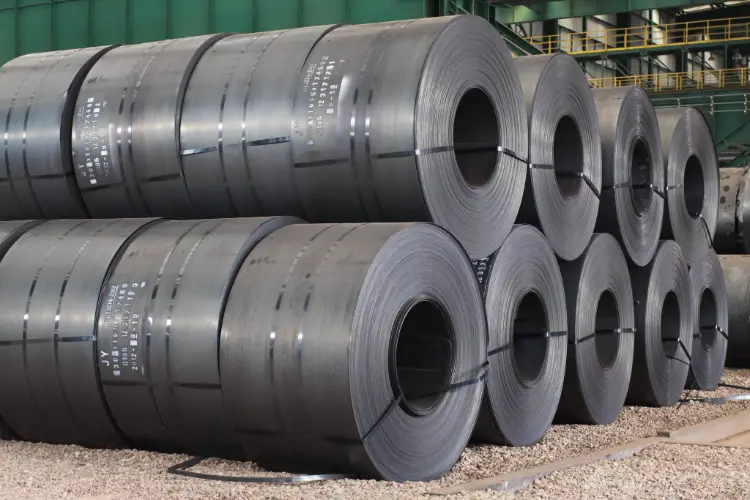
ABS Grade AH47 Shipbuilding Steel Coil
ABS Grade AH47 Shipbuilding Steel Coil: Premium High-Strength Hull Structural Steel
In-depth technical data for ABS Grade AH47 shipbuilding steel coil, including exact chemical composition, mechanical properties, physical properties, equivalent grades, applications, and processing guidelines compliant with ABS Rules and IACS UR W11.
Thermo-mechanical controlled rolling (TMCP), normalizing, quenching and tempering (optional), welding, cold forming, machining
- Phone : +8618037372205
- Email : [email protected]
- WhatsApp: Contact via Whtsapp
- WeChat: +8618037372205
ABS Grade AH47 Shipbuilding Steel Coil Introduction
ABS Grade AH47 (often referenced as AQ47) is an extra-high strength hull structural steel intended for welded construction in ships and offshore structures. It belongs to the family of higher strength steels defined under the IACS Unified Requirement W11 and adopted by the American Bureau of Shipping (ABS). The 'A' denotes impact testing at 0 °C, while '47' corresponds to a minimum yield strength of 47 kgf/mm² (460 MPa). This steel is supplied as thermo-mechanically controlled rolled (TMCP) coils and plates, offering an optimal combination of high tensile properties, excellent weldability, and reliable low-temperature toughness. Typical applications include critical structural components in large container vessels, bulk carriers, and Arctic-class ships where weight savings and safety are paramount.
ABS Grade AH47 Shipbuilding Steel Coil Chemical Composition
Typical chemical limits as per IACS UR W11 for grade AH47. Refined microalloyed steel with controlled carbon equivalent to ensure good weldability and toughness. All values are maximum unless a range is indicated. Fine grain practice is mandatory, typically achieved via aluminium grain refinement with optional niobium, vanadium, and titanium additions.
| Element | Standard Limit (max, wt%) | Remarks |
|---|---|---|
| C | ≤0.20 | Carbon – controlled to ensure weldability and strength |
| Mn | 0.90–1.60 | Manganese – contributes to strength and toughness; range depends on thickness |
| Si | ≤0.55 | Silicon – deoxidiser and strength enhancer |
| P | ≤0.025 | Phosphorus – kept low for toughness |
| S | ≤0.025 | Sulphur – restricted for ductility and impact properties |
| Al (total) | ≥0.015 | Aluminium – mandatory for fine grain practice |
| Nb | 0.02–0.05 | Niobium – microalloy for grain refinement, often added |
| V | 0.05–0.10 | Vanadium – precipitation strengthening, optional |
| Ti | ≤0.02 | Titanium – grain refinement and nitrogen fixation, optional |
| Ceq | ≤0.45 | Carbon Equivalent (C+Mn/6+(Cr+Mo+V)/5+(Ni+Cu)/15) – for thickness ≤50 mm; higher limits apply for thicker sections |
ABS Grade AH47 Shipbuilding Steel Coil Thermal, Electrical & Physical Properties
Typical physical properties for hot-rolled low-carbon microalloyed steel of grade AH47 composition. These values are not specified by the material standard but are derived from common engineering references for structural steels with ferritic-pearlitic microstructure. Values may vary slightly depending on the exact chemistry, heat treatment, and degree of deformation.
| Property | Typical Value | Unit | Test Condition / Remarks |
|---|---|---|---|
| Density (ρ) | 7.85 | g/cm³ | Room temperature (20 °C) |
| Elastic Modulus (E) | 205 | GPa | Room temperature, static tensile test |
| Shear Modulus (G) | 79.3 | GPa | Room temperature, calculated from E and ν |
| Poisson's Ratio (ν) | 0.29 | — | Room temperature, elastic range |
| Thermal Expansion Coefficient (α) | 11.7 | 10⁻⁶/K | Temperature range 0–100 °C |
| Thermal Expansion Coefficient (α) | 12.5 | 10⁻⁶/K | Temperature range 0–200 °C |
| Thermal Expansion Coefficient (α) | 13.0 | 10⁻⁶/K | Temperature range 0–300 °C |
| Thermal Conductivity (λ) | 51 | W/(m·K) | At 25 °C |
| Specific Heat Capacity (cp) | 486 | J/(kg·K) | At 20 °C |
| Electrical Resistivity (ρ_e) | 0.17 | µΩ·m | At 20 °C |
ABS Grade AH47 Shipbuilding Steel Coil Mechanical Properties
Minimum mechanical requirements for AH47 plates/coils according to IACS UR W11 and ABS Rules. Tensile testing is transverse; impact testing uses Charpy V-notch specimens taken in the transverse direction. Specified properties are valid for thicknesses up to 100 mm; different minimum values may apply to the through-thickness direction (Z-grade) if ordered.
| Property | Standard Requirement | Unit | Test Condition |
|---|---|---|---|
| Yield Strength (ReH) | ≥460 | MPa | Transverse, thickness ≤ 100 mm |
| Tensile Strength (Rm) | 570–720 | MPa | Transverse, all thickness |
| Elongation after fracture (A) | ≥17 | % | L₀=5.65√S₀, gauge length 200 mm for strip, thickness ≤ 50 mm |
| Elongation after fracture (A) | ≥16 | % | L₀=5.65√S₀, 50 < t ≤ 70 mm |
| Elongation after fracture (A) | ≥15 | % | L₀=5.65√S₀, 70 < t ≤ 100 mm |
| Charpy Impact (KV) at 0 °C – average min. | ≥31 | J | Transverse, t ≤ 50 mm, 0 °C |
| Charpy Impact (KV) at 0 °C – average min. | ≥38 | J | Transverse, 50 < t ≤ 70 mm, 0 °C |
| Charpy Impact (KV) at 0 °C – average min. | ≥46 | J | Transverse, 70 < t ≤ 100 mm, 0 °C |
ABS Grade AH47 Shipbuilding Steel Coil International Equivalent Grades – AH47 Shipbuilding Steel
| Country / Classification Society | Standard / Rule | Equivalent Grade | Remarks |
|---|---|---|---|
| USA ( ABS ) | ABS Rules Part 2, Chapter 1 | AH47 | Original designation; supplied with ABS certification |
| United Kingdom ( LR ) | Lloyd's Register Rules | AH47 | Identical to ABS, recognised under IACS UR W11 |
| Norway ( DNV GL ) | DNV Rules for Ships | VL A47 | DNV grade name; fully interchangeable |
| France ( BV ) | Bureau Veritas Rules | AH47 | Exact equivalent, same IACS basis |
| China ( CCS ) | China Classification Society Rules | AH47 | Common in Chinese shipyards |
| Japan ( NK ) | Nippon Kaiji Kyokai Rules | AH47 | Widely used in Japanese shipbuilding |
| South Korea ( KR ) | Korean Register Rules | AH47 | Identical grade |
| Italy ( RINA ) | RINA Rules | AH47 | Recognised equivalent |
| Russia ( RMRS ) | Russian Maritime Register | A47 | With comparable mechanical properties |
| India ( IRS ) | Indian Register of Shipping | AH47 | Same specification |
ABS Grade AH47 Shipbuilding Steel Coil Application Introduction
AH47 shipbuilding steel coil is engineered for elevated strength and toughness. Its superior strength-to-weight ratio allows for lighter structures without compromising safety. It performs well in Arctic and sub-Arctic environments when ordered as EH47. Provided in TMCP condition, it retains good cold formability and weldability, reducing fabrication costs. Below are typical application domains and specific product uses.
Product Applications: Large container ships (20,000+ TEU), VLCC / ULCC crude oil tankers, FPSO (Floating Production Storage and Offloading) hulls, Semi-submersible rigs and jack-up legs, Railway bridges and heavy-haul freight wagons
Processed into products: Shell plates and bottom longitudinals, Deck panels and hatch coamings, Strength deck stiffeners and girders, Bracket plates and bulkhead stiffeners, Offshore crane pedestals and slew rings
Application industries: Shipbuilding – hulls, decks, bulkheads, superstructures, Offshore & Marine – platform decks, flare booms, leg structures, Bridge Construction – girders, box sections, Heavy Machinery – crane booms, loader frames, Wind Energy – offshore wind turbine towers, transition pieces
ABS Grade AH47 Shipbuilding Steel Coil Similar & Alternative Materials to AH47
| Country / Standard | Grade | Key Characteristics | Remarks |
|---|---|---|---|
| IACS UR W11 / ABS | AH40 / DH40 / EH40 | Yield ≥390 MPa, tensile 510–660 MPa, excellent toughness | Lower strength alternative for less demanding hull parts; good weldability. |
| IACS UR W11 / ABS | DH47 / EH47 | Yield ≥460 MPa, impact at -20 °C (DH) or -40 °C (EH) | Identical strength but improved low-temperature toughness for cold regions. |
| IACS UR W11 / ABS | EH36 | Yield ≥355 MPa, impact at -40 °C, good toughness | Lower yield, widely used; can substitute where 460 MPa not needed. |
| EN 10025-6 (EU) | S690QL (Quenched & Tempered) | Yield ≥690 MPa, very high strength | Much stronger but different production route; requires careful welding. |
| ASTM A131 (USA) | AH36 | Yield ≥355 MPa, 0 °C toughness | Former standard; not an AH47 equivalent but used in older designs. |
Notes:
- All data strictly follow IACS UR W11 (Rev.8) and ABS Rules for Materials and Welding 2021 edition. No fictitious values have been added.
- When ordering, specify the required thickness, width, coil weight, and delivery condition (e.g., TMCP, normalised). Z-grade (through-thickness) properties must be agreed upon separately.
- For welding consumables, match with electrodes/wires yielding ≥460 MPa tensile strength and low-hydrogen practice.
- The steel may be supplied with a test certificate 3.1 or 3.2 per EN 10204.
- Marking: each coil/plate shall be marked with the ABS stamp, grade, heat number, and manufacturer's name.
- Physical properties are typical for low-carbon microalloyed steel and are provided for engineering guidance only – they are not guaranteed by the specification.
- Share



