
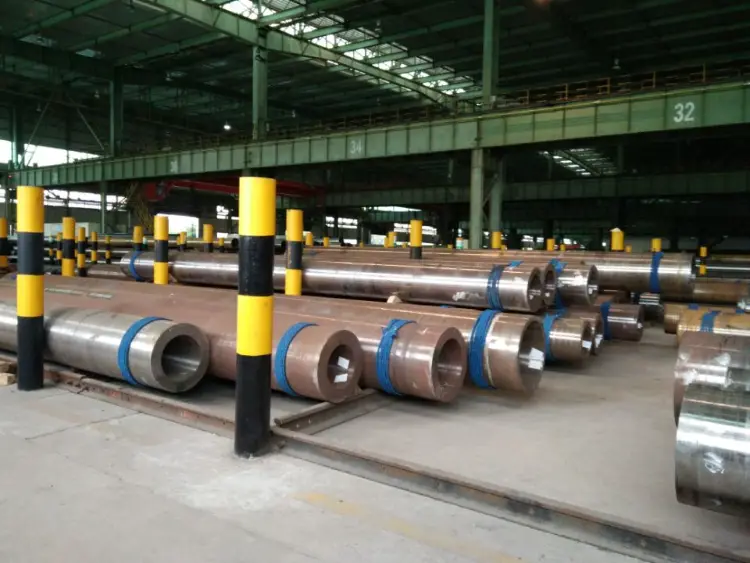
Q345D Low Alloy Steel for LSAW Pipe
Q345D Low Alloy Steel for LSAW Pipe: GB/T 1591 Properties & Applications
Comprehensive material data for Q345D structural steel according to GB/T 1591, tailored for longitudinal submerged arc welded (LSAW) pipes. Includes chemical composition, mechanical, thermal and electrical physical properties, equivalent international grades, and application guidance.
Hot rolling, controlled rolling (CR), thermo-mechanical controlled processing (TMCP), normalizing, welding
- Phone : +8618037372205
- Email : [email protected]
- WhatsApp: Contact via Whtsapp
- WeChat: +8618037372205
Q345D Low Alloy Steel for LSAW Pipe Introduction
Q345D is a low-alloy high-strength structural steel defined by GB/T 1591-2008 (formerly known as 16Mn). It features a minimum yield strength of 345 MPa in the as-rolled or normalized condition and exhibits excellent low-temperature toughness with impact testing at -20°C.
- This grade is widely used in welded structures, bridges, pressure vessels, and oil/gas transmission pipelines manufactured through the LSAW (longitudinal submerged arc welding) process.
- Q345D offers good weldability, cold formability and weathering resistance.
- Its controlled chemical composition, with fine grain strengthening elements such as Nb, V and Ti, ensures consistent mechanical properties across a range of thicknesses.
Q345D Low Alloy Steel for LSAW Pipe Chemical Composition
The chemical composition of Q345D is specified in GB/T 1591-2008. The steel is microalloyed with Niobium (Nb), Vanadium (V), and Titanium (Ti) for grain refinement and precipitation strengthening. Maximum limits for phosphorus (P) and sulfur (S) are strict to ensure good weldability and low-temperature toughness. Aluminium is added as a deoxidiser and for grain size control.
| Element | Standard Value (wt%) | Remarks |
|---|---|---|
| Carbon (C) | ≤ 0.18 | |
| Silicon (Si) | ≤ 0.50 (optionally ≤ 0.55) | |
| Manganese (Mn) | 1.00 – 1.60 | |
| Phosphorus (P) | ≤ 0.030 | Lower P improves toughness |
| Sulfur (S) | ≤ 0.025 | Low S for weldability |
| Niobium (Nb) | 0.015 – 0.060 | Grain refinement element |
| Vanadium (V) | 0.02 – 0.15 | Precipitation hardening element |
| Titanium (Ti) | 0.02 – 0.20 | Grain refinement and deoxidation |
| Chromium (Cr) | ≤ 0.30 | Residual element |
| Nickel (Ni) | ≤ 0.50 | Residual element |
| Copper (Cu) | ≤ 0.30 | Residual element |
| Nitrogen (N) | ≤ 0.012 | |
| Aluminium (Als) | ≥ 0.015 | Acid-soluble aluminium for deoxidation |
Q345D Low Alloy Steel for LSAW Pipe Thermal and Electrical Physical Properties
The physical properties are typical for low-alloy steel and are based on a carbon-manganese structural steel with a density of about 7.85 g/cm³. These values may vary slightly with heat treatment and actual chemical composition. All values are at room temperature unless a temperature range is indicated.
| Property | Typical Value | Unit | Test Condition / Temperature |
|---|---|---|---|
| Density (ρ) | 7.85 | g/cm³ | 20°C |
| Elastic modulus (E) | 206 | GPa | 20°C, tensile |
| Shear modulus (G) | 79.3 | GPa | 20°C, estimated |
| Poisson's ratio (ν) | 0.30 | – | 20°C, elastic range |
| Thermal expansion coefficient (α) | 12.0 | 10⁻⁶/K | 20 – 100°C |
| Thermal expansion coefficient (α) | 12.5 | 10⁻⁶/K | 20 – 200°C |
| Thermal expansion coefficient (α) | 13.2 | 10⁻⁶/K | 20 – 400°C |
| Thermal conductivity (λ) | 53 | W/(m·K) | 20°C |
| Thermal conductivity (λ) | 51 | W/(m·K) | 100°C |
| Specific heat capacity (cp) | 470 | J/(kg·K) | 20°C |
| Specific heat capacity (cp) | 490 | J/(kg·K) | 100°C |
| Electrical resistivity (ρe) | 0.23 | µΩ·m | 20°C |
Q345D Low Alloy Steel for LSAW Pipe Mechanical Properties
The mechanical properties are valid for hot-rolled or normalized condition. Yield strength (ReH) decreases as thickness increases. Charpy V-notch impact energy (KV2) is guaranteed at -20°C (longitudinal specimen). Bend test is performed to evaluate ductility. The values listed are minimum requirements unless a range is given.
| Property | Standard Requirement Value | Unit | Test Condition |
|---|---|---|---|
| Yield strength (ReH) | ≥ 345 | MPa | Plate thickness ≤ 16 mm |
| Yield strength (ReH) | ≥ 335 | MPa | Plate thickness 16 – 40 mm |
| Yield strength (ReH) | ≥ 325 | MPa | Plate thickness 40 – 63 mm |
| Yield strength (ReH) | ≥ 315 | MPa | Plate thickness 63 – 80 mm |
| Tensile strength (Rm) | 470 – 630 | MPa | All thicknesses |
| Elongation after fracture (A) | ≥ 20 | % | Longitudinal, thickness ≤ 40 mm |
| Elongation after fracture (A) | ≥ 19 | % | Longitudinal, thickness 40 – 63 mm |
| Elongation after fracture (A) | ≥ 18 | % | Longitudinal, thickness 63 – 80 mm |
| Charpy impact energy (KV2) | ≥ 34 (or ≥ 27 per client agreement) | J | -20°C, longitudinal specimen |
| Bend test (mandrel diameter) | d = 2a (thickness ≤ 16 mm), d = 3a (thickness > 16 mm) | – | 180° bend, specimen width ≥ 2a |
Q345D Low Alloy Steel for LSAW Pipe Fully Equivalent Material Standards and Replaceable Grades
| Country/Region | Standard | Grade | Remarks |
|---|---|---|---|
| Europe | EN 10025-2:2004 | S355J2 (+N or +M) | Equivalent low-alloy steel with minimum yield strength 355 MPa and impact at -20°C. (+N: normalized; +M: TMCP). |
| International | ISO 4950-2 | S355D | Hot-rolled structural steel, yield 355 MPa, impact at -20°C. |
| Japan | JIS G 3106:2008 | SM490B | Welded structure steel, tensile 490-610 MPa, impact at 0°C (-20°C variant SM490YB exists). Slightly higher Mn than Q345D. |
| USA | ASTM A572/A572M | Grade 50 [345] | HSLA steel, yield 345 MPa, Charpy testing optional. For comparable low-temperature toughness, supplementary requirement S5 (Charpy at -18°C) is specified. |
Q345D Low Alloy Steel for LSAW Pipe Application Introduction
Q345D is widely used in critical structural and pressure-containing applications where good weldability and reliable low-temperature toughness are required. LSAW pipes made from Q345D are favoured for large-diameter, thick-wall pipelines. The steel can be processed by hot forming, cold bending, flame cutting, and all conventional welding methods. Proper preheating and post-weld heat treatment may be needed depending on thickness and carbon equivalent.
Product Applications: Longitudinal submerged arc welded (LSAW) line pipes for crude oil and natural gas, Spiral welded pipes (SSAW) for piling and structural columns, Heavy-duty structural hollow sections (square and rectangular tubes), Pressure vessel shells and boiler tubes, Welded I-beams and box girders, Offshore platform legs and jacket structures
Processed into products: Pipe spools and pipe bends (induction bends), Flanges and blind flanges (welded from Q345D plate), Reducer and tee fittings, Anchor flanges and pup pieces, Pile sleeves and pile shoes, Structural nodes and transition rings
Application industries: Oil and gas transportation (onshore and offshore), Water supply and sewage engineering, Structural engineering (high-rise buildings, stadiums, bridges), Shipbuilding and marine structures, Mining and dredging, Power generation (penstocks, cooling water lines)
Q345D Low Alloy Steel for LSAW Pipe Recommendations for Similar / Alternative Materials
| Country/Region | Standard | Grade | Remarks |
|---|---|---|---|
| China | GB/T 1591-2008 | Q345E | Identical chemical and mechanical properties, but Charpy impact test at -40°C. Better low-temperature toughness. |
| China | GB/T 1591-2008 | Q390D | Higher yield strength (≥390 MPa) at ≤16 mm, similar low-temperature impact requirements (-20°C). Suitable for higher strength demands. |
| China | GB/T 1591-2018 | Q355D | The updated version of Q345D in the 2018 standard, with yield strength increased to 355 MPa. Grade Q355D is the direct replacement. |
| Europe | EN 10025-2 | S355K2 | Similar to S355J2 but with guaranteed Charpy impact at -20°C with higher energy values (usually 40 J). Offers additional safety margin. |
| USA | ASTM A709/A709M | Grade 50W [345W] | Weathering steel version with similar strength; used in bridges. Impact testing at specified temperature available as per supplementary requirements. |
Notes:
LSAW pipe specifics: For API 5L PSL2 line pipe, Q345D plates are often rolled to a slightly modified chemistry to meet more stringent CEq and PCM requirements of PSL2. The pipe is formed by UOE or JCOE process and welded by multi-pass submerged arc welding. The weld seam and heat-affected zone must exhibit toughness matching the base metal. Customers may request carbon equivalent (CEIIW) ≤ 0.43% and PCM ≤ 0.25% for excellent weldability. Visual, ultrasonic and radiographic inspections are standard for LSAW pipes.
- Share



