
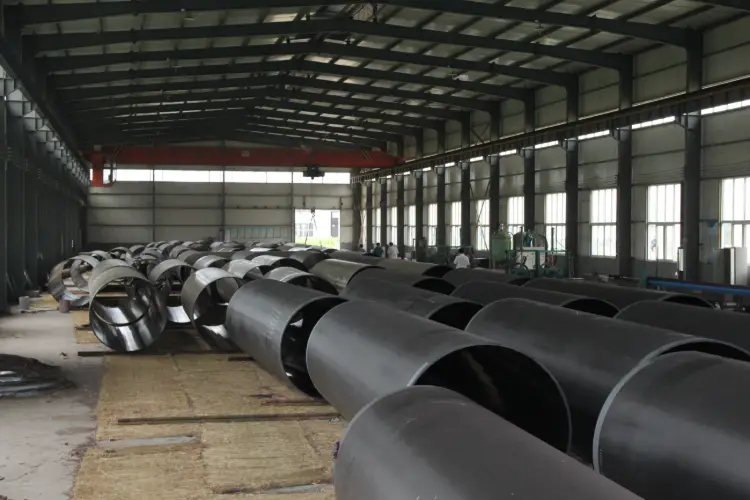
GB/T 1591 Q345B LSAW Pipe
GB/T 1591 Q345B LSAW Pipe - Low-Alloy Structural Steel for Large-Diameter Welded Pipes
Comprehensive material data for Q345B steel according to GB/T 1591, widely used in longitudinally submerged arc welded (LSAW) pipes. Chemical composition, mechanical and physical properties, equivalent grades, and application guidance.
Hot rolling, normalizing, cold forming, welding (especially LSAW, SAW, and SMAW), and machining
- Phone : +8618037372205
- Email : [email protected]
- WhatsApp: Contact via Whtsapp
- WeChat: +8618037372205
GB/T 1591 Q345B LSAW Pipe Introduction
Q345B is a Chinese standard low-alloy high-strength structural steel specified in GB/T 1591-2008. It offers a minimum yield strength of 345 MPa and good weldability, making it a principal material for LSAW (Longitudinally Submerged Arc Welded) pipes used in oil and gas transmission, structural applications, and pressure vessels. Key characteristics:
- Excellent combination of strength and ductility
- Reliable impact toughness at 20°C (longitudinal KV2 ≥ 34 J)
- Suitable for welded structures subjected to static and dynamic loads
- Typical delivery condition: hot-rolled or normalized for pipe manufacturing
GB/T 1591 Q345B LSAW Pipe Chemical Composition
The chemical composition of Q345B steel is defined in GB/T 1591-2008. Maximum limits are given for principal elements; microalloying elements (Nb, V, Ti) may be added singly or in combination to refine grain structure, but their individual contents must not exceed the specified maxima.
- Carbon equivalent (CEV) is often controlled to ensure weldability: typically CEV ≤ 0.45% depending on thickness.
- Aluminum is usually added as a grain refiner; total Al content commonly ≥ 0.015%.
| Element | Standard Value | Remarks |
|---|---|---|
| Carbon (C) | ≤ 0.20 | Heat analysis; CEV control critical for welding |
| Silicon (Si) | ≤ 0.50 | Deoxidizer; contributes to strength |
| Manganese (Mn) | ≤ 1.70 | Primary strengthening element |
| Phosphorus (P) | ≤ 0.035 | Retained impurity, lower desirable for toughness |
| Sulfur (S) | ≤ 0.035 | Retained impurity, lower desirable for ductility |
| Chromium (Cr) | ≤ 0.30 | Residual element |
| Nickel (Ni) | ≤ 0.50 | Residual element |
| Copper (Cu) | ≤ 0.30 | Residual element |
| Niobium (Nb) | ≤ 0.07 | Optional microalloy; grain refinement |
| Vanadium (V) | ≤ 0.15 | Optional microalloy; precipitation strengthening |
| Titanium (Ti) | ≤ 0.20 | Optional microalloy; grain refinement |
| Aluminum (Alt) | ≥ 0.015 (typical) | Usually added for fine grain practice |
GB/T 1591 Q345B LSAW Pipe Thermal and Electrical Physical Properties
Physical properties are representative for low-carbon low-alloy steels at room temperature unless otherwise indicated. Values may vary slightly with exact composition and heat treatment.
- Coefficient of thermal expansion is critical for welded pipe design to avoid thermal stresses.
- Thermal conductivity influences cooling rates during welding and in-service heat transfer.
| Property | Typical Value | Unit | Test Condition |
|---|---|---|---|
| Density (ρ) | 7.85 | g/cm³ | At 20 °C |
| Modulus of Elasticity (E) | 206 | GPa | At 20 °C |
| Shear Modulus (G) | 79 | GPa | At 20 °C |
| Poisson's Ratio (ν) | 0.30 | – | At 20 °C |
| Thermal Expansion Coefficient (α) | 11.5 | 10⁻⁶/K | Between 20 °C and 100 °C |
| Thermal Expansion Coefficient (α) | 12.0 | 10⁻⁶/K | Between 20 °C and 200 °C |
| Thermal Conductivity (λ) | 53 | W/(m·K) | At 20 °C |
| Specific Heat Capacity | 480 | J/(kg·K) | At 20 °C |
| Electrical Resistivity (ρ_e) | 0.24 | µΩ·m | At 20 °C |
GB/T 1591 Q345B LSAW Pipe Mechanical Properties
Mechanical properties are verified according to GB/T 1591-2008. Test specimens are taken in the longitudinal direction from the base material (before pipe forming) or from the pipe body after welding as agreed.
- For LSAW pipes, properties of the weld seam must also satisfy relevant pipe standards (e.g., GB/T 9711) with hardness and toughness requirements.
- Impact test temperature for Q345B is 20°C, minimum average absorbed energy 34 J (longitudinal).
| Property | Required Value | Unit | Test Condition |
|---|---|---|---|
| Yield Strength (ReH) | ≥ 345 | MPa | Thickness ≤ 16 mm |
| Yield Strength (ReH) | ≥ 335 | MPa | Thickness > 16 mm and ≤ 40 mm |
| Yield Strength (ReH) | ≥ 325 | MPa | Thickness > 40 mm and ≤ 63 mm |
| Yield Strength (ReH) | ≥ 315 | MPa | Thickness > 63 mm and ≤ 80 mm |
| Yield Strength (ReH) | ≥ 305 | MPa | Thickness > 80 mm and ≤ 100 mm |
| Yield Strength (ReH) | ≥ 285 | MPa | Thickness > 100 mm and ≤ 150 mm |
| Tensile Strength (Rm) | 470 – 630 | MPa | All thicknesses (typical range) |
| Elongation (A) | ≥ 20 | % | Longitudinal, gauge length 5.65√S0; thickness ≤ 40 mm |
| Elongation (A) | ≥ 19 | % | Longitudinal, thickness > 40 mm and ≤ 63 mm |
| Elongation (A) | ≥ 19 | % | Longitudinal, thickness > 63 mm and ≤ 100 mm |
| Elongation (A) | ≥ 18 | % | Longitudinal, thickness > 100 mm and ≤ 150 mm |
| Impact Energy (KV2) | ≥ 34 (average) | J | At 20 °C; longitudinal Charpy V-notch; single min 27 J |
| Bend Test | No cracks | – | 180° bending; d=2a (t ≤ 16 mm), d=3a (t > 16–100 mm); a = specimen thickness |
GB/T 1591 Q345B LSAW Pipe Direct Equivalent Material Standards and Substitute Grades
| Country / Region | Standard | Grade | Remarks |
|---|---|---|---|
| China | GB/T 1591-2008 | Q345B | Original standard; base material for LSAW pipe |
| China | GB/T 1591-2018 | Q355B | Current Chinese standard; replaces Q345B with slightly higher yield (355 MPa) |
| European Union | EN 10025-2:2004 | S355JR | Closest European equivalent; JR indicates 27 J impact at 20 °C |
| United States | ASTM A572/A572M | Grade 50 [345] | Strength grade matches; supplementary impact requirements must be specified |
| International | ISO 4950-2 | E355 | Yield strength 355 MPa; often used for structural and welded pipes |
| Japan | JIS G3106 | SM490A | Welding structural steel; typical yield 325–365 MPa depending on thickness |
| India | IS 2062 | E350 B | Equivalent structural steel with minimum yield 350 MPa and impact at 0°C or 20°C |
GB/T 1591 Q345B LSAW Pipe Application Introduction
Q345B LSAW pipes are utilized where a combination of moderate strength, good toughness at ambient temperatures, and cost-effective weldability is required. Typical applications include:
- Oil and gas long-distance transmission lines (onshore and offshore)
- Structural columns, trusses, and frameworks in high-rise buildings
- Bridge main girders and supporting members
- Circular hollow sections for jack-up rig legs and offshore structures
- Pressure vessel shells and piping systems under non-corrosive service
- Machinery and transport equipment manufacturing
Product Applications: LSAW longitudinal submerged arc welded steel pipes, Spiral welded pipes (SSAW) for piling and water pipelines, Pre-fabricated structural welded sections (box columns, Y-joints), Rolled and welded steel rings for wind turbine towers, Pipe bends, tees, and induction bends produced from Q345B mother pipe
Processed into products: Pipe spools and flanges for oil field gathering lines, Tubular bracing for earthquake-resistant building frames, Bridge bearing stiffeners and cross-beams made from LSAW segments, Wind tower segments (cylindrical shells) manufactured by cold-forming and welding, Port crane booms and lattice members, Hydraulic cylinder body tubes (heavy wall), Piling foundation tubes for quay walls and jetties
Application industries: Oil and Gas (pipeline transmission, gathering lines), Construction and Civil Engineering (building frameworks, bridges, stadiums), Offshore and Marine Engineering (platform jackets, risers, J-tubes), Water Treatment and Distribution (large-diameter water mains), Pressure Vessel and Boiler Manufacturing (medium-pressure vessels), Mining and Heavy Machinery (structural components)
GB/T 1591 Q345B LSAW Pipe Similar or Closely Related Material Grades
| Country / Region | Standard | Grade | Remarks |
|---|---|---|---|
| China | GB/T 1591-2008 | Q345C / Q345D / Q345E | Same strength level; lower impact test temperatures (0°C, -20°C, -40°C respectively) |
| China | GB/T 9711-2017 | L290 / X42 | Steel grade for LSAW line pipes; L290 has minimum yield 290 MPa, often produced from Q345-like chemistry with modified processing |
| European Union | EN 10219-1 | S355J2H | Cold-formed welded structural hollow section; similar strength, J2 ensures -20°C impact |
| United States | API 5L | X52 (L360) | Higher yield strength (360 MPa) line pipe steel; often produced by upgrading Q345 chemistry with microalloying |
Notes:
Important considerations for Q345B LSAW pipe:
- When thickness exceeds 40 mm, normalizing is often requested to refine grain and ensure Charpy requirements.
- Welding consumables should match the lower strength route (e.g., E50 series) to avoid excessive hardening in the heat-affected zone.
- CEV (carbon equivalent) should be limited to ≤ 0.43 % for excellent cold cracking resistance without preheat for moderate thicknesses.
- The current GB/T 1591-2018 standard replaces Q345B with Q355B; however, Q345B designation is still widely used commercially.
- For sour service applications (H2S), additional HIC/SSC testing per NACE MR0175 may be required, which is not covered by the base standard.
- Share



