
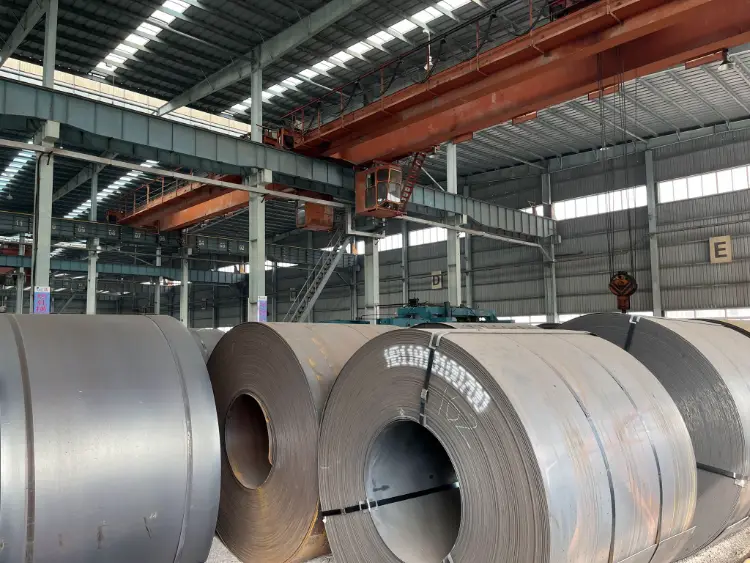
ABS Grade FH40 Shipbuilding Steel Coil
ABS Grade FH40 Shipbuilding Steel Coil | High Strength Hull Structural Steel
Complete material data for ABS Grade FH40 shipbuilding steel coil: chemical composition, mechanical properties, thermal & electrical physical properties, international equivalents, and application guidance. Ideal for marine & offshore structural engineering.
Cutting, bending, welding, forming, normalizing, TMCP
- Phone : +8618037372205
- Email : [email protected]
- WhatsApp: Contact via Whtsapp
- WeChat: +8618037372205
ABS Grade FH40 Shipbuilding Steel Coil Introduction
ABS Grade FH40 is a high-strength hull structural steel coil classified by the American Bureau of Shipping (ABS) for use in ship and offshore constructions. It belongs to the FH (fine grain, low-temperature toughness) category with a nominal minimum yield strength of 390 MPa (40 ksi class). The steel is characterized by a controlled microalloyed composition (Nb, V, Ti) and a fine-grained microstructure achieved through normalized or thermomechanical controlled processing (TMCP). FH40 offers excellent weldability, high strength-to-weight ratio, and guaranteed impact toughness at -60 °C (27 J min longitudinal). It is typically supplied in coil form for further cutting, forming, and welding into ship hull plates, decks, bulkheads, and offshore platform modules. The material complies with ABS Rules for Materials and Welding, Part 2, Chapter 1, ensuring strict quality and traceability.
ABS Grade FH40 Shipbuilding Steel Coil Chemical Composition
The chemical composition of ABS FH40 conforms to the ABS rule requirements for high-strength hull structural steel (ladle analysis). All elements are controlled to ensure fine grain strengthening, toughness at -60 °C, and excellent weldability. Elements not listed are limited by the standard's residual or unspecified limits. Equivalent carbon (CEV) is typically below 0.40% for good weldability.
| Element | Specification (max unless range given, %) | Remarks |
|---|---|---|
| C | ≤0.18 | Max for strength and weldability |
| Mn | 0.90–1.60 | Deoxidizer and strength enhancer |
| Si | 0.10–0.50 | Deoxidizer |
| P | ≤0.035 | Max for toughness |
| S | ≤0.035 | Max for cleanliness |
| Al (acid soluble) | ≥0.015 | Minimum for grain refinement (fine grain practice) |
| Nb | 0.02–0.05 | Microalloy for grain refinement and precipitation strengthening |
| V | 0.05–0.10 | Microalloy for strength and impact transition temperature |
| Ti | ≤0.02 | Grain refinement and nitrogen binding |
| Cu | ≤0.35 | Residual limit |
| Cr | ≤0.20 | Residual limit |
| Ni | ≤0.40 | Residual limit; can be added for low-temperature toughness |
| Mo | ≤0.08 | Residual limit |
| N | ≤0.009 (if added) | Max if intentionally alloyed |
ABS Grade FH40 Shipbuilding Steel Coil Thermal & Electrical Physical Properties
The ABS FH40 standard does not specify thermal or electrical physical property requirements. The values below are typical for C-Mn high-strength structural steel and can be used for design calculations. They are based on room temperature unless otherwise noted.
| Property | Standard Requirement | Unit | Test Condition |
|---|---|---|---|
| Density (ρ) | 7850 | kg/m³ | Typical for steel |
| Modulus of Elasticity (E) | 205–210 | GPa | Typical room temperature |
| Shear Modulus (G) | 80 | GPa | Approximate |
| Poisson's Ratio (ν) | 0.3 | - | - |
| Coefficient of Thermal Expansion (α) | 11.7 × 10⁻⁶ | /K | 20–200 °C, typical |
| Thermal Conductivity (λ) | 48–52 | W/(m·K) | At 25 °C, typical |
| Specific Heat (Cp) | 460–490 | J/(kg·K) | At 25 °C, typical |
| Electrical Resistivity (ρe) | 0.20–0.25 | μΩ·m | Typical for structural steel |
ABS Grade FH40 Shipbuilding Steel Coil Mechanical Properties
The following mechanical properties are required by the ABS standard for FH40 steel supplied in normalized or TMCP condition. The values apply to thicknesses ≤50 mm unless otherwise noted. Charpy V-notch impact test performed at -60 °C (F temperature designation). Transverse values may be agreed for certain applications. All test procedures per ABS Rules.
| Property | Standard Requirement | Unit | Test Condition |
|---|---|---|---|
| Yield Strength (ReH) | ≥ 390 | MPa | Transverse tensile, room temperature, t≤50 mm |
| Tensile Strength (Rm) | 510–650 | MPa | Transverse tensile, room temperature, t≤50 mm |
| Elongation (A5) | ≥ 20 | % | Gauge length 5.65√S0, t≤50 mm |
| Charpy Impact Energy (KV) | ≥ 27 | J | Longitudinal, -60 °C, V-notch |
| Charpy Impact Energy (KV) transverse | ≥ 20 | J | Transverse, -60 °C, V-notch (optional, if agreed) |
| Bend Test, 180° | No cracks, t≤25 mm: d=3a | Mandrel diameter = 3 × thickness (a) | |
| Bend Test, 180° | No cracks, t>25 mm: d=4a | Mandrel diameter = 4 × thickness |
ABS Grade FH40 Shipbuilding Steel Coil Completely Equivalent Grade Standards & Substitute Designations
| Country/Region | Standard | Grade | Remarks |
|---|---|---|---|
| International | IACS UR W11 (implied) | FH40 | Equivalent designation by any IACS member |
| Lloyd's Register (UK) | LR Rules | LR FH40 | Identical requirements |
| DNV (Norway/Germany) | DNV Rules Pt.2 Ch.1 | DNV FH40 | Identical |
| Bureau Veritas (France) | BV Rules Pt.2 | BV FH40 | Identical |
| China Classification Society | CCS Rules Pt.2 | CCS FH40 | Identical |
| Nippon Kaiji Kyokai (Japan) | NK Rules Pt.K | NK FH40 | Identical |
| Korean Register | KR Rules Pt.2 | KR FH40 | Identical |
| RINA (Italy) | RINA Rules Pt.2 | RINA FH40 | Identical |
| Russian Maritime Register | RMRS Rules Pt.2 | RMRS FH40 | Identical, may use cyrillic F |
ABS Grade FH40 Shipbuilding Steel Coil Application Introduction
ABS FH40 steel in coil form is designed for critical structural components in ships and offshore installations operating in severe marine environments and very low temperatures. Its high strength and excellent low-temperature toughness allow reduced structural weight and increased safety. Key industries and applications include:
Product Applications: Hull and deck plating, Longitudinal stiffeners and girders, Watertight bulkheads, Offshore structural frames and nodes, Icebreaker shell plates, Heavy-lift vessel crane pedestals
Processed into products: Cut and welded beams and columns, Bent profiles and corrugated bulkhead panels, Flanges for H-beams and channels, Cold-formed angles and channels (from coil), Cut-to-size blanks for further fabrication (drilling, tapping, welding)
Application industries: Shipbuilding (commercial and naval vessels), Offshore oil & gas platforms (jackets, topside modules), Arctic and ice-going ships, Marine equipment manufacturing, Wind turbine support structures (offshore)
ABS Grade FH40 Shipbuilding Steel Coil Similar/Alternative Grades with Close Properties
| Country/Region | Standard | Grade | Remarks |
|---|---|---|---|
| ABS | ABS Rules | EH40 | Identical mechanical properties; impact temperature -40 °C instead of -60 °C |
| ABS | ABS Rules | FH36 | Slightly lower yield (355 MPa min); same low-temperature toughness (-60 °C) |
| ABS | ABS Rules | DH40 | Same strength; impact temperature -20 °C |
| EN | EN 10025-4 | S420ML | 410 MPa yield; TMCP, similar toughness (ML up to -50 °C), but not specifically ship class |
| EN | EN 10025-4 | S420QL | Quenched and tempered, 420 MPa yield; -40 °C or lower impact |
| ASTM | A131 / A131M | ASTM FH40 (if covered) | ASTM A131 FH40 exists similarly, but IACS unified requirements generally align |
Notes:
Welding: FH40 is readily weldable by all conventional methods (SMAW, SAW, GMAW, FCAW). Preheat and interpass temperatures should be selected based on thickness and carbon equivalent. Low-hydrogen conditions are recommended.
Forming: Coil can be leveled and cut into blanks; cold bending radii should follow classification society guidance; hot forming may be allowed if the temperature does not degrade the TMCP/normalized condition.
Certification: Shipbuilding steels must be delivered with ABS or equivalent classification society certificates. Traceability of heat and test reports is mandatory.
- Share



