
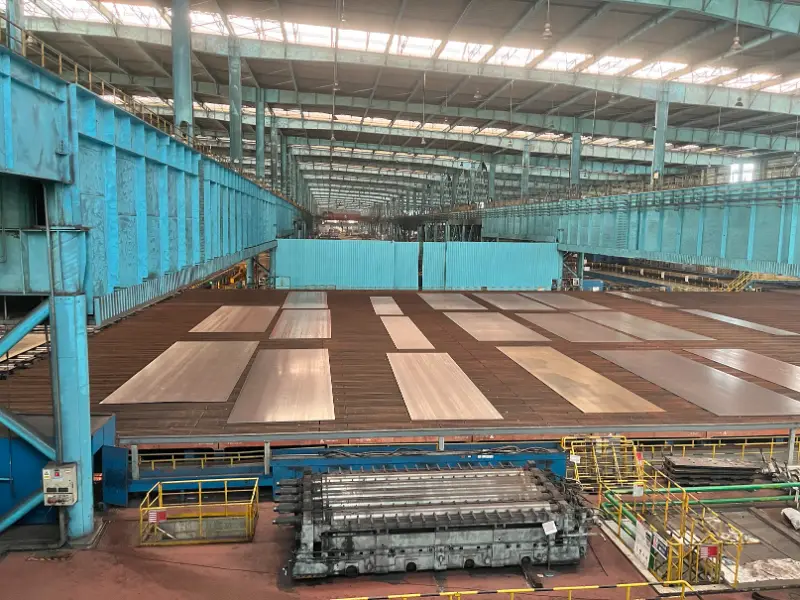
Q345A High-Strength Low-Alloy Steel
Q345A High-Strength Low-Alloy Steel for LSAW Pipe Under GB/T 1591
Comprehensive material data of Q345A structural steel grade according to GB/T 1591-2008, widely used for long seam submerged arc welded pipes. Covers chemical composition, mechanical and physical properties, international equivalents, and application guidelines.
Hot rolling, controlled rolling, normalizing (optional); suitable for LSAW pipe forming, welding (submerged arc), and cold/hot bending.
- Phone : +8618037372205
- Email : [email protected]
- WhatsApp: Contact via Whtsapp
- WeChat: +8618037372205
Q345A High-Strength Low-Alloy Steel Introduction
Q345A is a Chinese standard low-alloy high-strength structural steel defined in GB/T 1591. As a hot-rolled steel plate/coil grade, it serves as the base material for manufacturing LSAW (Longitudinal Submerged Arc Welded) pipes. Q345A features a minimum yield strength of 345 MPa for thicknesses ≤16 mm, good weldability, and sufficient toughness for general structural applications. The 'A' suffix indicates no mandatory impact test requirements, making it suitable for non-low-temperature service. It is widely adopted in welded pipes for fluid transportation, building structures, and offshore engineering. Important: the GB/T 1591-2008 Q345 series has been replaced by Q355 in the 2018 revision, but Q345A remains referenced in legacy projects and pipe specifications.
Q345A High-Strength Low-Alloy Steel Chemical Composition
Chemical requirements for Q345A steel according to GB/T 1591-2008. Values are ladle analysis maximums unless a range is given. Micro-alloying elements like Nb, V, Ti may be added singly or in combination to achieve strength. Residual elements are limited to ensure weldability and toughness.
| Element | Standard Value (%) | Remarks |
|---|---|---|
| Carbon (C) | ≤ 0.20 | |
| Silicon (Si) | ≤ 0.50 | |
| Manganese (Mn) | ≤ 1.70 | |
| Phosphorus (P) | ≤ 0.035 | |
| Sulfur (S) | ≤ 0.035 | |
| Niobium (Nb) | ≤ 0.07 | Optional micro-alloy, alone or combined |
| Vanadium (V) | ≤ 0.15 | |
| Titanium (Ti) | ≤ 0.20 | |
| Chromium (Cr) | ≤ 0.30 | Residual element |
| Nickel (Ni) | ≤ 0.50 | Residual element |
| Copper (Cu) | ≤ 0.30 | Residual element |
| Molybdenum (Mo) | ≤ 0.10 | Residual element |
| Nitrogen (N) | ≤ 0.012 | If containing Nb, V, Ti |
| Aluminum (Al) | ≥ 0.015 (total) | When used for grain refinement |
Q345A High-Strength Low-Alloy Steel Physical Properties
Typical physical constants for Q345A steel at room temperature and elevated temperatures. These values are not mandated by the material standard but are representative for low-alloy structural steels and essential for engineering design calculations, especially for LSAW pipe in service.
| Property | Typical Value | Unit | Test Condition |
|---|---|---|---|
| Density (ρ) | 7.85 | g/cm³ | Ambient temperature |
| Modulus of Elasticity (E) | 206 | GPa | Room temperature |
| Shear Modulus (G) | 79.3 | GPa | Calculated from E and ν |
| Poisson's Ratio (ν) | 0.30 | - | Room temperature |
| Thermal Expansion Coefficient (α) | 12.0 | 10⁻⁶/K | 20°C - 100°C (average) |
| Thermal Expansion Coefficient (α) | 12.8 | 10⁻⁶/K | 20°C - 200°C |
| Thermal Expansion Coefficient (α) | 13.5 | 10⁻⁶/K | 20°C - 400°C |
| Thermal Conductivity (λ) | 53 | W/(m·K) | At 100°C |
| Thermal Conductivity (λ) | 45 | W/(m·K) | At 400°C |
| Specific Heat Capacity (c) | 460 - 480 | J/(kg·K) | 20°C - 100°C |
| Electrical Resistivity (ρ_e) | ≈ 0.20 - 0.25 | μΩ·m | Room temperature |
Q345A High-Strength Low-Alloy Steel Mechanical Properties
Tensile properties and bend test requirements for Q345A steel plates/strips used in LSAW pipe production. Impact test is not mandatory for grade A; values may be agreed. The properties depend on thickness, and these are the minimum requirements per GB/T 1591-2008. For LSAW pipe body, properties may be affected by forming and welding, but base metal values apply.
| Property | Standard Requirement | Unit | Test Condition / Thickness |
|---|---|---|---|
| Yield Strength (ReH) | ≥ 345 | MPa | Thickness ≤ 16 mm |
| Yield Strength (ReH) | ≥ 335 | MPa | Thickness >16 mm - 40 mm |
| Yield Strength (ReH) | ≥ 325 | MPa | Thickness >40 mm - 63 mm |
| Yield Strength (ReH) | ≥ 315 | MPa | Thickness >63 mm - 80 mm |
| Yield Strength (ReH) | ≥ 305 | MPa | Thickness >80 mm - 100 mm |
| Tensile Strength (Rm) | 470 - 630 | MPa | All thicknesses |
| Elongation after fracture (A5) | ≥ 21 | % | Thickness ≤ 40 mm, longitudinal |
| Elongation after fracture (A5) | ≥ 20 | % | Thickness >40 mm - 100 mm, longitudinal |
| Bend Test (Bend Angle 180°) | d=2a (thickness ≤16mm) | Bend diameter d related to specimen thickness a, no cracks | |
| Bend Test (Bend Angle 180°) | d=3a (thickness >16mm-100mm) | ||
| Impact Energy (KV2) | No requirement | J | Q345A does not have guaranteed impact test; optional agreement |
Q345A High-Strength Low-Alloy Steel International Equivalent Standards and Substitutable Grades
| Country/Region | Standard | Grade | Remarks |
|---|---|---|---|
| China (current) | GB/T 1591-2018 | Q355B | Q345A replaced by Q355; Q355B has mandatory 20°C impact test, better toughness. |
| Europe | EN 10025-2:2019 | S355JR | Similar strength; S355JR requires 27J at +20°C, whereas Q345A has no impact requirement. Verify toughness compliance. |
| United States | ASTM A572/A572M | Grade 50 [345] | Yield strength 345 MPa; Grade 50 does not mandate impact test unless supplementary, thus comparable to Q345A. |
| Japan | JIS G3106:2015 | SM490A | Tensile strength 490-610 MPa; impact test not required, similar to Q345A. Check rolling and chemistry tolerances. |
| International | ISO 630-2:2021 | S345A | Grade S345A is the structural steel equivalent; still requires verification for impact requirements in specific applications. |
Q345A High-Strength Low-Alloy Steel Application Introduction
Q345A LSAW pipe is utilized where moderate strength and regular toughness are sufficient. The absence of guaranteed impact energy limits its use to ambient temperature or non-critical dynamic loading. Typical applications include:
Product Applications: Longitudinally submerged arc welded (LSAW) pipes, Structural hollow sections, Steel plate for welded pressure vessels (with additional requirements), Steel sheet piling
Processed into products: Pipe bodies and fittings (elbows, tees, reducers) for onshore pipelines, Supporting beams and columns in steel structures, Bracing members and offshore platform legs, Crane booms and heavy machinery parts
Application industries: Oil and gas transmission (low-pressure, non-sour service), Water supply and drainage pipelines, Structural engineering (building frames, bridge girders), Offshore and marine structures (deck elements, piles), Mining and slurry transport, Piling and foundation pipes
Q345A High-Strength Low-Alloy Steel Similar or Alternative Grades with Close Performance
| Country/Region | Standard | Grade | Remarks |
|---|---|---|---|
| China | GB/T 1591-2008 | Q345B | Better guaranteed impact toughness (20°C), otherwise same strength and weldability; recommended for LSAW pipe to assure toughness. |
| China | GB/T 1591-2018 | Q355C | Q355C provides higher guaranteed impact energy at 0°C, suitable for low-temperature service pipes. |
| Europe | EN 10025-2 | S355J0 | 0°C impact requirement, can replace Q345A when operating temperature is moderate. |
| United States | ASTM A572/A572M | Grade 50 (345) with supplementary Charpy | When impact test is required, negotiate with supplier; otherwise same strength. |
| Japan | JIS G3106 | SM490B | With mandatory impact test at 0°C, better toughness alternative for welded pipes. |
| Russia | GOST 19281 | 09G2S | Common low-alloy steel with similar Mn content; widely used for pipelines; delivery condition and testing scope differ. |
Notes:
Note: For LSAW pipe applications, Q345A base metal must also meet pipe manufacturing standard (e.g., API 5L or GB/T 9711). Additional testing like flattening, hardness, and weld seam toughness may be required. Q345A is not recommended for low-temperature service (<0°C) or dynamic loads without Charpy verification. Since GB/T 1591-2018 supersedes the 2008 edition, for new designs prefer Q355B or higher toughness grades to ensure compliance with current codes. Always verify the exact steelmaking and delivery condition with the supplier. The physical properties listed are typical for engineering estimation; for critical calculations, use measured values from the specific mill certificate.
- Share



