
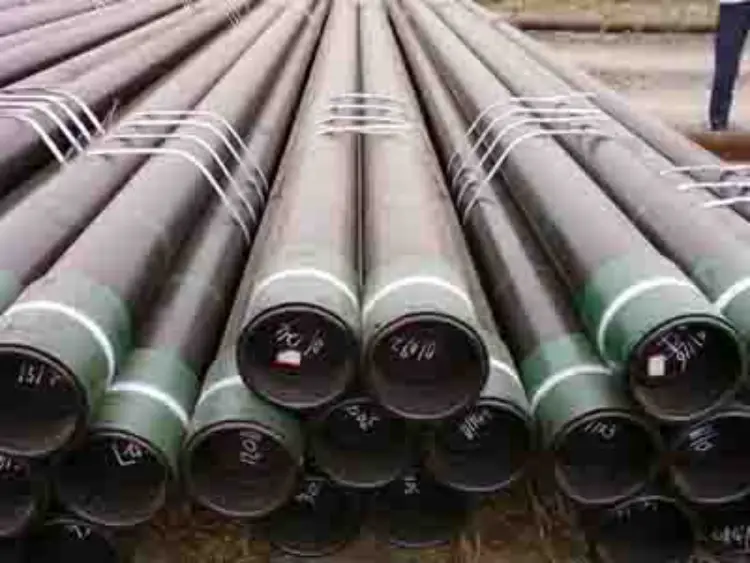
Q275 Carbon Structural Steel for LSAW Pipe
Q275 Carbon Structural Steel for LSAW Pipe - GB/T 700-2006 Data & Technical Properties
Comprehensive technical data for Q275 carbon structural steel used in LSAW pipes per GB/T 700-2006, including chemical, mechanical, thermal and equivalent grades.
Hot rolling, cold forming, submerged arc welding (for pipe), machining, forging, bending, flaring
- Phone : +8618037372205
- Email : [email protected]
- WhatsApp: Contact via Whtsapp
- WeChat: +8618037372205
Q275 Carbon Structural Steel for LSAW Pipe Introduction
Q275 is a carbon structural steel grade defined in the Chinese standard GB/T 700-2006. It offers a minimum yield strength of 275 MPa and good weldability, making it suitable for structural applications including LSAW (Longitudinally Submerged Arc Welded) pipes. The steel is typically supplied in hot-rolled condition and is characterized by a combination of moderate strength, good ductility and formability. Its chemistry is designed for general fabrication and structural engineering, with controlled levels of carbon and manganese. Widely used in buildings, bridges and pressure vessels, Q275 steel can be easily formed, welded and machined under standard practices. The grade is fully deoxidized (killed) to ensure homogeneous properties throughout the thickness.
Q275 Carbon Structural Steel for LSAW Pipe Chemical Composition
The chemical composition of Q275 steel is controlled to ensure the required mechanical properties and weldability. Typical tolerance limits are given in accordance with GB/T 700-2006. Residual elements such as Cr, Ni and Cu are limited to ≤0.30% each when not intentionally added. The steel is fully killed and the deoxidation method is at the manufacturer's discretion.
| Element | Standard Value (max, %) | Remarks |
|---|---|---|
| Carbon (C) | 0.24 | For thickness ≤ 100 mm; C ≤ 0.22 for thickness > 100 mm |
| Silicon (Si) | 0.35 | When used as a deoxidizer; for killed steel lower limits may apply |
| Manganese (Mn) | 1.60 | Higher Mn improves strength and toughness |
| Phosphorus (P) | 0.035 | Maximum for all products |
| Sulfur (S) | 0.035 | Maximum for all products |
| Residual elements (Cr, Ni, Cu each) | 0.30 | Typical limit; not explicitly specified for Q275 but common practice |
Q275 Carbon Structural Steel for LSAW Pipe Thermal, Electrical and Physical Properties
The following physical properties are representative for Q275 carbon steel at room temperature unless a temperature range is indicated. These values are typical for low-alloy carbon steels and may vary slightly depending on exact composition and heat treatment condition. They are suitable for design calculations.
| Property | Typical Value | Unit | Test Condition / Remarks |
|---|---|---|---|
| Density (ρ) | 7.85 | g/cm³ | At 20 °C |
| Elastic modulus (E) | 205 | GPa | At 20 °C |
| Shear modulus (G) | 80 | GPa | At 20 °C |
| Poisson's ratio (ν) | 0.30 | – | At 20 °C |
| Thermal expansion coefficient (α) | 12.0 | 10⁻⁶/K | Between 20–100 °C |
| Thermal expansion coefficient (α) | 12.5 | 10⁻⁶/K | Between 20–200 °C |
| Thermal expansion coefficient (α) | 13.1 | 10⁻⁶/K | Between 20–300 °C |
| Thermal conductivity (λ) | 50 | W/(m·K) | At 20 °C |
| Specific heat capacity (c) | 470 | J/(kg·K) | At 20 °C |
| Electrical resistivity (ρₑ) | 0.16 | µΩ·m | At 20 °C |
Q275 Carbon Structural Steel for LSAW Pipe Mechanical Properties
The mechanical properties depend on the product thickness and are tested on transverse samples (for plate) unless otherwise agreed. The values below are minimum requirements per GB/T 700-2006 for the hot-rolled delivery condition. Charpy V-notch impact energy is optional and is often required at 20°C for structural applications.
| Property | Standard Required Value | Unit | Test Condition / Remarks |
|---|---|---|---|
| Yield strength (ReH) | ≥ 275 | MPa | Thickness ≤ 16 mm |
| Yield strength (ReH) | ≥ 265 | MPa | Thickness 16–40 mm |
| Yield strength (ReH) | ≥ 255 | MPa | Thickness 40–60 mm |
| Yield strength (ReH) | ≥ 245 | MPa | Thickness 60–100 mm |
| Yield strength (ReH) | ≥ 235 | MPa | Thickness 100–150 mm |
| Yield strength (ReH) | ≥ 225 | MPa | Thickness 150–200 mm |
| Tensile strength (Rm) | 410–560 | MPa | All thickness ranges |
| Elongation after fracture (A) | ≥ 22 | % | L₀ = 5.65√S₀; thickness ≤ 40 mm |
| Elongation after fracture (A) | ≥ 21 | % | Thickness 40–60 mm |
| Elongation after fracture (A) | ≥ 20 | % | Thickness 60–100 mm |
| Elongation after fracture (A) | ≥ 19 | % | Thickness 100–150 mm |
| Elongation after fracture (A) | ≥ 18 | % | Thickness 150–200 mm |
| Bend test (bending angle 180°) | d = a | – | Thickness ≤ 60 mm; d = mandrel diameter, a = specimen thickness |
| Bend test (bending angle 180°) | d = 2a | – | Thickness 60–100 mm |
| Bend test (bending angle 180°) | d = 2.5a | – | Thickness 100–200 mm |
| Impact energy (KV₂) | ≥ 27 | J | At 20 °C, longitudinal Charpy V-notch (optional / upon agreement) |
Q275 Carbon Structural Steel for LSAW Pipe Fully Equivalent Material Standards and Replaceable Grades
| Country / Region | Standard | Grade | Remarks |
|---|---|---|---|
| Europe | EN 10025-2 | S275JR | Yield strength 275 MPa (t≤16 mm), equivalent chemistry and mechanical properties, commonly used in structural steel applications. |
| International | ISO 630-2 | S275 | Same minimum yield and tensile strength requirements; suitable for structural and general engineering. |
Q275 Carbon Structural Steel for LSAW Pipe Application Introduction
Q275 steel, thanks to its balanced strength and ductility, is a workhorse material for structural and pipeline engineering. It is easily weldable and can be cold-formed into various shapes. In the form of LSAW pipe, it is particularly valued for transporting fluids and for use in pile foundations and structural columns. The following summarizes its typical application areas.
Product Applications: LSAW steel pipes for oil and gas transportation, Spiral welded pipes (if applicable from plate), Structural hollow sections and columns, Pressure vessel shells and storage tanks, Bridge bearing plates and girders, Machine frames and heavy equipment chassis
Processed into products: Pipe body (mother pipe) of LSAW line pipe, Flanges, end caps and fittings for pipelines, Stiffening rings and saddles for pressure vessels, Built-up box columns and beam splices, Bracket plates and gussets in steel structures, Mounting pads and base plates for machinery
Application industries: Oil & gas (transmission pipelines, flowlines, gathering systems), Water & wastewater (long-distance water mains, penstocks), Construction & civil engineering (structural columns, bridge piers, foundation piling), Power generation (cooling water pipes, structural supports), Shipbuilding (deck structures, hull stiffeners), Machinery manufacturing (frames, load-bearing parts)
Q275 Carbon Structural Steel for LSAW Pipe Similar / Alternative Materials with Close Performance
| Country / Region | Standard | Grade | Remarks |
|---|---|---|---|
| China | GB/T 700-2006 | Q235 | Lower strength (ReH ≥235 MPa), similar weldability and formability; used when lower strength is acceptable. |
| China | GB/T 1591-2018 | Q345 | Higher strength (ReH ≥345 MPa) low-alloy steel; provides better weight reduction potential in structures. |
| Japan | JIS G3101 | SS400 | Yield strength ≥245 MPa, tensile 400-510 MPa; close in strength and widely used in general structures. |
| Japan | JIS G3101 | SS490 | Yield strength ≥285 MPa, tensile 490-610 MPa; slightly stronger alternative. |
| USA | ASTM A36/A36M | Grade A36 | Yield strength ≥250 MPa (t≤200 mm), similar carbon steel; often interchangeable in non-critical applications. |
| USA | ASTM A572/A572M | Grade 42 [290] | Yield strength 290 MPa, comparable weldability and formability for structural use. |
Notes:
- Q275 steel is typically supplied with a test certificate in accordance with EN 10204 type 3.1 or 2.2 depending on the order.
- For LSAW pipe applications, additional requirements such as NDT (ultrasonic or X-ray examination) of the weld seam and hydrostatic testing are mandatory per relevant pipe standards (e.g., API 5L PSL1/PSL2, GB/T 9711).
- Thickness range of plate for LSAW pipe is usually from 6 mm to 40 mm, and impact test at design temperature may be imposed.
- The steel has good resistance to brittle fracture down to –20°C when properly deoxidized and grain-refined.
- Carbon equivalent (CEV) is typically in the range of 0.30–0.40, ensuring good field weldability.
- Share



