
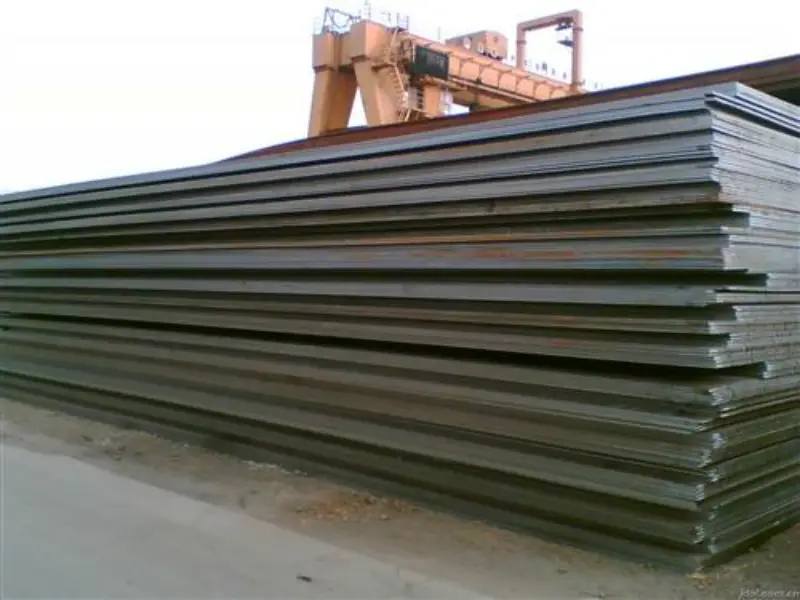
Q235D Carbon Structural Steel
Q235D Carbon Structural Steel: Comprehensive Data for LSAW Pipe Applications Per GB/T 700
Detailed material specifications of Q235D steel including chemical composition, mechanical properties, thermal properties, international equivalents, and application guidance for LSAW line pipes.
Hot rolling, normalizing, welding (LSAW), machining, forming, drilling, bending
- Phone : +8618037372205
- Email : [email protected]
- WhatsApp: Contact via Whtsapp
- WeChat: +8618037372205
Q235D Carbon Structural Steel Introduction
Q235D is a carbon structural steel defined by Chinese standard GB/T 700-2006. The designation "Q" represents yield strength, "235" indicates a minimum yield strength of 235 MPa for thicknesses ≤16 mm, and "D" denotes quality grade with an impact test temperature of -20°C and a minimum impact energy of 27 J. This grade is characterized by good weldability, moderate strength, and reliable toughness at sub-zero temperatures, making it widely used in welded structures.
- Commonly supplied as plates, strips, and sections for structural applications.
- For LSAW (Longitudinal Submerged Arc Welding) pipe production, Q235D plates are formed and welded into large-diameter pipes for oil, gas, and water transportation.
- Delivery condition is usually hot-rolled or normalized, with the pipe subsequently welded from the plate.
Q235D Carbon Structural Steel Chemical Composition
The chemical composition of Q235D is specified in GB/T 700-2006. Maximum values apply for ladle analysis. Key elements include carbon for strength, manganese for toughness and deoxidation, and strict limits on phosphorus and sulfur for improved weldability and low-temperature toughness. Residual elements like Cr, Ni, Cu are typically not intentionally added and must stay within specified limits.
- Carbon content is limited to ≤0.17% to ensure good weldability.
- Phosphorus and sulfur are each capped at 0.035% to reduce brittleness.
- Manganese up to 1.40% provides solid solution strengthening.
| Element | Specified Value (max unless range given) | Remarks |
|---|---|---|
| C | ≤0.17% | Heat analysis |
| Si | ≤0.35% | Deoxidizer |
| Mn | ≤1.40% | Adds strength and toughness |
| P | ≤0.035% | Controlled for cold brittleness |
| S | ≤0.035% | Controlled for hot shortness |
| N | ≤0.012% | If added as element, otherwise not specified |
| Cr | ≤0.30% | Residual element, not added intentionally |
| Ni | ≤0.30% | Residual element, not added intentionally |
| Cu | ≤0.30% | Residual element, not added intentionally |
Q235D Carbon Structural Steel Thermal, Electrical and Physical Properties
The following physical properties are typical for low-carbon structural steels similar to Q235D. These values are not part of the GB/T 700 standard certification but are widely used for design and simulation purposes.
- Density is used for weight calculations.
- Elastic modulus and shear modulus are essential for structural analysis.
- Thermal conductivity and thermal expansion govern heat transfer and thermal stress.
- Electrical resistivity is provided for electromagnetic applications.
| Property | Typical Value | Unit | Test Condition / Remarks |
|---|---|---|---|
| Density (ρ) | 7.85 | g/cm³ | At room temperature (20°C) |
| Elastic modulus (E) | 200 – 210 | GPa | At room temperature; for steel grades in this class |
| Shear modulus (G) | ~80 | GPa | Calculated from E and Poisson ratio |
| Poisson's ratio (ν) | 0.27 – 0.30 | - | Typical for structural steel |
| Thermal expansion coefficient (α) | 12×10⁶ | 1/K | Between 20°C and 100°C |
| Thermal conductivity (λ) | ~50 | W/(m·K) | At 20°C; decreases with temperature increase |
| Specific heat capacity | ~460 | J/(kg·K) | At 20°C to 100°C |
| Electrical resistivity (ρ_e) | 0.15 – 0.20 | Ω·mm²/m | At 20°C |
Q235D Carbon Structural Steel Mechanical Properties
Mechanical properties are guaranteed for delivery condition as per product thickness. Values are based on transverse test pieces for plates and strips. For LSAW pipes, the base plate properties apply after the pipe forming and welding processes.
- Yield strength (ReH) is the upper yield point and decreases with increasing thickness.
- Tensile strength (Rm) ranges from 370 to 500 MPa.
- Elongation (A) is measured on gauge length 5.65√So for flat products (L0 = 50 mm for common thicknesses).
- Impact energy (KV2) at -20°C is a mandatory requirement for grade D, with minimum 27 J.
| Property | Specified Value | Unit | Test Condition / Remarks |
|---|---|---|---|
| Yield strength (ReH) | ≥235 | MPa | Thickness ≤16 mm |
| Yield strength (ReH) | ≥225 | MPa | Thickness >16 mm to ≤40 mm |
| Yield strength (ReH) | ≥215 | MPa | Thickness >40 mm to ≤60 mm |
| Yield strength (ReH) | ≥205 | MPa | Thickness >60 mm to ≤100 mm |
| Yield strength (ReH) | ≥195 | MPa | Thickness >100 mm to ≤150 mm |
| Yield strength (ReH) | ≥185 | MPa | Thickness >150 mm to ≤200 mm |
| Tensile strength (Rm) | 370 – 500 | MPa | All thicknesses |
| Elongation (A) after fracture | ≥26 | % | Thickness ≤40 mm, L0 = 5.65√So (approx. 50 mm) |
| Elongation (A) after fracture | ≥25 | % | Thickness >40 mm to ≤60 mm |
| Elongation (A) after fracture | ≥24 | % | Thickness >60 mm to ≤100 mm |
| Elongation (A) after fracture | ≥23 | % | Thickness >100 mm to ≤150 mm |
| Elongation (A) after fracture | ≥22 | % | Thickness >150 mm to ≤200 mm |
| Bend test (180°) | d = a | - | a = specimen thickness; mandrel diameter equal to specimen thickness; no cracking is allowed on the outer surface. |
| Impact energy (KV2) | ≥27 (-20°C) | J | Longitudinal or transverse sample; -20°C test temperature; D-grade mandatory |
Q235D Carbon Structural Steel Exact Equivalent Material Standards and Substitutable Grades
These materials are considered fully equivalent or directly substitutable for Q235D based on matched yield strength, tensile properties, and especially the -20°C impact requirement (27 J). Notes clarify comparison criteria.
| Country/Region | Standard | Grade | Remarks |
|---|---|---|---|
| International (ISO) | ISO 630 | S235D | Equivalent mechanical properties; impact temperature 0°C for D, but may be specified at -20°C; verify impact requirements. |
| European Union | EN 10025-2 | S235J2 (1.0117) | Identical impact grade and temperature (-20°C, 27 J); interchangeability confirmed with Q235D. |
| China | GB/T 700 | Q235D | Original standard; also for reference. |
Q235D Carbon Structural Steel Application Introduction
Q235D steel, especially in plate form, is widely used for fabricating LSAW (Longitudinal Submerged Arc Welding) pipes intended for oil and gas transmission, water lines, and structural piling. Its guaranteed toughness at -20°C makes it suitable for northern climate regions and winter construction. Below are typical sectors, products, and components:
Product Applications: LSAW line pipe (oil, gas, water), Structural steel columns and beams, Welded H-beams and box columns, Pipeline risers and supports, Steel sheet piling, Railway and highway bridges, Pressure vessel shells (non-high temperature)
Processed into products: LSAW pipe body (longitudinal seam), Pipe end fittings and flanges, Pipe supporting brackets and clamps, Bridge truss chords and diagonals, Tanker truck frames, Excavator boom and arm parts, Transmission tower legs and gusset plates
Application industries: Oil and gas pipeline transmission, Water and sewage infrastructure, Building and civil engineering construction, Bridge and highway engineering, Shipbuilding and marine structures, Power plant and industrial equipment manufacturing, Automotive frames and heavy machinery
Q235D Carbon Structural Steel Similar / Alternative Material Recommendations
These materials have similar strength levels but differ in impact toughness temperature or chemical limits. They can be used with caution if -20°C toughness is not critical.
| Country/Region | Standard | Grade | Remarks |
|---|---|---|---|
| China | GB/T 700 | Q235C | Higher temperature toughness (0°C, 27 J); slightly higher sulfur/phos limits. |
| China | GB/T 700 | Q235B | Lower toughness (20°C, 27 J); suitable for ambient temperature only. |
| USA | ASTM A36/A36M | A36 | Similar strength; impact properties not specified unless supplementary requirements are added. |
| Japan | JIS G3101 | SS400 | Yield ~245 MPa; no impact test specified; for general structural use. |
| Germany (obsolete) | DIN 17100 | St37-2 | Equivalent to previous Q235A/B; does not guarantee -20°C toughness. |
| China | GB/T 1591 | Q345D | Higher strength (min yield 345 MPa); may be used where weight saving is needed, but costs higher. |
Notes:
When used for welded pipes, additional requirements such as drop weight tear test (DWTT) or hydrogen-induced cracking (HIC) tests may be specified by the pipe standard (e.g., API 5L) and not covered by GB/T 700 alone. For LSAW pipe production, the plate should be ordered with through-thickness (Z) properties if lamellar tearing resistance is needed. The actual mechanical properties of the pipe may slightly differ from the raw plate due to cold forming (Bauschinger effect). It is recommended to verify that the pipe manufacturer follows a recognized production standard, such as GB/T 9711 or API 5L, when ordering Q235D pipe.
- Share



