
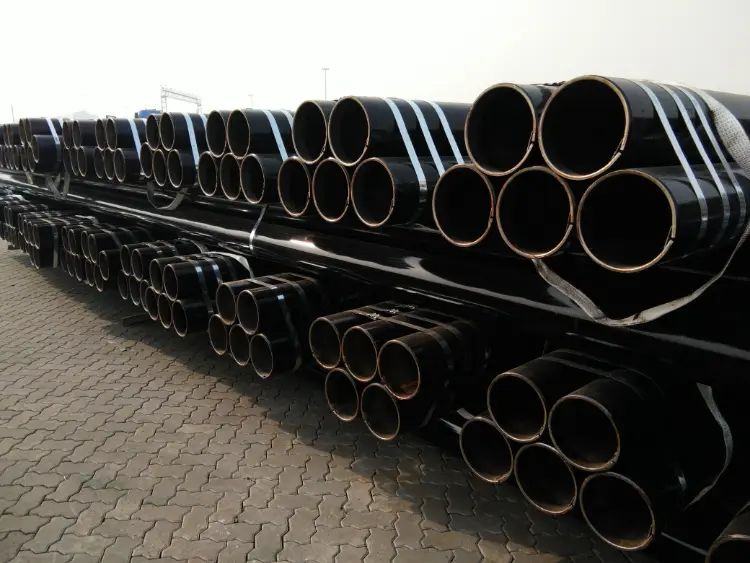
Q235C Carbon Structural Steel for LSAW Pipe
Q235C Carbon Structural Steel for LSAW Pipe: GB/T 700 Grade Analysis
In-depth material data for Q235C carbon structural steel according to GB/T 700, used for LSAW pipes. Includes chemical composition, mechanical and physical properties, equivalent materials, and application guidance.
Welding, hot rolling, cold forming, machining, cutting
- Phone : +8618037372205
- Email : [email protected]
- WhatsApp: Contact via Whtsapp
- WeChat: +8618037372205
Q235C Carbon Structural Steel for LSAW Pipe Introduction
Q235C is a Chinese carbon structural steel grade specified in GB/T 700. It features moderate strength, excellent weldability, good plasticity, and guaranteed impact toughness at 0 °C. With a minimum yield strength of 235 MPa for thin sections, it is widely utilized in welded structures, bridges, buildings, and manufacturing of longitudinal submerged arc welded (LSAW) pipes. Its balanced composition (low carbon, controlled sulfur and phosphorus) ensures reliable cold forming and hot working characteristics. The material is delivered in hot-rolled, normalized, or as-rolled conditions, making it a cost-effective choice for general engineering applications where toughness at low ambient temperatures is not required below 0 °C.
Q235C Carbon Structural Steel for LSAW Pipe Chemical Composition
Chemical composition limits according to GB/T 700-2006 for Q235C. Values depend on product thickness (t) in the as-delivered condition. Elements not listed, such as Cr, Ni, Cu, are residual and generally not specified unless agreed upon.
| Element | Standard Value | Remarks |
|---|---|---|
| C | ≤0.17 (t ≤ 16 mm); ≤0.20 (16 < t ≤ 40 mm) | Lower carbon ensures good weldability |
| Mn | 0.35 – 0.80 | All thickness ranges |
| Si | ≤0.35 | |
| P | ≤0.035 | Phosphorus control for toughness |
| S | ≤0.035 | Sulfur control for hot workability |
| Alt | ≥0.015 (if added) | Optional, for grain refinement; not required by standard but often present |
| Cr, Ni, Cu | ≤0.30 each (residual) | Residual elements; may be specified in contract |
Q235C Carbon Structural Steel for LSAW Pipe Thermal and Electrical Physical Properties
These typical physical properties are not part of GB/T 700 but are commonly referenced for Q235 carbon steel. They apply at room temperature unless noted. Properties may vary with processing and testing conditions.
| Property | Typical Value | Unit | Test Condition / Remarks |
|---|---|---|---|
| Density (ρ) | 7.85 | g/cm³ | 20 °C |
| Modulus of elasticity (E) | 200 – 210 | GPa | Room temperature |
| Shear modulus (G) | 79 – 81 | GPa | Estimated |
| Poisson's ratio (ν) | 0.27 – 0.30 | - | Elastic range |
| Thermal expansion coefficient (α) | 12.0 – 12.5 | 10⁻⁶/K | 20–100 °C |
| Thermal conductivity (λ) | 51.9 – 48.5 | W/(m·K) | At 100 °C and 200 °C respectively |
| Specific heat capacity (c) | ~486 | J/(kg·K) | Room temperature |
| Electrical resistivity (ρ_e) | 0.15 – 0.18 | 10⁻⁶ Ω·m | At 20 °C |
Q235C Carbon Structural Steel for LSAW Pipe Mechanical Properties
Selected mechanical properties from GB/T 700-2006 for Q235C. Yield strength and elongation depend on thickness (t). Impact test required at 0 °C. Bend test acceptable without cracking when bending around a mandrel with diameter related to thickness.
| Property | Required Value | Unit | Test Condition |
|---|---|---|---|
| Yield strength (ReH) | ≥235 | MPa | t ≤ 16 mm |
| Yield strength (ReH) | ≥225 | MPa | 16 mm < t ≤ 40 mm |
| Yield strength (ReH) | ≥215 | MPa | 40 mm < t ≤ 60 mm |
| Yield strength (ReH) | ≥215 | MPa | 60 mm < t ≤ 100 mm |
| Yield strength (ReH) | ≥195 | MPa | 100 mm < t ≤ 150 mm |
| Yield strength (ReH) | ≥185 | MPa | 150 mm < t ≤ 200 mm |
| Tensile strength (Rm) | 370 – 500 | MPa | All thicknesses |
| Elongation after fracture (A) | ≥26 | % | t ≤ 40 mm, L₀ = 5.65√S₀ |
| Elongation after fracture (A) | ≥25 | % | 40 mm < t ≤ 60 mm |
| Elongation after fracture (A) | ≥24 | % | 60 mm < t ≤ 100 mm |
| Elongation after fracture (A) | ≥22 | % | 100 mm < t ≤ 150 mm |
| Elongation after fracture (A) | ≥21 | % | 150 mm < t ≤ 200 mm |
| Impact energy (KV) | ≥27 | J | Longitudinal, 0 °C |
| Bend test (mandrel diameter) | d = a (≤60 mm) / d = 2a (>60–100 mm) | - | t ≤ 60 mm / 60–100 mm, 180° bending |
Q235C Carbon Structural Steel for LSAW Pipe Completely Equivalent Material Standards and Substitute Grades
| Country / Region | Standard | Grade | Remarks |
|---|---|---|---|
| China | GB/T 700 | Q235C | Direct match, 0 °C impact requirement |
| European Union | EN 10025-2 | S235J0 (1.0114) | Equivalent yield strength and impact at 0 °C (27J) |
| International | ISO 630-2 | E235B | Similar to S235J0, comparable properties |
| Russia | GOST 380 | St3ps (or St3sp for enhanced toughness) | Grade with impact at 0 °C, but check exact specification |
| Japan | JIS G3101 | SS400 | No impact requirement; only approximate equivalent when impact is not critical |
Q235C Carbon Structural Steel for LSAW Pipe Application Introduction
Q235C is extensively used in welded structural applications that demand moderate strength and dependable impact toughness at 0 °C. Its excellent weldability allows it to be formed into LSAW (Longitudinal Submerged Arc Welded) pipes for fluid transmission and structural pilings. The material is suitable for both static and dynamically loaded components in civil engineering, shipbuilding, and machinery.
Manufacturing processes: hot rolling, cold bending, stamping, and welding. It is recommended to preheat thick sections before welding and to apply post-weld stress relief if service conditions are severe.
Product Applications: LSAW steel pipes (long-distance oil/gas, water pipelines), Hot-rolled sections (I-beams, channels, angles for structural frames), Steel plates for bridges and building columns, Cold-formed hollow sections (square/rectangular tubes), Welded structural assemblies (crane booms, storage tanks)
Processed into products: Pipe spools and fittings (flanges, elbows, reducers), Structural columns and beams, Heavy equipment chassis, Storage tank shells, Ship hull stiffeners
Application industries: Construction and infrastructure (buildings, bridges, towers), Oil and gas (pipeline systems, LSAW pipes for transportation), Shipbuilding (hulls, decks, structural elements), Machinery (frames, supports, agricultural equipment), Transportation (vehicle chassis, railway components), Energy (wind turbine towers, thermal power structures)
Q235C Carbon Structural Steel for LSAW Pipe Similar or Alternative Materials Recommendation
| Country / Region | Standard | Grade | Remarks |
|---|---|---|---|
| China | GB/T 700 | Q235B | Impact at +20 °C (lower toughness requirement) |
| China | GB/T 700 | Q235D | Impact at -20 °C (higher toughness) |
| EU | EN 10025-2 | S235JR (1.0038) | Impact at +20 °C, close to Q235B |
| EU | EN 10025-2 | S235J2 (1.0117) | Impact at -20 °C, similar to Q235D |
| USA | ASTM A36/A36M | A36 | No impact requirement; used when toughness is not specified |
| USA | ASTM A283/A283M | Grade C | Similar tensile properties, no impact specified |
| Japan | JIS G3106 | SM400A | Welded structural steel, some grades with impact; similar strength |
Notes:
Additional information: Q235C is typically supplied in hot-rolled condition. When used for LSAW pipe manufacturing, the strip or plate is formed and welded longitudinally under a flux blanket, providing high penetration and quality. Pipe dimensions and pressure ratings must be designed according to relevant pipeline standards (e.g., API 5L for line pipe, though Q235C is often used for structural pipe rather than sour service). Post-weld heat treatment may be required for thick-walled pipes or demanding applications.
For critical applications requiring guaranteed through-thickness properties, specify Q235C-Z15/Z25/Z35 according to GB/T 5313.
- Share



