
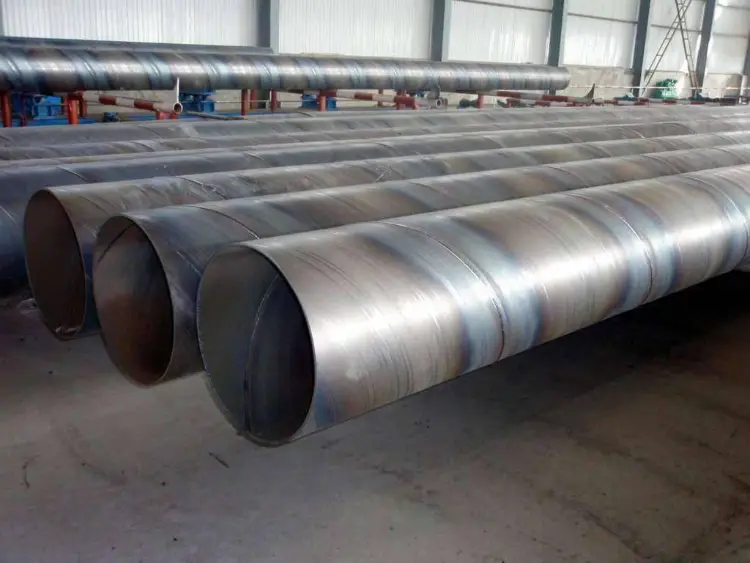
Q235B Carbon Structural Steel for LSAW Pipe
Q235B Carbon Structural Steel for LSAW Pipe: Chemical, Mechanical & Thermal Properties, Equivalents and Applications
Comprehensive material data for Q235B steel according to GB/T 700-2006, commonly used for longitudinal submerged arc welded (LSAW) pipes. Includes chemical composition, mechanical and physical performance, international equivalents, and application guide.
Hot rolling, cold forming, welding, bending, stamping, cutting
- Phone : +8618037372205
- Email : [email protected]
- WhatsApp: Contact via Whtsapp
- WeChat: +8618037372205
Q235B Carbon Structural Steel for LSAW Pipe Introduction
Q235B is a carbon structural steel defined in the Chinese standard GB/T 700-2006. It offers a good balance of strength, ductility, and weldability, making it one of the most widely used structural steels in China. The "B" designation indicates a guaranteed impact toughness at +20°C (minimum 27 J). Typical applications include building frames, bridges, vehicles, general machinery, and welded pipes such as LSAW pipes. In the hot-rolled condition, it exhibits a minimum yield strength of 235 MPa for thicknesses ≤16 mm and a tensile strength between 370 and 500 MPa. Its excellent formability and cost-effectiveness suit it for a wide range of structural and engineering purposes.
Q235B Carbon Structural Steel for LSAW Pipe Chemical Composition
Limits of chemical elements according to GB/T 700-2006 for grade Q235B. The values apply to ladle analysis. Additional residual elements (Cr, Ni, Cu) may be present but are not specified; their total content typically does not exceed 0.30% each unless agreed otherwise.
| Chemical element | Standard value | Remarks |
|---|---|---|
| Carbon (C) | ≤ 0.20 | Ladle analysis |
| Silicon (Si) | ≤ 0.35 | Ladle analysis |
| Manganese (Mn) | ≤ 1.40 | No lower limit specified; commonly 0.30–0.80 |
| Phosphorus (P) | ≤ 0.045 | Ladle analysis |
| Sulfur (S) | ≤ 0.045 | Ladle analysis |
Q235B Carbon Structural Steel for LSAW Pipe Thermal and Electrical Physical Properties
The following values are typical for carbon structural steel and serve as estimates for grade Q235B. They are not specified in GB/T 700-2006 but are commonly used in engineering calculations. Actual properties may vary slightly depending on product form and heat treatment.
| Property | Standard requirement value | Unit | Test condition |
|---|---|---|---|
| Density (ρ) | 7.85 | g/cm³ | Room temperature |
| Elastic modulus (E) | 200 – 210 | GPa | Room temperature |
| Shear modulus (G) | ~ 80 | GPa | Room temperature |
| Poisson's ratio (ν) | 0.27 – 0.30 | — | Room temperature |
| Thermal expansion coefficient (α) | 11.5 – 12.5 | 10⁻⁶/K | 20–100°C |
| Thermal conductivity (λ) | 45 – 55 | W/(m·K) | 20°C |
| Specific heat capacity | ~ 460 | J/(kg·K) | 20°C |
| Electrical resistivity (ρe) | 0.13 – 0.16 | 10⁻⁶ Ω·m | 20°C |
Q235B Carbon Structural Steel for LSAW Pipe Mechanical Properties
Tensile and impact properties as per GB/T 700-2006 for Q235B steel. Yield strength and elongation values depend on the nominal thickness. Impact test (Charpy V-notch) is performed at +20°C on longitudinal specimens. Bending test applies to thicknesses ≤60 mm with 180° bend and mandrel diameter equal to specimen thickness.
| Property | Standard requirement value | Unit | Test condition |
|---|---|---|---|
| Yield strength (ReH) | ≥ 235 | MPa | Thickness ≤ 16 mm |
| Yield strength (ReH) | ≥ 225 | MPa | Thickness > 16 mm to 40 mm |
| Yield strength (ReH) | ≥ 215 | MPa | Thickness > 40 mm to 60 mm |
| Yield strength (ReH) | ≥ 205 | MPa | Thickness > 60 mm to 100 mm |
| Yield strength (ReH) | ≥ 195 | MPa | Thickness > 100 mm to 150 mm |
| Yield strength (ReH) | ≥ 185 | MPa | Thickness > 150 mm to 200 mm |
| Tensile strength (Rm) | 370 – 500 | MPa | All thicknesses up to 200 mm |
| Elongation (A) | ≥ 26 | % | Thickness ≤ 40 mm (L0 = 5.65√S0) |
| Elongation (A) | ≥ 25 | % | Thickness > 40 mm to 60 mm |
| Elongation (A) | ≥ 24 | % | Thickness > 60 mm to 100 mm |
| Elongation (A) | ≥ 22 | % | Thickness > 100 mm to 150 mm |
| Elongation (A) | ≥ 21 | % | Thickness > 150 mm to 200 mm |
| Impact energy (KV2) | ≥ 27 | J | +20°C, longitudinal, 10×10×55 mm specimen |
| Bend test | No cracks | — | 180° bend; mandrel dia. = a (specimen thickness); for thickness ≤ 60 mm |
Q235B Carbon Structural Steel for LSAW Pipe Exact Equivalent Material Standards and Substitute Grade Recommendations
| Country/Region | Standard | Grade | Remarks |
|---|---|---|---|
| China (Origin) | GB/T 700-2006 | Q235B | Reference grade |
| USA | ASTM A36/A36M | Grade 36 | Direct equivalent; similar strength and weldability |
| European Union | EN 10025-2 | S235JR | Comparable yield strength and impact class (J) |
| Japan | JIS G3101 | SS400 | Tensile and yield comparable; impact not specified |
| International | ISO 630-2 | S235B | Chemical and mechanical properties closely match |
Q235B Carbon Structural Steel for LSAW Pipe Application Introduction
Q235B steel is widely selected for its good combination of strength, ductility, and affordability. It can be used in welded, bolted, and riveted structures. Preheating may be required for heavy sections or low ambient temperatures during welding. Typical applications include:
Product Applications: LSAW (longitudinal submerged arc welded) pipes, Steel plates for general structures, Hot-rolled sections (I-beams, channels, angles), Reinforcing bars (non-prestressed), Welded structural assemblies
Processed into products: Pipe flanges and fittings, Structural support beams and columns, Machinery frames and bases, Storage tank shells and roofs, Bridge trusses and decks, General engineering brackets and fasteners
Application industries: Building and construction, Bridge engineering, Vehicle and railway manufacturing, Shipbuilding and offshore structures, Pressure vessel and storage tank production, Pipeline transportation (oil, gas, water)
Q235B Carbon Structural Steel for LSAW Pipe Similar / Alternative Material Recommendations
| Country/Region | Standard | Grade | Remarks |
|---|---|---|---|
| China | GB/T 700-2006 | Q235A | Lower toughness requirements; no guaranteed impact energy |
| China | GB/T 700-2006 | Q235C / Q235D | Higher toughness grades for lower temperatures (0°C / -20°C) |
| USA | ASTM A283/A283M | Grade C / D | Lower strength range; similar weldability |
| Japan | JIS G3101 | SS330 | Lower tensile strength (330–430 MPa); otherwise comparable |
| Germany (historical) | DIN 17100 | St37-2 / USt37-2 | Old designation, superseded by S235JR; often interchangeable |
Notes:
Welding: Q235B exhibits good weldability by common methods (SMAW, GMAW, SAW). For thicknesses above 30 mm, preheating to 100–150°C is recommended. Post-weld heat treatment is generally not required.
Corrosion: As a plain carbon steel, corrosion resistance is moderate; protective coatings (paint, galvanizing) or cathodic protection are advised for outdoor or submerged applications.
Forming: Can be cold bent to a minimum radius of about 1.5 times the thickness, depending on direction relative to rolling. Hot forming should be performed at 850–1100°C and followed by normalizing if mechanical properties need restoration.
- Share



