
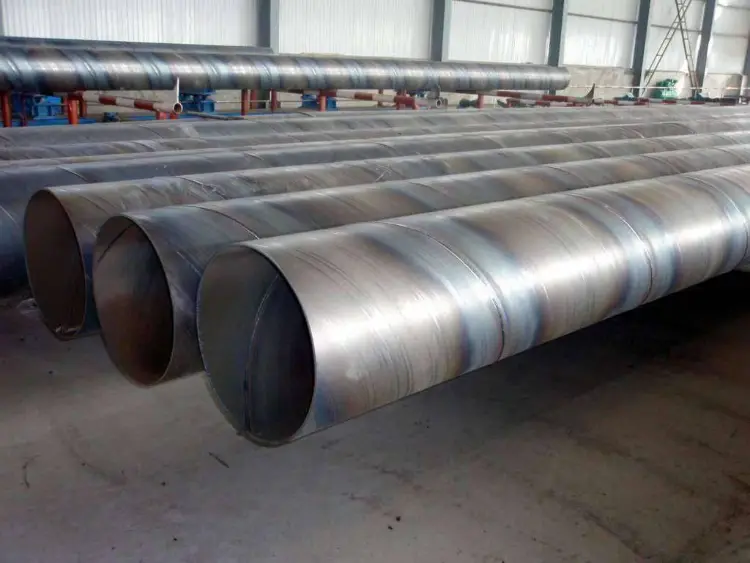
Q235A Carbon Steel LSAW Pipe
Q235A Carbon Steel LSAW Pipe - GB/T 700 Standard Material Data
Comprehensive material properties of Q235A carbon structural steel for LSAW pipes per GB/T 700 standard, including chemistry, mechanics, thermals, equivalents, and application guidance.
Hot rolling, cold forming, welding (SAW, SMAW, GMAW), machining, bending, punching
- Phone : +8618037372205
- Email : [email protected]
- WhatsApp: Contact via Whtsapp
- WeChat: +8618037372205
Q235A Carbon Steel LSAW Pipe Introduction
Q235A is a carbon structural steel grade defined in GB/T 700-2006, widely used for general structural and welded pipe applications such as LSAW (Longitudinal Submerged Arc Welded) pipes. It provides a good balance of moderate strength, excellent weldability, and sufficient ductility. The A-level quality designation means that impact testing is not required, making it suitable for ambient-temperature service conditions. The typical minimum yield strength is 235 MPa for thicknesses up to 16 mm, with tensile strength ranging from 370 to 500 MPa. The material is commonly supplied in hot-rolled condition for plates and strips, and in as-welded condition for pipes. Q235A is one of the most utilized structural steels in China, forming the backbone of many construction and pipeline projects.
Q235A Carbon Steel LSAW Pipe Chemical Composition
The ladle analysis conforms to GB/T 700-2006 for grade Q235A. Maximum values apply unless a range is shown. Residual elements (Cr, Ni, Cu) are limited to ensure weldability and general performance. The grade may be supplied as rimmed (F), balanced (Z), or killed (Z) steel, but silicon content can vary accordingly.
| Element | Standard Value (≤, wt%) | Remarks |
|---|---|---|
| Carbon (C) | ≤0.22 (thickness ≤16mm); ≤0.22 (16 | Permissible variation within the cast analysis |
| Silicon (Si) | ≤0.35 | Can be lower for rimmed steel (e.g., ≤0.07) |
| Manganese (Mn) | ≤1.40 | Slightly higher Mn improves strength and deoxidation |
| Phosphorus (P) | ≤0.045 | Phosphorus is kept low to avoid cold brittleness |
| Sulfur (S) | ≤0.050 | Sulfur controlled for weldability and hot working |
| Chromium (Cr) | ≤0.30 | Residual element, not intentionally added |
| Nickel (Ni) | ≤0.30 | Residual element, not intentionally added |
| Copper (Cu) | ≤0.30 | Residual element, not intentionally added |
| Nitrogen (N) | ≤0.008 (for killed steel) | Optional, when nitrogen is not used as an alloying element |
Q235A Carbon Steel LSAW Pipe Thermal and Electrical Physical Properties
The following physical properties are typical for Q235A carbon steel (low-carbon mild steel) and are provided to facilitate engineering calculations. Exact values may vary slightly depending on the specific heat treatment and processing history. These data are not specified in GB/T 700 but are widely accepted references for this class of material.
| Property | Typical Value | Unit | Test Condition / Remarks |
|---|---|---|---|
| Density (ρ) | 7.85 | g/cm³ | At 20 °C |
| Modulus of elasticity (E) | 200–210 | GPa | At room temperature (approx. 29.0–30.5 ×10⁶ psi) |
| Shear modulus (G) | 79–81 | GPa | Calculated from E and ν |
| Poisson's ratio (ν) | 0.30 | – | At room temperature |
| Thermal expansion coefficient (α) | 12.0 | 10⁻⁶/°C | Temperature range 20–100 °C |
| Thermal expansion coefficient (α) | 13.2 | 10⁻⁶/°C | Temperature range 20–300 °C |
| Thermal expansion coefficient (α) | 13.9 | 10⁻⁶/°C | Temperature range 20–500 °C |
| Thermal conductivity (λ) | 52 | W/(m·K) | At 20 °C |
| Thermal conductivity (λ) | 45 | W/(m·K) | At 200 °C |
| Thermal conductivity (λ) | 36 | W/(m·K) | At 400 °C |
| Specific heat capacity | 450–500 | J/(kg·K) | Ambient temperature |
| Electrical resistivity (ρe) | 0.15–0.20 | µΩ·m | At 20 °C |
Q235A Carbon Steel LSAW Pipe Mechanical Properties
Mechanical properties are determined from test pieces representative of the product thickness as per GB/T 700-2006. Tensile testing is performed at room temperature. Q235A does not require impact testing. For LSAW pipe made from hot-rolled plate, the properties of the base metal pipe body shall comply with the values listed, unless the pipe standard imposes stricter requirements. The bending test is mandatory for plate material.
| Property | Standard Requirement | Unit | Test Condition |
|---|---|---|---|
| Upper yield strength (ReH) | ≥235 | MPa | Thickness ≤16 mm |
| Upper yield strength (ReH) | ≥225 | MPa | Thickness >16–40 mm |
| Upper yield strength (ReH) | ≥215 | MPa | Thickness >40–60 mm |
| Upper yield strength (ReH) | ≥205 | MPa | Thickness >60–100 mm |
| Upper yield strength (ReH) | ≥195 | MPa | Thickness >100–150 mm |
| Upper yield strength (ReH) | ≥185 | MPa | Thickness >150–200 mm |
| Tensile strength (Rm) | 370–500 | MPa | All thicknesses |
| Elongation after fracture (A) | ≥26 | % | Thickness ≤40 mm (gauge length = 5.65√S₀) |
| Elongation after fracture (A) | ≥25 | % | Thickness >40–60 mm |
| Elongation after fracture (A) | ≥24 | % | Thickness >60–100 mm |
| Elongation after fracture (A) | ≥22 | % | Thickness >100–150 mm |
| Elongation after fracture (A) | ≥21 | % | Thickness >150–200 mm |
| Bend test (180°), mandrel diameter d = a | No cracks | – | Thickness a ≤60 mm |
| Bend test (180°), mandrel diameter d = 2a | No cracks | – | Thickness a >60–100 mm |
| Bend test (180°), mandrel diameter d = 3a | No cracks | – | Thickness a >100–200 mm |
| Charpy impact (KV2) | No requirement | J | A-grade: impact test is not specified |
Q235A Carbon Steel LSAW Pipe Fully Equivalent Material Standards & Replaceable Grades
While exact one-to-one equivalence between national standards rarely exists, the following grades are considered functionally equivalent to Q235A in terms of chemical composition range, mechanical properties, and typical usage. Selection of replacement should be confirmed with the specific product standard and service requirements.
| Country/Region | Standard | Grade | Remarks |
|---|---|---|---|
| International | ISO 630-2 | E235B (Fe360B) | Comparable carbon structural steel, Manganese ~1.40%, P, S limits similar. |
| EU | EN 10025-2 | S235JR (1.0038) | JR – room temperature impact optional; chemical limits closely match Q235A. |
| USA | ASTM A36/A36M | A36 | Mild carbon steel with tensile 400–550 MPa, although yield min 250 MPa; slightly different chemistry but frequently substituted for Q235A in structural applications. |
| Japan | JIS G3101 | SS400 | General structural rolled steel; tensile 400–510 MPa, yield ≥245 MPa for thickness ≤16 mm. Minor differences in Si and Mn limits. |
| China | GB/T 700 | Q235A | Original specification |
| India | IS 2062 | E250A (Fe410WA) | Though 'A' indicates no impact requirement, the tensile and yield values are marginally higher; acceptable for many non-critical replacements. |
Q235A Carbon Steel LSAW Pipe Application Introduction
Q235A LSAW pipe is a cost-effective solution for conveying fluids and for structural use where there is no severe low-temperature service requirement. The LSAW manufacturing process uses hot-rolled plates formed into a cylindrical shape and welded by submerged-arc welding, allowing large diameters (up to 56'' or more) and thick walls (up to 50 mm or more). This product is mainly used in:
- Oil and gas transmission pipelines (on-shore gathering lines, distribution).
- Water and sewage systems (large-diameter aqueducts).
- Structural tubulars for bridges, offshore platforms, and building columns.
- Piling pipe and casing for foundation engineering.
The as-welded pipe can be supplied with a bare, black varnish, or 3LPE/3LPP/FBE coating for corrosion protection.
Product Applications: LSAW steel pipes (API 5L PSL1/PSL2 equivalent for non-sour service, GB/T 3091, GB/T 9711), Welded structural hollow sections (square, rectangular), Hot-rolled steel plates for pressure vessels (with re-certification), Hot-rolled sections (I-beams, channels, angles), Cold-formed sections and open profiles
Processed into products: Line pipes (API 5L Gr. B level when tested accordingly), Piling pipes and conductor casings, Transmission towers and lattice masts, Bridge beams and trusses, Storage tank shells and roofs, Machine bases and support frames, Rail transport vehicle underframes
Application industries: Oil & Gas (transmission and distribution pipelines), Water & Wastewater treatment, Civil Engineering and Infrastructure (bridges, stadiums), Construction (high-rise buildings, industrial sheds), Shipbuilding and offshore structures (jackets, piles), Machinery manufacturing (frames, supports)
Q235A Carbon Steel LSAW Pipe Similar / Alternative Material Recommendations
The grades listed below share a similar carbon-manganese backbone but often have different quality levels (impact requirements) or slight variations in mechanical properties that make them suitable for specific applications where Q235A might be considered. They are not exact equivalents but are commonly used as alternatives when a different property (e.g., certified impact toughness) is needed.
| Country/Region | Standard | Grade | Remarks |
|---|---|---|---|
| China | GB/T 700 | Q235B | B grade adds impact test at +20°C; chemistry tighter for S, P; stronger guarantee of quality. |
| China | GB/T 700 | Q235C | C grade ensures impact test at 0°C; used where notch toughness is required. |
| China | GB/T 700 | Q235D | D grade requires impact test at -20°C; for critical structural applications. |
| China | GB/T 1591 | Q345B | Higher strength low-alloy steel; minimum yield 345 MPa; often substituted when weight reduction is needed, but weldability and formability differ. |
| EU | EN 10025-2 | S235J0 (1.0114) | Similar base strength but with 0°C impact test; closer to Q235C in quality. |
| EU | EN 10025-2 | S235J2 (1.0117) | With -20°C impact test; substitutes for Q235D. |
| USA | ASTM A283/A283M | Grade C or D | Carbon steel plates of structural quality; lower strength but may be used in similar applications with engineering recertification. |
| Japan | JIS G3101 | SS330 | Lower strength version (<330 MPa tensile); only for lightly loaded structures. |
Notes:
Important remarks for LSAW pipe specifically:
- For line pipe applications, Q235A plate is often used to manufacture Grade B pipes per API 5L, provided supplementary testing (e.g., Charpy impact for PSL2) is performed and passed. Q235A itself does not satisfy impact requirements; thus, such pipes are typically designated as Q235A or GB/T 9711 L245 with no impact test.
- Welding consumables (e.g., ER50-6 wire, E43 series electrodes) should match the base metal strength and be selected per the applicable welding code.
- Post-weld heat treatment (PWHT) is not mandatory for Q235A due to its low carbon content, but stress relieving at 550–600 °C may be specified for thick-wall pipe or when required by service conditions.
- Share



